
Hydrogen water 500 mL/day,
does it really help with Slower one-year cognitive decline in mild cognitive impairment?
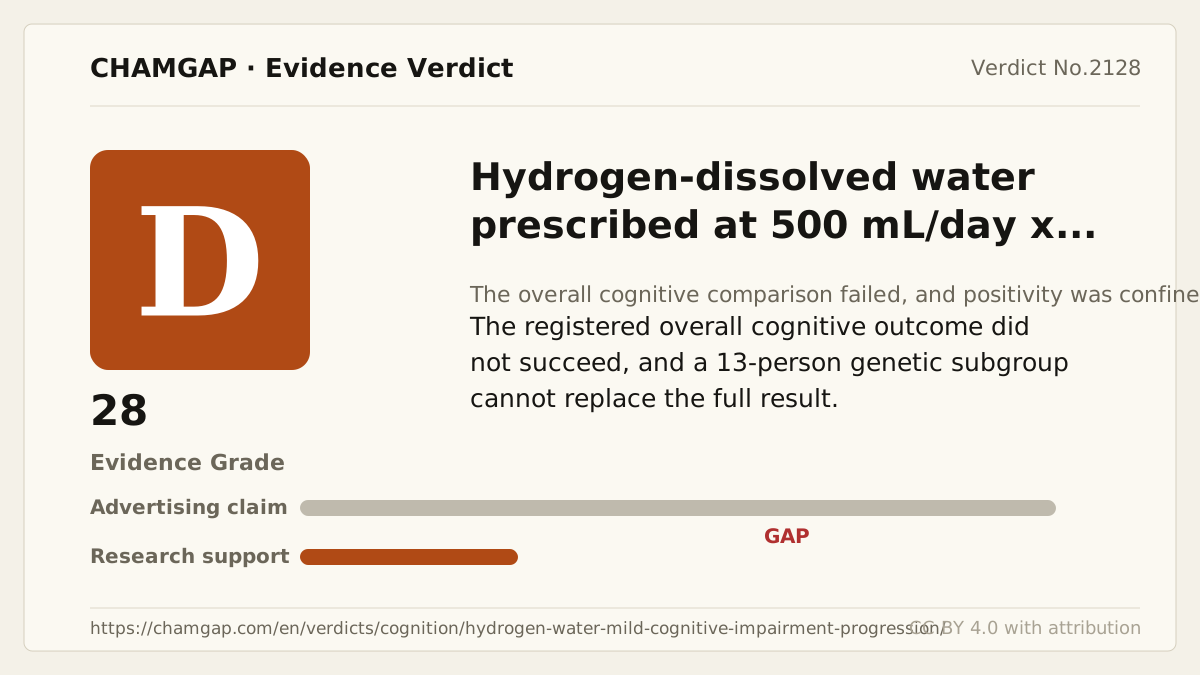
research showsThe grade is D. Eight participants were excluded as ineligible after 81 had been randomized, leaving 73 in analysis, and the overall one-year ADAS-cog comparison was not significant. The registered MMSE result was not clearly presented, while the positive finding came only from an exploratory subgroup of 13 APOE4 carriers. The claim of slowing progression in the full population was not supported.
ads claimAt least 0.6 mM dissolved hydrogen is a measured product fact, not evidence that memory decline is prevented. Marketing should not substitute the 13-person subgroup for the null 73-person result.
Useful facts when choosing a product
- The 500-mL aluminum packages were used only when a hydrogen sensor measured at least 0.6 mM dissolved hydrogen.
- Empty-package adherence averaged 64% in both groups, corresponding to estimated intake of about 320 mL/day.
- Registration specified 500 mL/day for two years with ADAS-cog and MMSE, whereas the paper centered on one-year ADAS-cog and incompletely reported MMSE and the two-year time point.
Chamgap Semantic Classification Code
Candidate index · review held
UNK.hydrogen-dissolved-water-prescribed-at.UNK.slower-cognitive-decline-in-mild-cognitive-impairment.reduce.placeboUnknown > Hydrogen-dissolved water prescribed at > Unknown > Slower cognitive decline in mild cognitive impairment > Reduction claim > Placebo
An automated migration candidate, not an issued permanent code; exact claim scope remains under review. This machine-generated migration candidate helps retrieval but is not a permanent assignment. The original verdict ID and URL remain authoritative.
What the research actually shows
Eighty-one participants were randomized, but three controls and five hydrogen-water recipients were excluded as ineligible after randomization, leaving 38 and 35, or 73 total. Registered primary outcomes were ADAS-cog and MMSE over two years, but the paper centered on approximately one-year ADAS-cog, leaving MMSE and the two-year time point incompletely reported. The APOE4 analysis was an unregistered exploratory subgroup of seven hydrogen-water and six control participants. Empty-package adherence was 64% in both arms. At least 0.6 mM dissolved hydrogen was a sensor measurement of the trial product, not a general product-category range. JSPS funded the work, and Blue Mercury supplied active and placebo water.
Why this is classified as D (28)
The single double-blind randomized trial was null for the overall cognitive comparison, excluded participants after randomization, was small, and lacked a verified overall confidence interval, giving D with 28 points.
Counterpoint. D does not deny that hydrogen was present or that a 13-person subgroup signal occurred. It reflects the unsupported claim of slowing progression in the overall MCI population.
Rejudgment record. Cross-check applied — The overall randomized one-year ADAS-cog comparison was null, while positivity was confined to 13 APOE4 carriers
| Endpoint | P | Symptom or function itself is the target - including patient reports and performance tests |
| Replication | R1 | Single confirmatory trial |
| Independence | I1 | Mixed funding sources |
| Effect size | E0 | Null |
| Precision | CX | No pooled confidence interval could be confirmed |
Stored derived and displayed grades match; this is not a current recalculation or validity check (D).
Sub-claim grades by effect
This ingredient is marketed for several effects. A single overall grade blends strong and weak claims together, so each effect is graded separately here. The overall grade reflects the strongest disconfirming or core claim.
| Effect (sub-claim) | Grade | Basis |
|---|---|---|
| Slower cognitive decline in the full MCI population | D | The overall one-year ADAS-cog comparison was not significant. |
| Cognitive improvement in APOE4 carriers | C | This was an exploratory signal in 13 people requiring confirmation. |
| Prevention of progression to dementia | ? | The trial did not measure incident dementia as its endpoint. |
Cross-check — AI research and Codex final gate
Evidence Table
| Study | Design | Sample | Funding | Endpoint | Result | Weight |
|---|---|---|---|---|---|---|
| Nishimaki K et al. 2018 | Double-blind randomized placebo-controlled trial | 81 randomized; 8 excluded as ineligible after randomization; 73 analyzed, 35 versus 38 | Japan Society for the Promotion of Science grants; Blue Mercury supplied active and placebo water | One-year ADAS-cog; registered primary outcomes were ADAS-cog and MMSE | The overall ADAS-cog comparison was not significant; positivity was confined to an unregistered exploratory APOE4 subgroup (7 hydrogen water, 6 control). | Null overall primary comparison |
Receipt — 2 References
All 2 cited sources were verified for existence at the original page (as of 2026-08-04).
Final verification and publication gate: Codex · Evidence date: 2026-08-04 · Corrections: none
Cite this verdict
[Chamgap] Hydrogen water 500 mL/day x slowed progression of mild cognitive impairment — Evidence Grade D·28. 2 cited sources checked. Source: https://chamgap.com/en/verdicts/cognition/hydrogen-water-mild-cognitive-impairment-progression/ · CC BY 4.0CC BY 4.0 — free to use with attribution; do not distort grades, numbers, or verdict meaning.
What this document does and does not do
Chamgap is an information source. It reports what research has and has not confirmed; it does not tell readers what to take or buy. That decision belongs to readers and, when needed, medical or legal professionals. This verdict reflects literature available up to the search date and may change as new research appears. Nothing here is medical advice.