
Gabapentin,
does it really help with Prevention of attack frequency in adult episodic migraine?
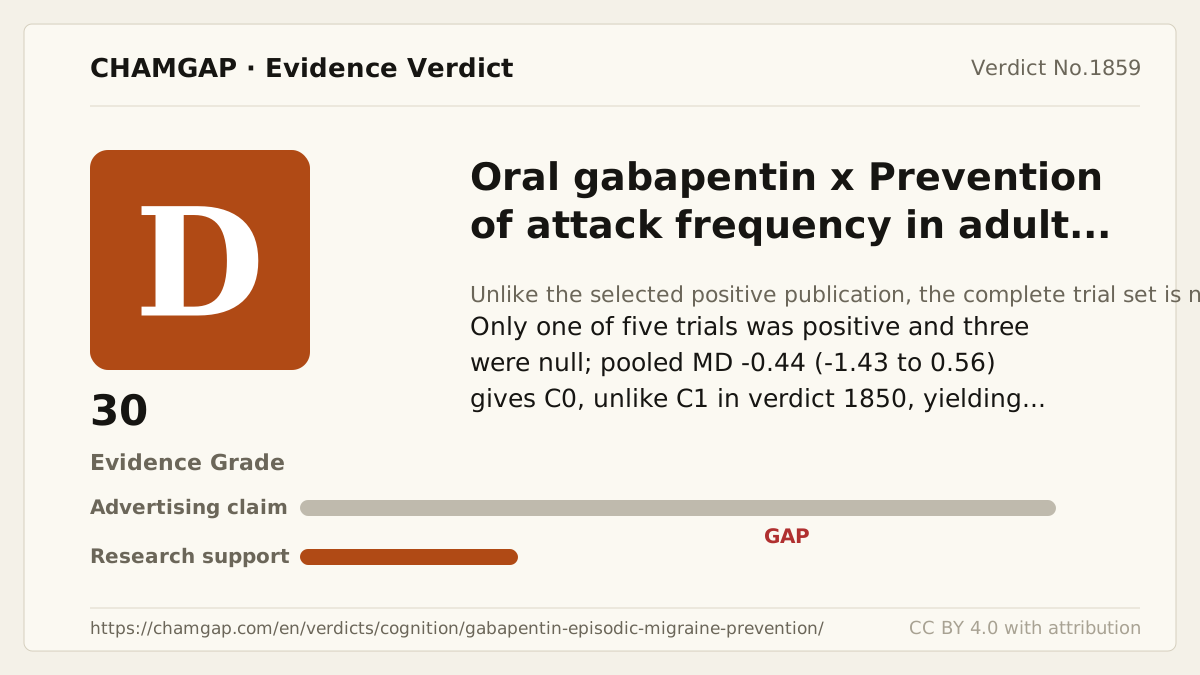
research showsGabapentin is rated D because the Cochrane review combining published and unpublished trials found no significant reduction in episodic-migraine frequency. Across four trials and 351 participants, monthly headache frequency MD was -0.44 (95% CI -1.43 to 0.56), which was null but still included benefit exceeding one attack per month, so meaningful benefit was not excluded and F is unwarranted.
ads claimUse for neuropathic pain and other neurologic symptoms is generalized into migraine prevention, or only the selected positive publication is cited. Evidence from another indication for the same drug is not preventive-migraine evidence.
Useful facts when choosing a product
- RR995-00085 randomized 157, treated 143 under double masking, and included 122 in the prespecified efficacy analysis, so enrollment and actual analysis counts differed.
- Cochrane included three confidential manufacturer reports released through litigation, correcting the bias from published evidence alone.
Chamgap Semantic Classification Code
Candidate index · review held
UNK.gabapentin.oral.attack-frequency-episodic-migraine.prevent.placeboUnknown > Gabapentin > Oral > attack frequency episodic migraine > Occurrence-prevention claim > Placebo
An automated migration candidate, not an issued permanent code; exact claim scope remains under review. This machine-generated migration candidate helps retrieval but is not a permanent assignment. The original verdict ID and URL remain authoritative.
What the research actually shows
RR995-00085 was a separate unpublished Parke-Davis trial: 157 randomized, 143 treated, and 122 analyzed for frequency, with a null result. Mathew 2001 was not RR995-00085; it published the distinct RR995-00074 trial, whose frequency analysis of 113 participants gave MD -0.80 (95% CI -1.55 to -0.05), the only positive result among five gabapentin trials. Three other trials were null. Linde 2013 reviewed six gabapentin or gabapentin-enacarbil trials and 1,009 participants. The four-trial, 351-participant gabapentin frequency synthesis was null, MD -0.44 (95% CI -1.43 to 0.56), P=0.39. This gives R0 and C0 because the interval retains a reduction of 1.43 attacks. Verdicts 780, 1682, and 1136 concern other indications and were not transferred. Verdict 1850 for episodic botulinum toxin is F with 10 points because axis 5 is C1 and excludes benefit; gabapentin remains D because its C0 interval leaves meaningful benefit possible.
Why this is classified as D (28)
P, R0, I1, E0, B1, and C0 derive D with 28 points. Some trials were positive and others null, individual trials were small, and pooled intervals did not exclude meaningful benefit.
Counterpoint. Preventive decisions should compare options with direct positive evidence, including topiramate. A person already taking gabapentin should not stop abruptly and should discuss tapering with the prescriber.
Rejudgment record. Cross-check applied — Applied the null Cochrane synthesis including unpublished company reports while assigning C0 because the monthly headache-frequency interval retained clinically meaningful benefit
| Endpoint | P | Symptom or function itself is the target - including patient reports and performance tests |
| Replication | R0 | Trials conflict in direction |
| Independence | I1 | Mixed funding sources |
| Effect size | E0 | Null |
| Precision | C0 | The confidence interval leaves room for benefit |
Stored derived and displayed grades match; this is not a current recalculation or validity check (D).
Sub-claim grades by effect
This ingredient is marketed for several effects. A single overall grade blends strong and weak claims together, so each effect is graded separately here. The overall grade reflects the strongest disconfirming or core claim.
| Effect (sub-claim) | Grade | Basis |
|---|---|---|
| Reduction in monthly headache frequency | D | Four trials and 351 participants gave a null MD of -0.44 (-1.43 to 0.56). |
| At least 50% migraine-frequency response | D | Two trials and 235 participants gave a nonsignificant OR of 1.59 (0.57 to 4.46). |
| Reduction in 28-day migraine attack frequency | D | The prespecified analysis in the key company report failed primary efficacy with a between-group difference of +0.50 attacks. |
Cross-check — AI research and Codex final gate
Evidence Table
| Study | Design | Sample | Funding | Endpoint | Result | Weight |
|---|---|---|---|---|---|---|
| Unpublished Parke-Davis company report RR995-00085 | Separate randomized double-blind placebo-controlled manufacturer trial | 157 randomized, 143 treated, and 122 in the prespecified efficacy analysis | Manufacturer trial by Parke-Davis with an employee coauthor | Twenty-eight-day headache frequency | Null frequency result in 122 analyzed participants | Unpublished null trial distinct from Mathew 2001 |
| Mathew NT et al. RR995-00074, 2001 | Separate multicenter randomized double-blind placebo-controlled trial | 113 in the frequency analysis | Manufacturer trial by Parke-Davis with an employee coauthor | Monthly headache frequency | MD -0.80 (95% CI -1.55 to -0.05); the only positive result among five trials | Positive trial distinct from RR995-00085 |
| Linde M et al. Cochrane review. 2013 | Systematic review and meta-analysis of randomized and quasi-randomized trials | Six trials and 1,009 participants; four trials and 351 for frequency, two and 235 for response | Academic Cochrane review; included evidence mixed manufacturer and nonmanufacturer sources | Monthly headache frequency and at least 50% response | Frequency MD -0.44 (-1.43 to 0.56), P=0.39; response OR 1.59 (0.57 to 4.46), P=0.38 | Decisive synthesis for E0 effect and C0 precision |
Receipt — 2 References
All 2 cited sources were verified for existence at the original page (as of 2026-07-24).
Final verification and publication gate: Codex · Evidence date: 2026-07-24 · Corrections: none
Cite this verdict
[Chamgap] Gabapentin x episodic migraine prevention — Evidence Grade D·28. 2 cited sources checked. Source: https://chamgap.com/en/verdicts/cognition/gabapentin-episodic-migraine-prevention/ · CC BY 4.0CC BY 4.0 — free to use with attribution; do not distort grades, numbers, or verdict meaning.
What this document does and does not do
Chamgap is an information source. It reports what research has and has not confirmed; it does not tell readers what to take or buy. That decision belongs to readers and, when needed, medical or legal professionals. This verdict reflects literature available up to the search date and may change as new research appears. Nothing here is medical advice.