
Endovascular coil embolization,
does it really help with Reduced death or dependency at one year in ruptured intracranial aneurysms suitable for either coiling or clipping?
research showsEndovascular coiling is graded B because it reduced death or dependency at one year versus clipping in patients with ruptured intracranial aneurysms judged suitable for either procedure. In the final ISAT report, the composite outcome occurred in 23.5% versus 30.9%, and a survival advantage persisted in long-term follow-up. This was superiority over another effective procedure rather than placebo or no treatment, and randomized patients were a selected fraction of those screened. More late rebleeding and retreatment after coiling also qualify its durability.
ads claimDescriptions can turn coiling into a uniformly superior and recurrence-free procedure for every aneurysm. The randomized evidence directly applies to patients with rupture for whom both treatments were technically feasible and clinical equipoise existed.
Useful facts when choosing a product
- Coil embolization is a hospital-based prescription procedure that advances a catheter into the aneurysm and uses platinum coils or related devices to obstruct blood flow.
- The direct comparator in ISAT was surgical clipping through craniotomy.
- The evidence is most direct for ruptured intracranial aneurysms judged suitable for either coiling or clipping by experienced teams.
- Intraprocedural rupture, thromboembolism, cerebral infarction, and hemorrhage can occur; incomplete occlusion or recanalization can require imaging surveillance and retreatment.
Chamgap Semantic Classification Code
Candidate index · review held
P.endovascular-coil-embolization.procedural.death-or-dependency-at-in-ruptured-intracranial-aneurysms-suitable-for-either-coiling-or-clipping.reduce.activeProcedures, devices and tests > Endovascular coil embolization > Procedural > death or dependency at in ruptured intracranial aneurysms suitable for either coiling or clipping > Reduction claim > Active comparator
An automated migration candidate, not an issued permanent code; exact claim scope remains under review. This machine-generated migration candidate helps retrieval but is not a permanent assignment. The original verdict ID and URL remain authoritative.
What the research actually shows
The 2005 final ISAT report randomized 2,143 patients at 43 centers to coiling or clipping and reported one-year death or dependency of 23.5% versus 30.9%. The 2009 long-term follow-up found lower mortality after assignment to coiling but more late rebleeding from the treated aneurysm. A 2007 analysis also found more retreatment after coiling. This evidence concerns coiling for ruptured aneurysm and is distinct from decompressive hemicraniectomy or alteplase for acute ischemic stroke.
Why this is classified as B (78)
A large randomized ISAT comparison reduced one-year death or dependency and long-term mortality. Because this was superiority over active clipping in a selected population and rebleeding and retreatment were more frequent after coiling, the verdict is B with 78 points.
Counterpoint. The absolute frequency of late rebleeding was low and disability-free long-term survival favored coiling. Durability and early clinical benefit are separate outcomes that should be retained together.
Rejudgment record. New verdict — Accepted randomized ISAT reductions in one-year death or dependency and long-term mortality versus active clipping, while applying the B ceiling for active-control superiority in a population selected for suitability for both procedures and retaining higher late rebleeding and retreatment after coiling
Sub-claim grades by effect
This ingredient is marketed for several effects. A single overall grade blends strong and weak claims together, so each effect is graded separately here. The overall grade reflects the strongest disconfirming or core claim.
| Effect (sub-claim) | Grade | Basis |
|---|---|---|
| Reduced death or dependency at one year | B | ISAT reported 23.5% with coiling versus 30.9% with clipping, but this was an active-procedure comparison in a selected population. |
| Reduced long-term mortality | B | Long-term follow-up of the randomized cohort found lower mortality after assignment to coiling. |
Cross-check — AI research and Codex final gate
Evidence Table
| Study | Design | Sample | Funding | Endpoint | Result | Weight |
|---|---|---|---|---|---|---|
| Molyneux AJ et al. ISAT 2005 | Multicenter randomized active comparison of coiling versus clipping | 2,143 patients with ruptured intracranial aneurysms | Public and nonprofit support including the UK Medical Research Council | Death or dependency at one year | The outcome occurred in 23.5% with coiling and 30.9% with clipping, an absolute difference of 7.4 percentage points favoring coiling. | Key large randomized active-control evidence |
| Molyneux AJ et al. ISAT long-term follow-up 2009 | Long-term follow-up of the randomized ISAT cohort | 2,143 originally randomized participants | Public and nonprofit support | Long-term death, dependency, and rebleeding | Mortality was lower after assignment to coiling, while late rebleeding from the treated aneurysm was more frequent after coiling. | Long-term clinical and durability evidence |
Receipt — 3 References
All 3 cited sources were verified for existence at the original page (as of 2026-07-23).
Final verification and publication gate: Codex · Evidence date: 2026-07-23 · Corrections: none
Cite this verdict
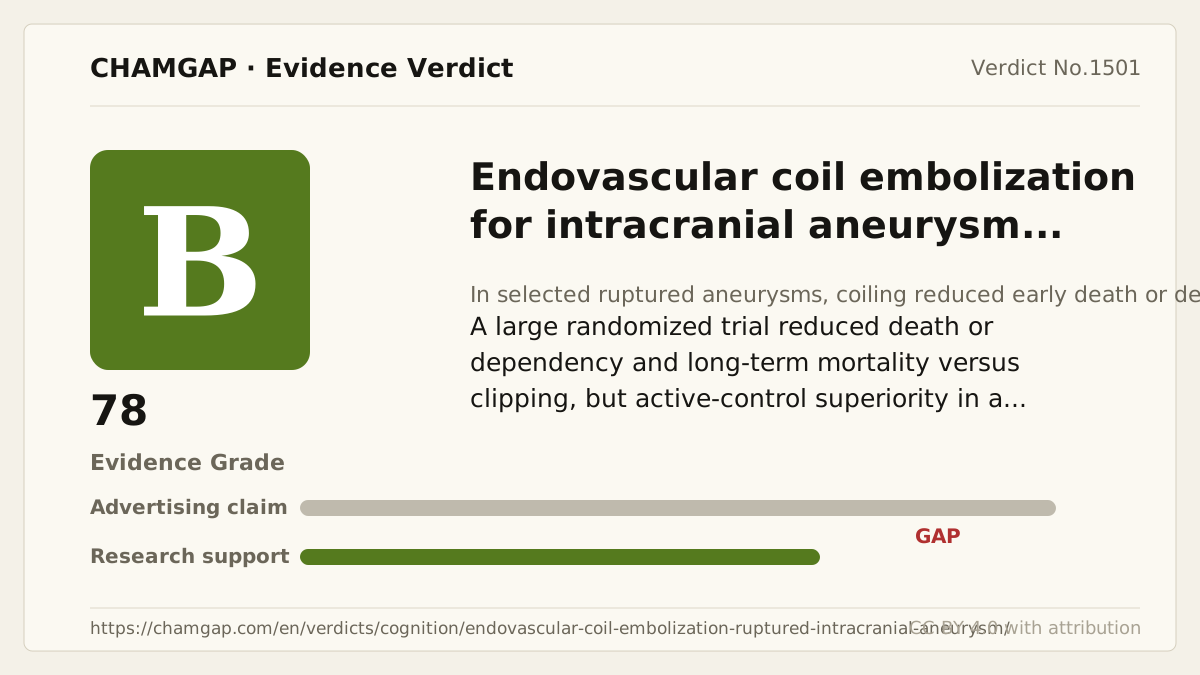
[Chamgap] Endovascular coil embolization x reduced death or dependency after ruptured intracranial aneurysm — Evidence Grade B·78. 3 cited sources checked. Source: https://chamgap.com/en/verdicts/cognition/endovascular-coil-embolization-ruptured-intracranial-aneurysm/ · CC BY 4.0CC BY 4.0 — free to use with attribution; do not distort grades, numbers, or verdict meaning.
What this document does and does not do
Chamgap is an information source. It reports what research has and has not confirmed; it does not tell readers what to take or buy. That decision belongs to readers and, when needed, medical or legal professionals. This verdict reflects literature available up to the search date and may change as new research appears. Nothing here is medical advice.