
Dihexa,
does it really help with Enhanced memory and concentration in healthy adults by promoting synaptogenesis?
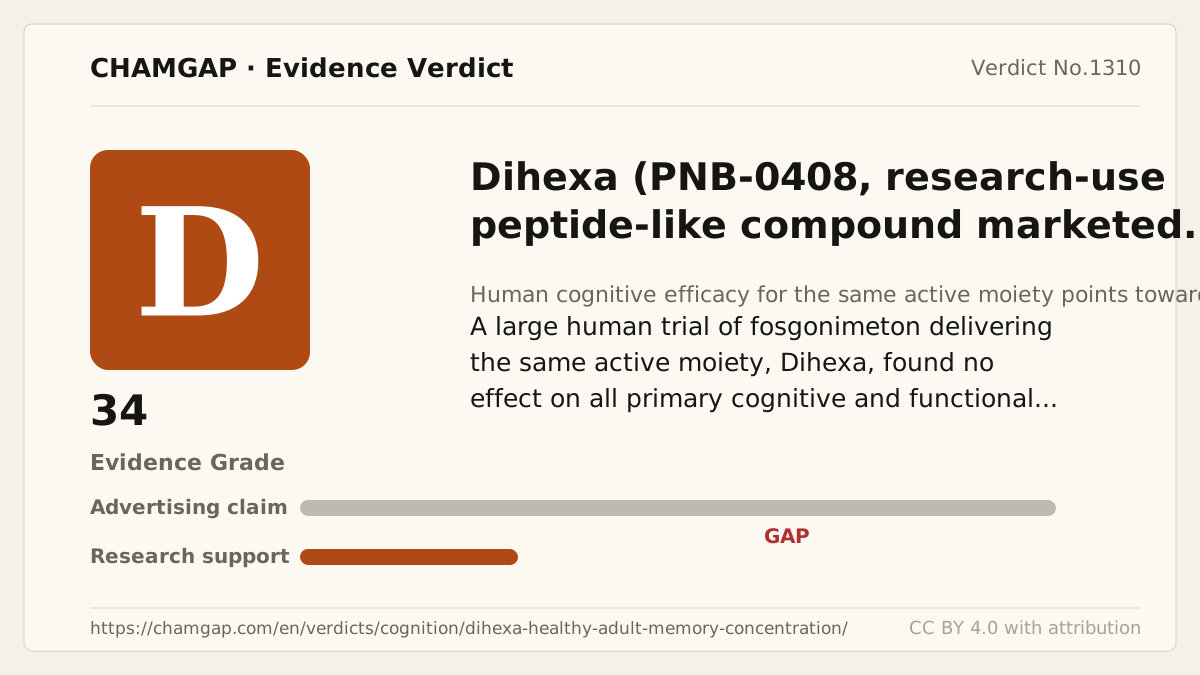
research showsAfter cross-checking, the verdict is D with 34 points. FDA GSRS links fosgonimeton to the active metabolite Dihexa, and a Phase I study in 88 people confirmed conversion of administered fosgonimeton to ATH-1001 and systemic exposure. In the 287-participant LIFT-AD Phase II/III trial delivering the same active moiety, GST (-0.08, p=0.70), ADAS-Cog11 (-0.70, p=0.35), and ADCS-ADL23 (+0.67, p=0.61) were all nonsignificant. The relevant human cognitive-efficacy evidence therefore points toward no effect rather than being absent. Indirectness remains because the trial did not directly test oral Dihexa itself in healthy adults.
ads claimVendors expand cell and diseased-rodent findings into claims of brain rewiring or genius-level cognition in healthy people, although cognitive and functional endpoints were null in a large human trial delivering the same active moiety. Numbers from a retracted mechanism paper and unvalidated oral dosing claims do not establish efficacy or safety.
Useful facts when choosing a product
- Dihexa is an Ang IV-derived research peptidomimetic also called PNB-0408, and fosgonimeton is a prodrug that delivers the same active moiety, Dihexa (ATH-1001).
- Relevant human cognitive-efficacy evidence for the same active moiety points toward no effect in LIFT-AD; Dihexa is not an approved cognitive enhancer or a validated dietary supplement.
- No direct study has established the pharmacokinetics, effective dose, or long-term safety of oral Dihexa itself in healthy people.
- Research-use-only products may not provide pharmaceutical-grade assurance of identity, potency, purity, sterility, or contamination control, making self-administration an uncontrolled human experiment.
Chamgap Semantic Classification Code
Candidate index · review held
UNK.dihexa.oral.memory-and-concentration-by-promoting-synaptogenesis.improve.placeboUnknown > Dihexa > Oral > memory and concentration by promoting synaptogenesis > Improvement claim > Placebo
An automated migration candidate, not an issued permanent code; exact claim scope remains under review. This machine-generated migration candidate helps retrieval but is not a permanent assignment. The original verdict ID and URL remain authoritative.
What the research actually shows
FDA GSRS records an active-metabolite-to-prodrug relationship between Dihexa and fosgonimeton. A randomized, double-blind Phase I study administered subcutaneous fosgonimeton to 88 people: 48 healthy young adults, 29 healthy older adults, and 11 people with Alzheimer's disease. It confirmed rapid plasma conversion to and dose-related exposure of ATH-1001. In the 287-participant primary analysis of randomized, placebo-controlled LIFT-AD, the 26-week differences were -0.08 for GST (p=0.70), -0.70 for ADAS-Cog11 (p=0.35), and +0.67 for ADCS-ADL23 (p=0.61), so none of the primary cognitive or functional endpoints was significant. The APP/PS1 mouse signal from Sun 2021 and the 32 nonhuman studies reviewed by Ho and Nation in 2018 do not overturn the human result, while the Benoist 2014 HGF/c-Met mechanism paper was retracted in 2025 after falsified or fabricated data were identified.
Why this is classified as D (34)
Human conversion and exposure to the Dihexa active moiety were confirmed after fosgonimeton, and all primary cognitive and functional endpoints were null in the 287-participant LIFT-AD trial. The retracted mechanism paper is also unfavorable; indirectness from the absence of a direct oral-Dihexa trial in healthy adults yields D with 34 points.
Counterpoint. Concerns about cognitive decline call first for evaluation of sleep, depression or anxiety, medicines, thyroid status, anemia, hearing and vision, and neurocognitive disease. There is no evidence-based Dihexa dose or monitoring protocol for enhancing concentration in healthy adults.
Rejudgment record. Cross-check applied — The FDA GSRS active-metabolite-to-prodrug relationship and Phase I ATH-1001 conversion and exposure support applying the null LIFT-AD human cognitive and functional results for the same active moiety; indirectness from the absence of a direct oral-Dihexa trial in healthy adults places the score at 34 points in the upper D band
Sub-claim grades by effect
This ingredient is marketed for several effects. A single overall grade blends strong and weak claims together, so each effect is graded separately here. The overall grade reflects the strongest disconfirming or core claim.
| Effect (sub-claim) | Grade | Basis |
|---|---|---|
| Improved memory | D | Cognitive primary endpoints were null in the human LIFT-AD trial of fosgonimeton, which delivered the same active moiety, Dihexa. |
| Improved concentration and synaptogenesis | D | Human cognitive efficacy for the same active moiety was null, and the key HGF/c-Met synaptogenesis paper was retracted in 2025. |
| Direct cognitive enhancement from oral Dihexa itself in healthy adults | ? | No cognitive efficacy trial has directly administered oral Dihexa itself to healthy adults. |
Cross-check — AI research and Codex final gate
Evidence Table
| Study | Design | Sample | Funding | Endpoint | Result | Weight |
|---|---|---|---|---|---|---|
| Porsteinsson AP et al. LIFT-AD. 2025 | Randomized, double-blind, placebo-controlled Phase II/III trial in mild-to-moderate Alzheimer's disease | 287 participants in the primary analysis | Trial conduct and data analysis funded by Athira Pharma | GST, ADAS-Cog11, and ADCS-ADL23 at 26 weeks | GST -0.08 (p=0.70), ADAS-Cog11 -0.70 (p=0.35), and ADCS-ADL23 +0.67 (p=0.61) were all nonsignificant. | Large null human trial delivering the same active moiety |
| Hua X et al. 2022 | Randomized, double-blind, placebo-controlled Phase I trial in healthy adults, older adults, and people with Alzheimer's disease | 88 participants | Supported by Athira Pharma and an Alzheimer's Drug Discovery Foundation PACT grant | Fosgonimeton and ATH-1001 pharmacokinetics, safety, qEEG, and ERP P300 | Fosgonimeton was rapidly converted in plasma to ATH-1001, with dose-related ATH-1001 exposure. | Bridging evidence confirming human conversion and exposure to the same active moiety |
| Sun X et al. 2021 | Preclinical experiment in APP/PS1 Alzheimer-model mice | 12 mice per group for the water maze; six per group for many tissue analyses | Research support from the National Natural Science Foundation of China and Jiangsu and Nanjing programs | Morris water maze, synaptophysin, neuronal and inflammatory markers, and PI3K/AKT | Dihexa-treated APP/PS1 mice showed improved water-maze learning and platform crossings and favorable changes in selected tissue markers. | Direct but limited to a disease-model animal |
| Ho JK and Nation DA. 2018 | Systematic review of nonhuman experimental cognition studies of Ang IV and Ang-(1-7) | 32 studies, all nonhuman | Academic support including the United States National Institute on Aging | Avoidance learning, object recognition, and spatial working memory in normal and cognitively impaired animals | Found signals for Ang IV-related compounds in cognitively impaired animals but included no human trial. | Defines the preclinical boundary and human-evidence gap |
| Benoist CC et al. retraction notice. 2025 | Retraction notice for a Dihexa HGF/c-Met mechanism paper | Investigation of key figures and data in the 2014 paper | Journal editorial retraction | Research integrity of Figures 1B and 2A/C and data submitted for an erratum | The HGF/c-Met-dependent synaptogenesis paper was retracted after falsified or fabricated data were identified. | Major loss of confidence in key mechanism evidence |
Receipt — 6 References
All 6 cited sources were verified for existence at the original page (as of 2026-07-24).
Final verification and publication gate: Codex · Evidence date: 2026-07-24 · Corrections: none
Cite this verdict
[Chamgap] Dihexa x enhanced memory and concentration in healthy adults — Evidence Grade D·34. 6 cited sources checked. Source: https://chamgap.com/en/verdicts/cognition/dihexa-healthy-adult-memory-concentration/ · CC BY 4.0CC BY 4.0 — free to use with attribution; do not distort grades, numbers, or verdict meaning.
What this document does and does not do
Chamgap is an information source. It reports what research has and has not confirmed; it does not tell readers what to take or buy. That decision belongs to readers and, when needed, medical or legal professionals. This verdict reflects literature available up to the search date and may change as new research appears. Nothing here is medical advice.