
Cod during pregnancy,
does it really help with Improved infant cognitive, language, and motor development at 11 months?
research showsThe grade is D with 34 points. A trial randomized 133 women and analyzed 112 infants. Maternal urinary iodine, the registered primary outcome, improved, but infant cognitive, language, and motor development did not improve overall. Only cognition had a nominal adverse signal without multiplicity correction.
ads claimThe iodine content of cod and improved maternal iodine status are real, but the trial did not support the next step, better infant cognition, language, or motor development. Verdict 381 is B with 72 points for DHA supplements and infant vision, while verdict 533 is B with 74 points for prenatal omega-3 supplements and preterm birth; neither tests frozen cod fillets and Bayley development.
Useful facts when choosing a product
- Thirty trial-cod samples contained a mean 81 micrograms iodine per 100 g, ranging from 31 to 630 micrograms per 100 g.
- The intervention was 200 g frozen cod twice weekly; participants chose preparation methods. Wild versus farmed status was not verified in accessible reporting.
- The article analyzed total mercury in the trial food, not methylmercury directly. A separate FDA monitoring table lists mean total mercury for cod as 0.111 ppm.
- Improved maternal iodine concentration is a separate fact from improved infant development.
Chamgap Semantic Classification Code
Candidate index · review held
F.frozen-cod-fillets.oral.infant-cognitive-language-and-motor-development-at.improve.UNKFoods and beverages > Frozen cod fillets > Oral > infant cognitive, language, and motor development at > Improvement claim > Unknown
An automated migration candidate, not an issued permanent code; exact claim scope remains under review. This machine-generated migration candidate helps retrieval but is not a permanent assignment. The original verdict ID and URL remain authoritative.
What the research actually shows
The study enrolled 137 women and randomized 133, 68 to cod and 65 to usual diet. Maternal iodine analyses included 61 per arm; Bayley-III analyses included 57 and 55 infants. The intervention supplied Lerøy frozen cod fillets, 200 g twice weekly from gestational weeks 20 through 36; mean intake was 306±62 g/week. Developmental assessors were masked. NCT02610959 was registered before recruitment. FHF is state-owned but funded entirely by a 0.3% seafood-export levy and aims to add industry value. The authors declared no competing interests.
Why this is classified as D (34)
A single small trial found no developmental improvement, one unadjusted nominal cognitive signal, and more than 15% missing from infant analysis, giving D with 34 points.
Counterpoint. This does not advise avoiding every low-mercury fish during pregnancy; it narrowly rejects proven developmental improvement from this cod regimen.
Rejudgment record. Cross-check applied — The article, prospective registry, and food analyses were reconciled to separate the primary iodine outcome from registered infant-development outcomes and use analyzed counts
| Endpoint | P | Symptom or function itself is the target - including patient reports and performance tests |
| Replication | R1 | Single confirmatory trial |
| Independence | I2 | Decisive evidence is publicly or non-profit funded |
| Effect size | E0 | Null |
| Precision | C1 | The confidence interval excludes meaningful benefit |
Stored derived and displayed grades match; this is not a current recalculation or validity check (D).
Sub-claim grades by effect
This ingredient is marketed for several effects. A single overall grade blends strong and weak claims together, so each effect is graded separately here. The overall grade reflects the strongest disconfirming or core claim.
| Effect (sub-claim) | Grade | Basis |
|---|---|---|
| Improved maternal urinary iodine concentration | C | The primary nutritional outcome favored cod. |
| Improved infant cognitive, language, and motor development | D | Language and motor outcomes did not differ; only cognition had an unadjusted nominal adverse signal. |
Cross-check — AI research and Codex final gate
Evidence Table
| Study | Design | Sample | Funding | Endpoint | Result | Weight |
|---|---|---|---|---|---|---|
| Markhus MW et al. 2021 Mommy's Food | Assessor-masked randomized controlled food trial | 133 randomized, cod 68 and control 65; iodine 61/61 and infant Bayley 57/55 analyzed | FHF is state-owned but funded entirely by a 0.3% seafood-export levy and aims to add industry value; authors declared no competing interests | Primary maternal urinary iodine concentration; registered secondary 11-month Bayley-III | Registered primary maternal iodine improved; no overall improvement across three infant-development domains; cognition 95±9 versus 99±10, d≈-0.42, log control-minus-cod difference 0.016, 95% CI 0.0004 to 0.0321, unadjusted P=.045; language P=.67 and motor P=.24 | Direct whole-food randomized evidence limited by small size and infant follow-up loss |
Receipt — 3 References
All 3 cited sources were verified for existence at the original page (as of 2026-08-03).
Final verification and publication gate: Codex · Evidence date: 2026-08-03 · Corrections: none
Cite this verdict
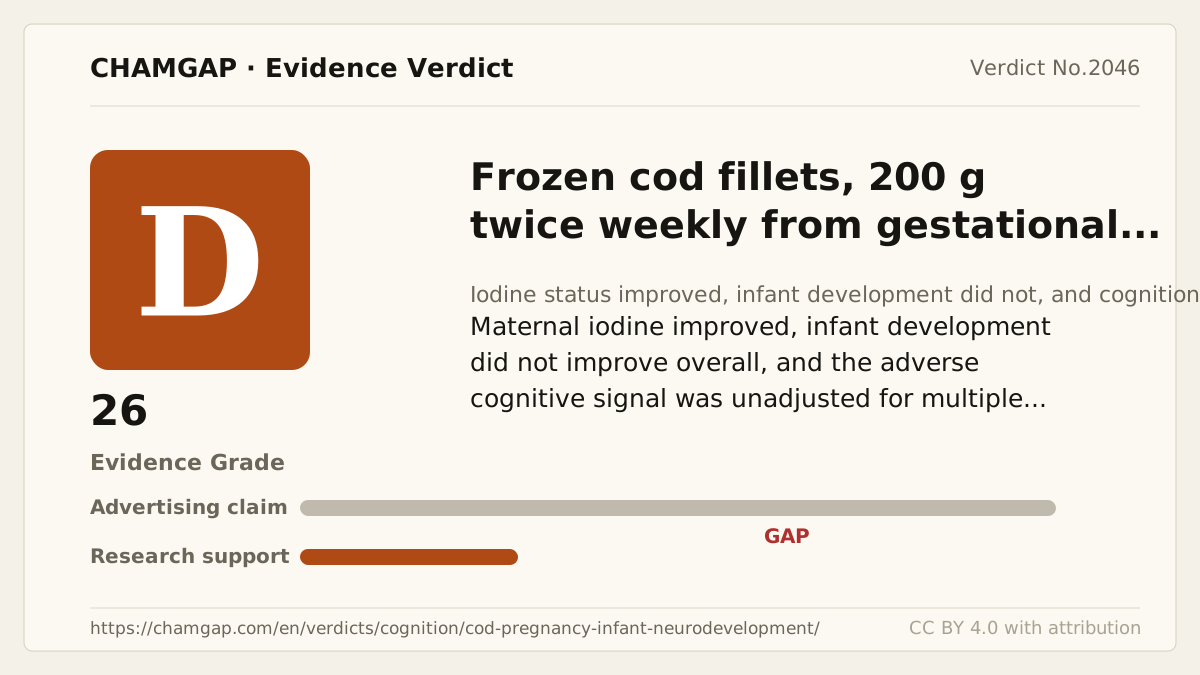
[Chamgap] Cod during pregnancy x improved infant neurodevelopment — Evidence Grade D·34. 3 cited sources checked. Source: https://chamgap.com/en/verdicts/cognition/cod-pregnancy-infant-neurodevelopment/ · CC BY 4.0CC BY 4.0 — free to use with attribution; do not distort grades, numbers, or verdict meaning.
What this document does and does not do
Chamgap is an information source. It reports what research has and has not confirmed; it does not tell readers what to take or buy. That decision belongs to readers and, when needed, medical or legal professionals. This verdict reflects literature available up to the search date and may change as new research appears. Nothing here is medical advice.