
Cenobamate,
does it really help with Complete seizure freedom as adjunctive therapy for focal seizures uncontrolled by existing medicines in adults?
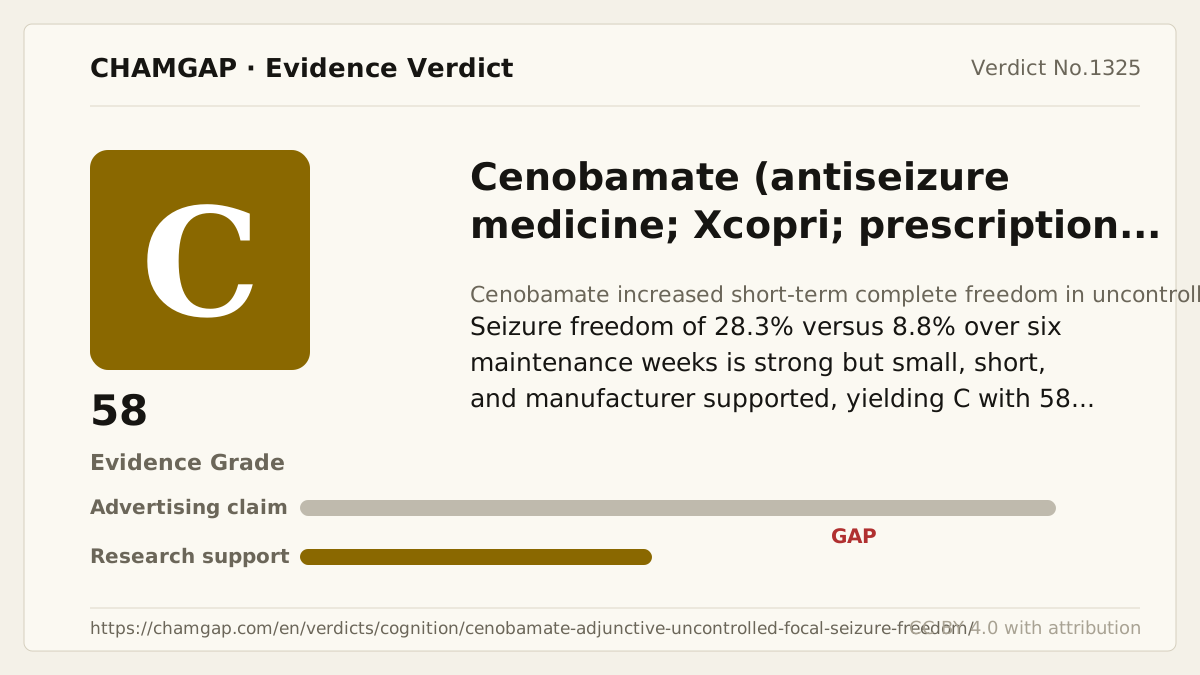
research showsCenobamate is rated C because adjunctive treatment increased short-term complete seizure freedom in adults whose focal seizures remained uncontrolled on existing antiseizure medicines. In a 222-participant phase 2 trial, seizure freedom during the six-week maintenance phase was 28.3% versus 8.8% with placebo, and median seizure-frequency reduction was 55.6% versus 21.5%. The small sample, short maintenance period, manufacturer support, and limited independent replication of long-term complete freedom yield C with 58 points.
ads claimSix-week complete seizure freedom can be expanded into a long-term cure for drug-resistant epilepsy or permission to stop existing medicines. Use requires slow titration, adjustment of concomitant medicines, and continued follow-up.
Useful facts when choosing a product
- Cenobamate is an oral prescription antiseizure medicine for focal-onset seizures in adults; the evidence in this verdict concerns addition to existing treatment.
- To reduce DRESS risk, treatment commonly starts at 12.5 mg daily and increases every two weeks, and it should not be stopped abruptly without supervision.
- Somnolence, dizziness, fatigue, diplopia, and impaired gait or coordination are common and can worsen with alcohol or other sedatives.
- It shortens the QT interval and is contraindicated in familial short-QT syndrome; CYP2C19 inhibition and CYP3A induction can require adjustment of concomitant antiseizure medicines.
Chamgap Semantic Classification Code
Candidate index · review held
M.cenobamate.UNK.complete-seizure-freedom-as-adjunctive-therapy-for-focal-seizures-uncontrolled-by-existing-medicines.assess.placeboMedicinal interventions > Cenobamate > Unknown > Complete seizure freedom as adjunctive therapy for focal seizures uncontrolled by existing medicines > Association or change assessment > Placebo
An automated migration candidate, not an issued permanent code; exact claim scope remains under review. This machine-generated migration candidate helps retrieval but is not a permanent assignment. The original verdict ID and URL remain authoritative.
What the research actually shows
Chung and colleagues randomized 222 adults with uncontrolled focal seizures despite one to three antiseizure medicines to cenobamate 200 mg daily or placebo under double masking. Complete seizure freedom during the six-week maintenance phase was 28.3% versus 8.8%, and median seizure-frequency reduction over the double-blind period was 55.6% versus 21.5%. In a separate 437-participant dose-ranging trial, at least 50% response rates were 25% with placebo and 40%, 56%, and 64% with 100, 200, and 400 mg, with dose-related maintenance-phase seizure freedom.
Why this is classified as C (58)
Seizure freedom of 28.3% versus 8.8% and frequency reduction were positive, but 222 participants, six maintenance weeks, manufacturer support, and limited independent long-term replication yield C with 58 points.
Counterpoint. The chance of complete freedom matters for treatment choice, but a specialist must titrate while tracking seizures, adverse effects, and interactions.
Rejudgment record. Cross-check applied — Accepted complete seizure freedom and frequency reduction with placebo-controlled adjunctive therapy in adults uncontrolled by existing medicines, while reflecting that the pivotal freedom estimate came from a six-week maintenance phase in 222 participants with manufacturer support and limited independent long-term replication
Sub-claim grades by effect
This ingredient is marketed for several effects. A single overall grade blends strong and weak claims together, so each effect is graded separately here. The overall grade reflects the strongest disconfirming or core claim.
| Effect (sub-claim) | Grade | Basis |
|---|---|---|
| Complete seizure freedom during maintenance | C | It was 28.3% versus 8.8% over the six-week maintenance phase in the 222-participant trial. |
| Reduced focal-seizure frequency | C | Median frequency reduction was 55.6% versus 21.5%, with replication in a separate dose-ranging trial. |
| Increased response of at least 50% seizure-frequency reduction | C | In the dose-ranging trial, response was 25% with placebo versus 56% at 200 mg and 64% at 400 mg. |
Cross-check — AI research and Codex final gate
Evidence Table
| Study | Design | Sample | Funding | Endpoint | Result | Weight |
|---|---|---|---|---|---|---|
| Chung SS et al. 2020, Study C013 | Multicenter randomized double-blind placebo-controlled phase 2 trial | 222 adults with uncontrolled focal seizures | Supported by SK Life Science | Seizure-frequency change, 50% response, and complete seizure freedom during six maintenance weeks | Maintenance-phase seizure freedom 28.3% versus 8.8%; median frequency reduction 55.6% versus 21.5%. | Pivotal short-term seizure-freedom trial |
| Krauss GL et al. 2020, Study C017 | Multinational randomized double-blind placebo-controlled dose-response trial | 437 adults with uncontrolled focal seizures | Supported by SK Life Science | Seizure-frequency change and at least 50% response | Maintenance-phase 50% response was 25% with placebo versus 40%, 56%, and 64% with 100, 200, and 400 mg. | Dose-response randomized replication |
Receipt — 2 References
All 2 cited sources were verified for existence at the original page (as of 2026-07-23).
Final verification and publication gate: Codex · Evidence date: 2026-07-23 · Corrections: none
Cite this verdict
[Chamgap] Cenobamate x seizure freedom as adjunctive therapy for uncontrolled focal seizures in adults — Evidence Grade C·58. 2 cited sources checked. Source: https://chamgap.com/en/verdicts/cognition/cenobamate-adjunctive-uncontrolled-focal-seizure-freedom/ · CC BY 4.0CC BY 4.0 — free to use with attribution; do not distort grades, numbers, or verdict meaning.
What this document does and does not do
Chamgap is an information source. It reports what research has and has not confirmed; it does not tell readers what to take or buy. That decision belongs to readers and, when needed, medical or legal professionals. This verdict reflects literature available up to the search date and may change as new research appears. Nothing here is medical advice.