
CEFALY,
does it really help with Reduction in episodic migraine days with daily preventive use?
research showsThe grade is C. PREMICE randomized 67 people and analyzed all 67, 34 active and 33 sham, after last-observation-carried-forward imputation. Mean monthly migraine-day reduction missed significance between groups, P=0.054, while the coprimary rate of at least 50% response was significantly higher, 38.24% versus 12.12%, P=0.023.
ads claimMarketing extends a real 60-Hz device specification and a large response in some users into a dependable preventive effect for everyone.
Useful facts when choosing a product
- The official CEFALY Enhanced manual specifies 60 Hz, a 250-microsecond pulse width, a maximum intensity of 16 mA, and a 20-minute PREVENT session. These are measurable device facts, not proof of prevention.
- PREMICE randomized and analyzed all 67 after last-observation-carried-forward imputation; 59 was the completer count. The migraine-day comparison gave P=0.054, while response of at least 50% was 38.24% versus 12.12%, P=0.023.
- Verdict 1859, which is D with 28 points, concerns gabapentin prevention. Evidence for that drug is not evidence for this device.
Chamgap Semantic Classification Code
Candidate index · review held
P.cefaly-external-trigeminal-nerve-stimulation-device.transdermal.episodic-migraine-days-with-daily-preventive-use.prevent.shamProcedures, devices and tests > CEFALY external trigeminal nerve stimulation device > Transdermal > episodic migraine days with daily preventive use > Occurrence-prevention claim > Sham procedure or device
An automated migration candidate, not an issued permanent code; exact claim scope remains under review. This machine-generated migration candidate helps retrieval but is not a permanent assignment. The original verdict ID and URL remain authoritative.
What the research actually shows
PREMICE randomized 67 people. Although 59 completed treatment, the primary analysis included all 67 after last-observation-carried-forward imputation, 34 active and 33 sham. For the first coprimary endpoint, monthly migraine days changed from 6.94 to 4.88 in the active group, -2.06 (95% CI -3.58 to -0.54), and from 6.54 to 6.22 with sham, -0.32 (95% CI -1.27 to 0.63); the between-group P value was 0.054. The other coprimary endpoint, response of at least 50%, was 13 of 34, 38.24%, versus 4 of 33, 12.12%, P=0.023. Trial costs were publicly funded by the Walloon Region under Research Convention No. 1017266, DG06. STX-Med supplied devices and technical help for allocation and blinding; the paper does not report manufacturer funding of trial costs.
Why this is classified as C (54)
Publicly funded PREMICE showed a clinically recognized response of at least 50%, but the mean migraine-day coprimary endpoint failed, the trial had only 67 participants, and no separate sham replication exists, yielding C with 54 points.
Counterpoint. A trial of use can be reasonable for adults who cannot take medicines or prefer a non-drug option. A headache diary over two to three months can show whether an individual response justifies continued use.
Rejudgment record. Cross-check applied — Split coprimary outcomes, one small confirmatory trial, and no independent sham replication
| Endpoint | P | Symptom or function itself is the target - including patient reports and performance tests |
| Replication | R1 | Single confirmatory trial |
| Independence | I2 | Decisive evidence is publicly or non-profit funded |
| Effect size | E+ | Meets the clinically important threshold |
Stored derived and displayed grades match; this is not a current recalculation or validity check (C).
Sub-claim grades by effect
This ingredient is marketed for several effects. A single overall grade blends strong and weak claims together, so each effect is graded separately here. The overall grade reflects the strongest disconfirming or core claim.
| Effect (sub-claim) | Grade | Basis |
|---|---|---|
| Mean reduction in monthly migraine days | C | The between-group coprimary test failed at P=0.054. |
| At least a 50% reduction in migraine days | C | The 38.24% versus 12.12% result was positive, but it comes from one small trial. |
| Independently replicated long-term preventive efficacy | D | No additional independent sham-controlled confirmatory trial of the same device exists. |
Cross-check — AI research and Codex final gate
Evidence Table
| Study | Design | Sample | Funding | Endpoint | Result | Weight |
|---|---|---|---|---|---|---|
| Schoenen J et al. 2013 PREMICE | Multicenter double-blind randomized sham-controlled trial | 67 randomized and analyzed after last-observation-carried-forward imputation; 59 completed | Walloon Region, FNRS, and University of Liege support; devices supplied by STX-Med | Coprimary: change in monthly migraine days and 50% responder rate | The between-group migraine-day test failed at P=0.054; the 50% responder rate succeeded at 38.24% versus 12.12%, P=0.023. | Key single sham-controlled trial |
| Danno D et al. 2019 | Four-center prospective open-label single-arm study | 100 enrolled; 96 completed; 83 analyzed for efficacy | No external study funding reported in the article; manufacturer device used | Change in monthly migraine days at 12 weeks | Migraine days decreased from 8.16 to 6.84, but the absence of a control prevents confirmatory inference. | Supportive uncontrolled evidence |
Receipt — 3 References
All 3 cited sources were verified for existence at the original page (as of 2026-07-24).
Final verification and publication gate: Codex · Evidence date: 2026-07-24 · Corrections: none
Cite this verdict
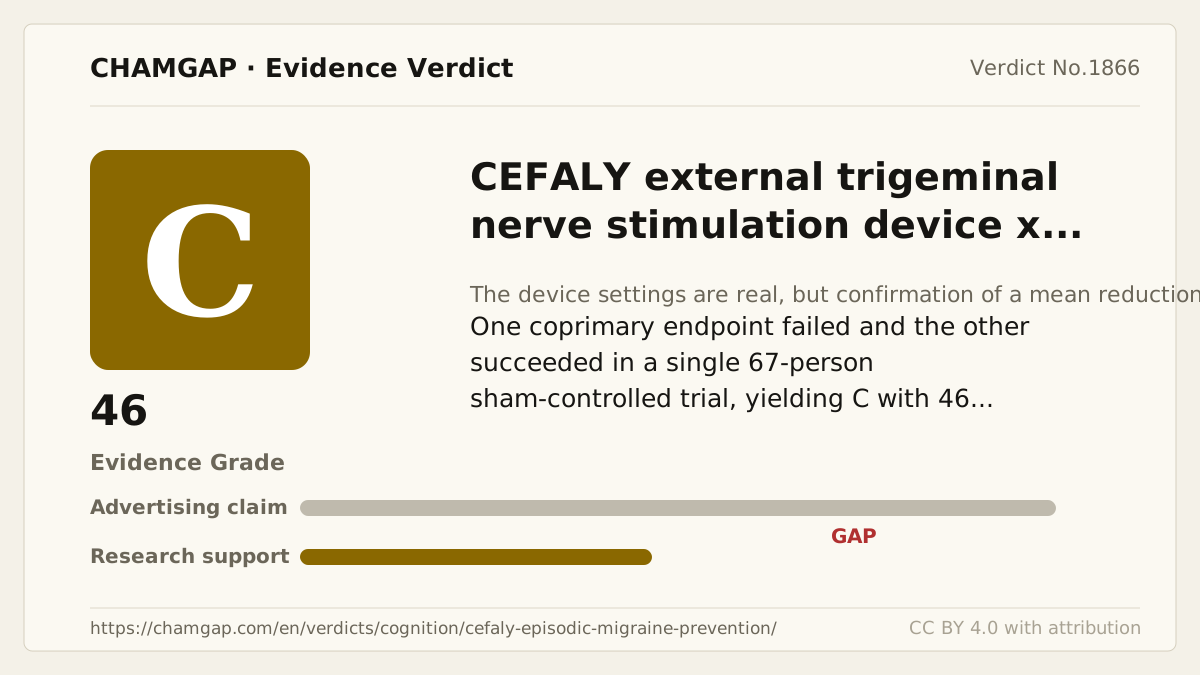
[Chamgap] CEFALY x prevention of episodic migraine — Evidence Grade C·54. 3 cited sources checked. Source: https://chamgap.com/en/verdicts/cognition/cefaly-episodic-migraine-prevention/ · CC BY 4.0CC BY 4.0 — free to use with attribution; do not distort grades, numbers, or verdict meaning.
What this document does and does not do
Chamgap is an information source. It reports what research has and has not confirmed; it does not tell readers what to take or buy. That decision belongs to readers and, when needed, medical or legal professionals. This verdict reflects literature available up to the search date and may change as new research appears. Nothing here is medical advice.