
Levodopa–carbidopa,
does it really help with Improvement of tremor, rigidity, and bradykinesia in Parkinson disease?
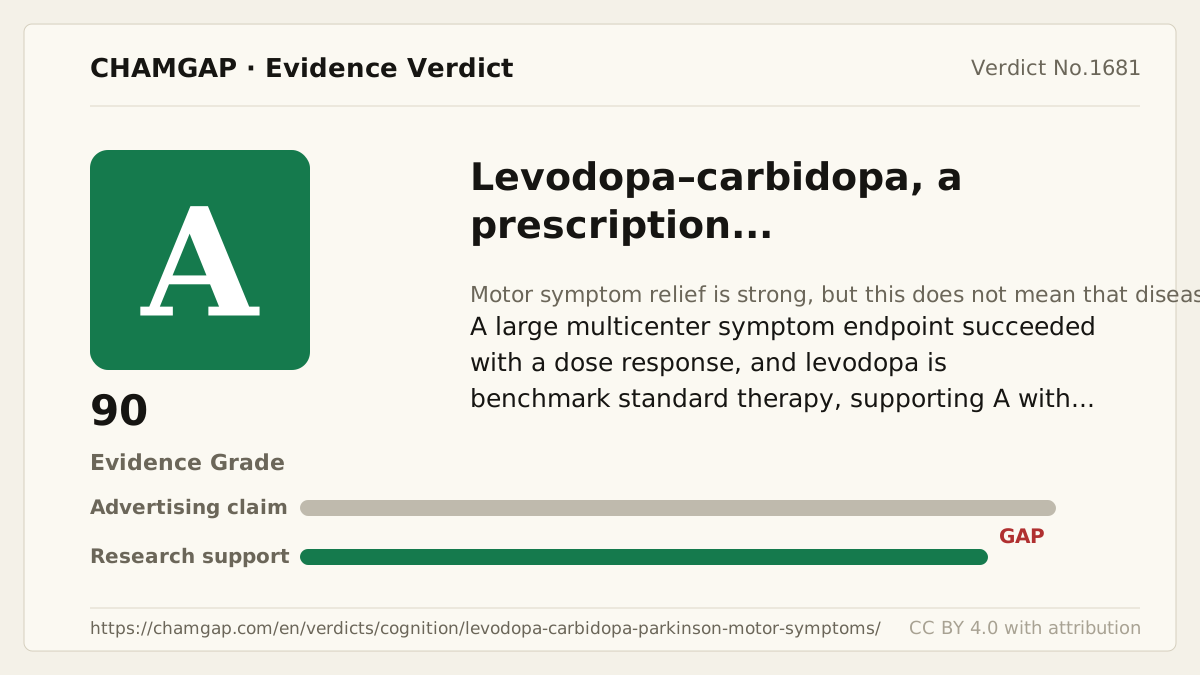
research showsLevodopa–carbidopa is rated A because it is the benchmark standard treatment for Parkinson motor symptoms and produces large direct improvement. ELLDOPA, designed to test disease modification, randomized 361 participants; 311 were assessed at week 42, and the prespecified primary total-UPDRS endpoint succeeded with a dose response (P<0.001). Delayed-start LEAP also tested disease modification and randomized 445 participants, but its week-80 total-UPDRS primary endpoint failed. Both groups were receiving levodopa by week 80, so this rejects disease modification, not symptomatic efficacy.
ads claimExtending symptomatic relief into neuronal protection or halted progression exceeds the evidence.
Useful facts when choosing a product
- Levodopa is converted to dopamine in the brain, while carbidopa reduces peripheral breakdown.
- Dose and timing require individualized specialist adjustment.
- High-protein meals can interfere with absorption or brain transport in some patients.
Chamgap Semantic Classification Code
Candidate index · review held
M.levodopacarbidopa.UNK.tremor-rigidity-and-bradykinesia-in-parkinson-disease.improve.placeboMedicinal interventions > Levodopa–carbidopa > Unknown > tremor, rigidity, and bradykinesia in Parkinson disease > Improvement claim > Placebo
An automated migration candidate, not an issued permanent code; exact claim scope remains under review. This machine-generated migration candidate helps retrieval but is not a permanent assignment. The original verdict ID and URL remain authoritative.
What the research actually shows
Both ELLDOPA and LEAP were designed to determine whether levodopa modifies disease. ELLDOPA assigned 361 patients with early Parkinson disease to three carbidopa–levodopa doses or placebo, and 311 were assessed at week 42. The prespecified week-42 total-UPDRS primary endpoint succeeded versus placebo with a dose response, but disease modification itself was not established. LEAP randomized 445 patients to early or 40-week delayed start and failed on its week-80 total-UPDRS primary endpoint. Because both groups were receiving levodopa by week 80, the null result rejects disease modification rather than symptomatic efficacy.
Why this is classified as A (90)
The symptom-improvement primary endpoint succeeded with a dose response in a large multicenter trial, and levodopa is benchmark standard therapy for Parkinson motor symptoms, supporting A with 90 points. The two cited studies were designed for disease modification rather than as dedicated confirmatory symptomatic-efficacy trials, so this is not the very top of A.
Counterpoint. This is a central symptomatic treatment, not evidence that all nonmotor symptoms improve or that progression stops.
Rejudgment record. Cross-check applied — A symptom-improvement primary endpoint succeeded with a dose response in a large multicenter trial, and levodopa is benchmark standard therapy for Parkinson motor symptoms. However, both ELLDOPA and LEAP were designed to test disease modification rather than as dedicated confirmatory symptomatic-efficacy trials; LEAP's week-80 failure occurred when both groups were receiving levodopa and therefore rejects disease modification, not symptomatic efficacy, keeping the rating below the very top of A
Sub-claim grades by effect
This ingredient is marketed for several effects. A single overall grade blends strong and weak claims together, so each effect is graded separately here. The overall grade reflects the strongest disconfirming or core claim.
| Effect (sub-claim) | Grade | Basis |
|---|---|---|
| On-treatment improvement of Parkinson motor symptoms | A | Large randomized trials showed a substantial replicated direct UPDRS benefit. |
| Delay of motor disability in early disease | B | On-treatment function is preserved better, but this must be distinguished from disease modification. |
| Modification of Parkinson disease progression | D | The LEAP week-80 primary endpoint failed. |
Cross-check — AI research and Codex final gate
Evidence Table
| Study | Design | Sample | Funding | Endpoint | Result | Weight |
|---|---|---|---|---|---|---|
| Fahn S et al. 2004 ELLDOPA | Multicenter randomized double-blind placebo-controlled trial designed to assess disease modification | 361 randomized; 311 actually assessed at week 42 | Public NINDS, Department of Defense, and NIH support; Teva supplied study medication | Prespecified primary change in total UPDRS at week 42 | Placebo worsened by +7.8 versus +1.9, +1.9, and -1.4 across doses; primary endpoint succeeded with a dose response (P<0.001), but disease modification remained unconfirmed. | Key direct symptom evidence |
| Verschuur CVM et al. 2019 LEAP | Multicenter randomized double-blind delayed-start trial designed to assess disease modification | 445 randomized; 417 completed 80 weeks | Noncommercial Dutch governmental, patient-organization, and foundation grants | Primary change in total UPDRS at week 80 | The week-80 difference was 1.0 point, P=0.44, so the disease-modification primary endpoint failed; both groups were then receiving levodopa, so symptomatic efficacy was not negated. | Independent replication and scope limitation |
Receipt — 2 References
All 2 cited sources were verified for existence at the original page (as of 2026-07-24).
Final verification and publication gate: Codex · Evidence date: 2026-07-24 · Corrections: none
Cite this verdict
[Chamgap] Levodopa–carbidopa x improvement of Parkinson motor symptoms — Evidence Grade A·90. 2 cited sources checked. Source: https://chamgap.com/en/verdicts/cognition/levodopa-carbidopa-parkinson-motor-symptoms/ · CC BY 4.0CC BY 4.0 — free to use with attribution; do not distort grades, numbers, or verdict meaning.
What this document does and does not do
Chamgap is an information source. It reports what research has and has not confirmed; it does not tell readers what to take or buy. That decision belongs to readers and, when needed, medical or legal professionals. This verdict reflects literature available up to the search date and may change as new research appears. Nothing here is medical advice.