
Food-color and sodium-benzoate mixtures,
does it really help with Increased hyperactivity scores in children from the general population?
research showsThe grade is C with 50 points. A double-blind crossover trial in 153 three-year-olds and 144 eight- to nine-year-olds from the general population found higher aggregate hyperactivity with some mixtures. In the full three-year-old analysis, mix A had a standardized effect of 0.20 (95% CI 0.01 to 0.39), while mix B was null. Positive values of 0.12 and 0.17 in older children came from the subgroup consuming at least 85% of drinks with no missing data. Effects were small, and every active drink also contained 45 mg sodium benzoate, so the color contribution cannot be isolated.
ads claimA color-free claim should not turn this into evidence that one dye causes ADHD. The trial combined four colors with a preservative in unselected children, and average changes were small and dependent on age, mixture, and analysis set.
Useful facts when choosing a product
- Total color dose was 20 or 30 mg/day in three-year-olds and 24.98 or 62.4 mg/day in eight- to nine-year-olds.
- Every active mixture included 45 mg/day sodium benzoate, preventing separation of color and preservative effects.
- The trial enrolled community children across the full hyperactivity range, not only children diagnosed with ADHD.
Chamgap Semantic Classification Code
Candidate index · review held
F.mixtures-of-artificial-food-colors-plus-sodium-benzoate.food.hyperactivity-scores-from-the-general-population.increase.placeboFoods and beverages > Mixtures of artificial food colors plus sodium benzoate > Food consumption > hyperactivity scores from the general population > Increase claim > Placebo
An automated migration candidate, not an issued permanent code; exact claim scope remains under review. This machine-generated migration candidate helps retrieval but is not a permanent assignment. The original verdict ID and URL remain authoritative.
What the research actually shows
Participants were not selected for ADHD: 153 three-year-olds and 144 eight- to nine-year-olds came from the general community. Each child crossed through placebo, mix A, and mix B over six weeks. Sixteen and 14 did not complete, leaving 137 and 130 completers. For three-year-olds, color totals were 20 mg in A and 30 mg in B; for older children, 24.98 mg in A and 62.4 mg in B. The four colors differed by mix, and every active drink contained 45 mg sodium benzoate, so the color contribution cannot be separated from the preservative contribution. ISRCTN74481308 was not prospectively registered. The main outcome aggregated parent, teacher, and observer ratings, plus a computerized attention test for older children. The UK Food Standards Agency funded the trial, and the paper declared no conflicts.
Why this is classified as C (50)
A publicly funded blinded trial found small positive signals, but the mixture design, short exposure, age-specific small samples, and dependence on completer or high-adherence analyses give C with 50 points.
Counterpoint. C describes limited certainty for the harm claim, not a medium level of danger.
Rejudgment record. Cross-check applied — Assessment of age-specific full and high-adherence analyses in a community-child double-blind crossover trial, including inability to isolate colors from sodium benzoate
| Endpoint | P | Symptom or function itself is the target - including patient reports and performance tests |
| Replication | R1 | Single confirmatory trial |
| Independence | I2 | Decisive evidence is publicly or non-profit funded |
| Effect size | E~ | Statistically positive but below the threshold |
Stored derived and displayed grades match; this is not a current recalculation or validity check (C).
Sub-claim grades by effect
This ingredient is marketed for several effects. A single overall grade blends strong and weak claims together, so each effect is graded separately here. The overall grade reflects the strongest disconfirming or core claim.
| Effect (sub-claim) | Grade | Basis |
|---|---|---|
| Higher hyperactivity with mix A in general-population three-year-olds | C | The full-sample effect was 0.20 (95% CI 0.01 to 0.39). |
| Higher hyperactivity with both mixtures in eight- to nine-year-olds | C | Positive estimates came from 91 children with at least 85% intake and no missing data. |
| An individual artificial color causes ADHD | ? | Four colors and sodium benzoate were coadministered, so individual ingredients and incident ADHD were not isolated. |
Cross-check — AI research and Codex final gate
Evidence Table
| Study | Design | Sample | Funding | Endpoint | Result | Weight |
|---|---|---|---|---|---|---|
| McCann et al. 2007 | Randomized double-blind placebo-controlled crossover trial in community children | 153 three-year-olds with 137 completers; 144 eight- to nine-year-olds with 130 completers | Public funding from the UK Food Standards Agency | Global hyperactivity aggregate combining multiple raters and measures | In the full three-year-old sample, mix A was 0.20 (95% CI 0.01 to 0.39) and B was null; among older high-adherence complete cases, A was 0.12 (0.02 to 0.23) and B 0.17 (0.07 to 0.28) | Pivotal direct behavioral evidence |
Receipt — 2 References
All 2 cited sources were verified for existence at the original page (as of 2026-08-04).
Final verification and publication gate: Codex · Evidence date: 2026-08-04 · Corrections: none
Cite this verdict
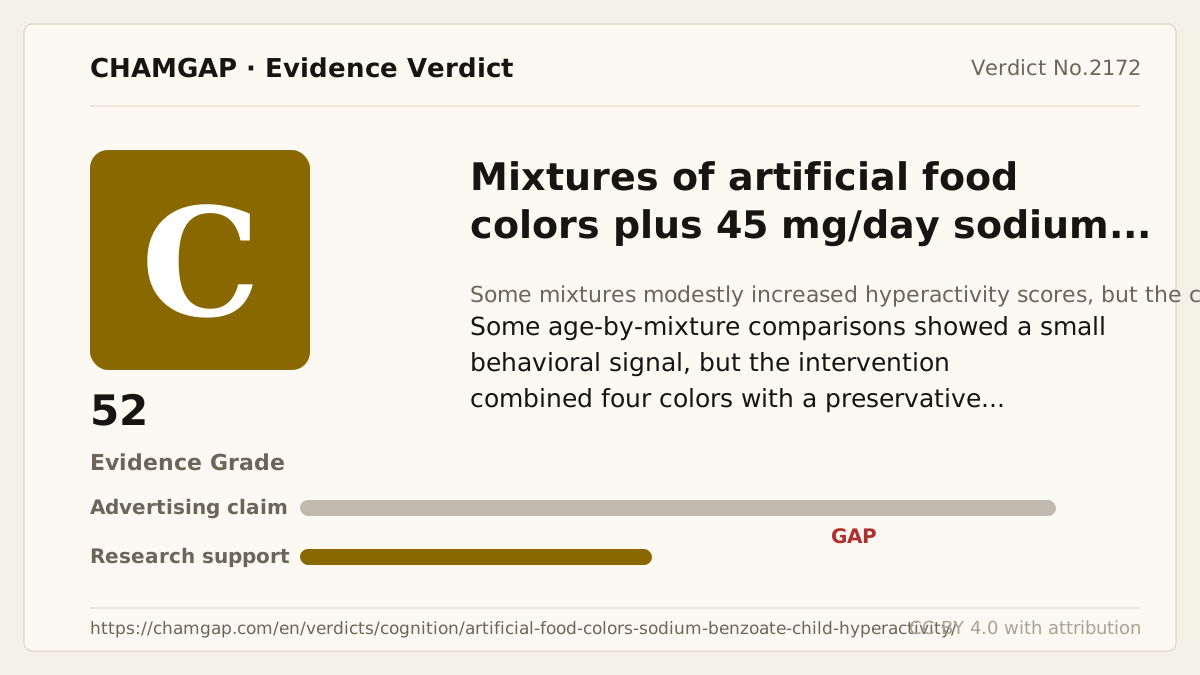
[Chamgap] Food-color and sodium-benzoate mixtures x child hyperactivity — Evidence Grade C·50. 2 cited sources checked. Source: https://chamgap.com/en/verdicts/cognition/artificial-food-colors-sodium-benzoate-child-hyperactivity/ · CC BY 4.0CC BY 4.0 — free to use with attribution; do not distort grades, numbers, or verdict meaning.
What this document does and does not do
Chamgap is an information source. It reports what research has and has not confirmed; it does not tell readers what to take or buy. That decision belongs to readers and, when needed, medical or legal professionals. This verdict reflects literature available up to the search date and may change as new research appears. Nothing here is medical advice.