
Amitriptyline or topiramate,
does it really help with At least 50% reduction in headache days over 24 weeks in migraine patients aged 8 to 17?
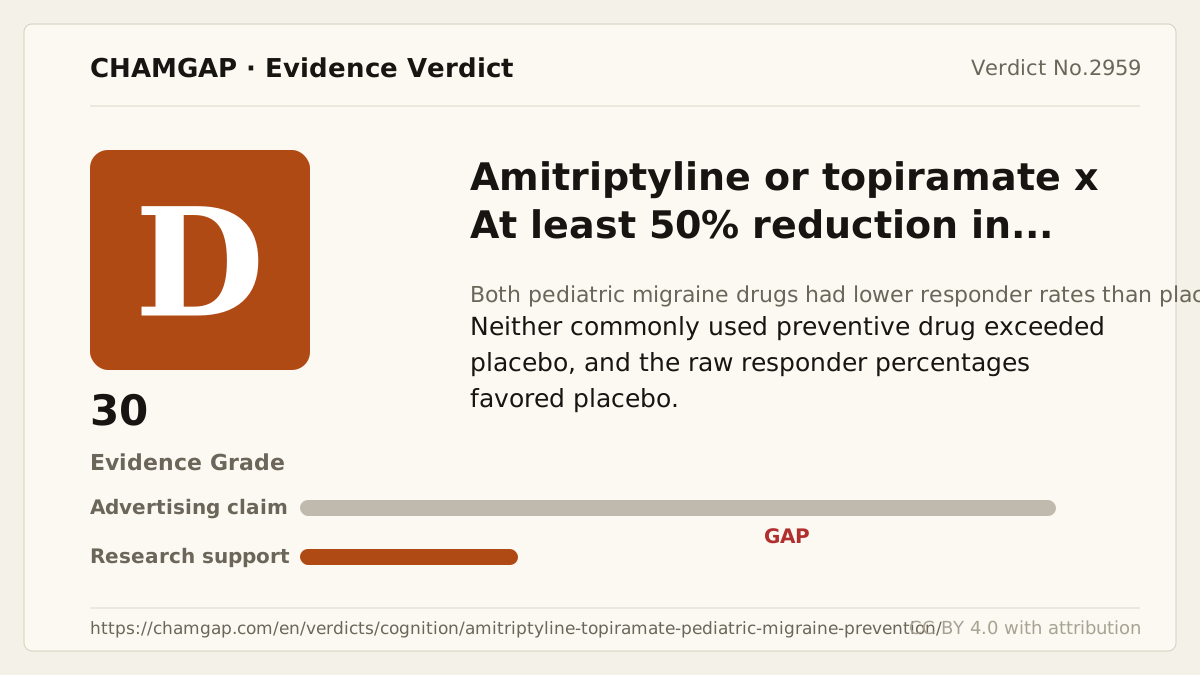
research showsGrade D. The 50% responder rate was 52% with amitriptyline, 55% with topiramate, and 61% with placebo. Both active drugs were numerically worse than placebo: amitriptyline OR 0.71 (98.3% CI 0.34 to 1.48; P=.26) and topiramate OR 0.81 (0.39 to 1.68; P=.48).
ads claimAdult migraine evidence cannot simply be transferred to ages 8 to 17. This conclusion is limited to these two drugs and this 24-week pediatric prevention claim.
Useful facts when choosing a product
- Generic drugs were purchased with grant funds and overencapsulated to match placebo.
- No pharmaceutical donation, analysis service, or commercial cofunding was reported.
- Conditional power was 16% and 14% for the two active drugs.
Chamgap Semantic Classification Code
Candidate index · review held
UNK.amitriptyline-or-topiramate.UNK.at-least-50-percent-reduction-in-headache-days-over-in-migraine-patients.reduce.placeboUnknown > Amitriptyline or topiramate > Unknown > At least 50% reduction in headache days over in migraine patients > Reduction claim > Placebo
An automated migration candidate, not an issued permanent code; exact claim scope remains under review. This machine-generated migration candidate helps retrieval but is not a permanent assignment. The original verdict ID and URL remain authoritative.
What the research actually shows
CHAMP randomized 361 participants at 31 US centers in a 2:2:1 ratio: 144 to amitriptyline, 145 to topiramate, and 72 to placebo. The primary endpoint was at least a 50% reduction in headache days during the final 28 days of the 24-week period versus baseline. Three pairwise comparisons used Bonferroni-adjusted two-sided alpha .017. At planned interim analysis, conditional power was 16% and 14%, below the prespecified 20% futility threshold, and the study ended after DSMB recommendation and NINDS approval. The paper did not name a specific statistical boundary.
Why this is classified as D (30)
A patient-centered endpoint and public funding are strengths, but both drugs were null and substantial incomplete follow-up plus futility stopping give D with 30 points.
Counterpoint. A null result is not proof that every meaningful benefit was excluded; the intervals remain wide.
Rejudgment record. Cross-check applied — Null CHAMP primary endpoint for both active drugs with substantial incomplete follow-up and prespecified futility stopping
| Endpoint | P | Symptom or function itself is the target - including patient reports and performance tests |
| Replication | R1 | Single confirmatory trial |
| Independence | I2 | Decisive evidence is publicly or non-profit funded |
| Effect size | E0 | Null |
| Precision | C0 | The confidence interval leaves room for benefit |
Stored derived and displayed grades match; this is not a current recalculation or validity check (D).
Sub-claim grades by effect
This ingredient is marketed for several effects. A single overall grade blends strong and weak claims together, so each effect is graded separately here. The overall grade reflects the strongest disconfirming or core claim.
| Effect (sub-claim) | Grade | Basis |
|---|---|---|
| Increased 50% headache-day response with amitriptyline in children | D | The rate was 52% versus 61% with placebo. |
| Increased 50% headache-day response with topiramate in children | D | The rate was 55% versus 61% with placebo. |
Cross-check — AI research and Codex final gate
Evidence Table
| Study | Design | Sample | Funding | Endpoint | Result | Weight |
|---|---|---|---|---|---|---|
| Powers SW et al. 2017 CHAMP | Multicenter double-blind placebo-controlled randomized trial | 361 randomized, 144/145/72 | NIH/NINDS U01 NS076788 and U01 NS077108, plus NCATS UL1 TR000077 | At least 50% reduction in headache days during the final 28 days of 24 weeks | 52% and 55% vs 61% placebo; OR 0.71 (98.3% CI 0.34-1.48), P=.26; OR 0.81 (0.39-1.68), P=.48 | Pivotal direct placebo trial for both drugs |
| Le K et al. 2017 topiramate meta-analysis | Systematic review and meta-analysis of four RCTs | 465 participants | Systematic review | At least 50% reduction in headache frequency | RR 1.26 (95% CI 0.94-1.67), P=.12 | Repeated null context for topiramate only |
Receipt — 2 References
All 2 cited sources were verified for existence at the original page (as of 2026-08-26).
Final verification and publication gate: Codex · Evidence date: 2026-08-26 · Corrections: none
Cite this verdict
[Chamgap] No Benefit of Amitriptyline or Topiramate for 50% Headache-Day Reduction in Pediatric Migraine — Evidence Grade D·30. 2 cited sources checked. Source: https://chamgap.com/en/verdicts/cognition/amitriptyline-topiramate-pediatric-migraine-prevention/ · CC BY 4.0CC BY 4.0 — free to use with attribution; do not distort grades, numbers, or verdict meaning.
What this document does and does not do
Chamgap is an information source. It reports what research has and has not confirmed; it does not tell readers what to take or buy. That decision belongs to readers and, when needed, medical or legal professionals. This verdict reflects literature available up to the search date and may change as new research appears. Nothing here is medical advice.