
Amitriptyline,
does it really help with Reduction in monthly migraine days and increased 50% response in adults?
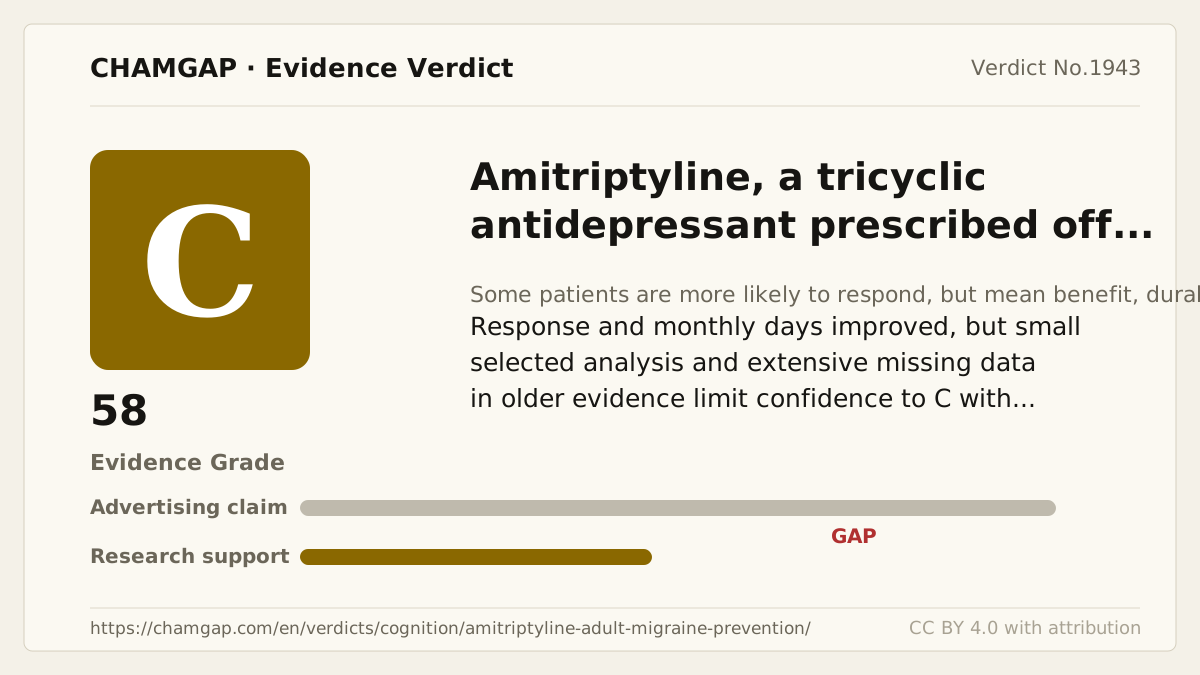
research showsThe grade is C. A 2023 reappraisal pooled three RCTs with 389 participants and found at least 50% response RR 1.60 (95% CI 1.17 to 2.19), an absolute increase of 16.5 points; one 118-person comparison reduced monthly migraine days by 1.2 (0.3 to 2.1) more than placebo. But the pivotal modern trial randomized only 196 and analyzed 178 who took medication and had follow-up, while an older large trial lost its effect after week eight, giving C with 54 points.
ads claimMarketing should not promise at least two fewer days per month. The modern placebo-adjusted mean was about 1.1 to 1.2 days, and the larger older trial did not sustain separation beyond week eight. A higher chance of 50% response for some patients remains supported.
Useful facts when choosing a product
- The IHS at-least-50% reduction recommendation is a somewhat arbitrary individual-responder definition, not a between-group minimal important difference.
- The Gonçalves direct analysis was 59 versus 59 and the between-group monthly migraine-day difference was -1.2 days.
- Couch found superiority at week 8 but not significant superiority at later time points.
Chamgap Semantic Classification Code
Candidate index · review held
UNK.amitriptyline.UNK.monthly-migraine-days-and-increased-50-percent-response.reduce.MULTIUnknown > Amitriptyline > Unknown > monthly migraine days and increased 50% response > Reduction claim > Multiple: primary unresolved
An automated migration candidate, not an issued permanent code; exact claim scope remains under review. This machine-generated migration candidate helps retrieval but is not a permanent assignment. The original verdict ID and URL remain authoritative.
What the research actually shows
Gonçalves 2016 randomized 196 and analyzed 178. The direct amitriptyline-placebo analysis included 59 versus 59; monthly migraine days fell by 2.2 versus 1.1, with reanalyzed between-group MD -1.2 days (95% CI -2.1 to -0.3). FAPESP and other public sources supported the trial. Pooled 50% response across three trials and 389 participants was RR 1.60 (95% CI 1.17 to 2.19), I-squared 0%, an absolute difference of about 16.5 percentage points. Couch enrolled 391 and randomized 338; follow-up availability fell from 317 at week 8 to 186 at week 20, and week-8 superiority was not significant later. Some older trials had Merck support, but exact funding for each older trial could not be confirmed.
Why this is classified as C (54)
Pooled response was positive, but post-randomization selection in the small modern trial and extensive missing data in the older large trial give C with 54 points.
Counterpoint. The mean monthly difference was about 1.2 days, and the largest trial did not sustain separation from weeks 12 to 20.
Rejudgment record. Cross-check applied — Positive pooled 50% response with post-randomization selection in a trial under 200 and extensive missing data in the older large trial
| Endpoint | P | Symptom or function itself is the target - including patient reports and performance tests |
| Replication | R2 | Independently replicated across trials |
| Independence | I1 | Mixed funding sources |
| Effect size | E+ | Meets the clinically important threshold |
Stored derived and displayed grades match; this is not a current recalculation or validity check (C).
Sub-claim grades by effect
This ingredient is marketed for several effects. A single overall grade blends strong and weak claims together, so each effect is graded separately here. The overall grade reflects the strongest disconfirming or core claim.
| Effect (sub-claim) | Grade | Basis |
|---|---|---|
| Increased chance of at least 50% migraine response | C | The three-trial pooled RR was 1.60, but trials with substantial missing-data risk contributed. |
| Reduced monthly migraine days | C | One modern trial found about 1.2 fewer days than placebo. |
| Preventive benefit sustained through 20 weeks | D | The largest older trial found no placebo separation at weeks 12, 16, or 20. |
Cross-check — AI research and Codex final gate
Evidence Table
| Study | Design | Sample | Funding | Endpoint | Result | Weight |
|---|---|---|---|---|---|---|
| Gonçalves et al. 2016 | Three-arm double-blind placebo- and active-controlled 12-week randomized trial | 196 randomized, 178 took medication and had follow-up; 59 amitriptyline and 59 placebo participants in efficacy analysis | Public funding from the São Paulo Research Foundation, FAPESP | Primary change in monthly migraine days | Minus 2.2 versus minus 1.1 days, about 1.1 days between groups; reappraisal MD -1.2 (-2.1 to -0.3) | Modern direct placebo-controlled evidence |
| Lampl et al. 2023 EHF reappraisal | Systematic review and meta-analysis of adult placebo-controlled RCTs | Three trials and 389 participants for 50% response; one trial and 118 for monthly days | Academic EHF synthesis; included trials comprised two Merck-related and one FAPESP-funded study | At least 50% response and monthly migraine days | Response RR 1.60 (1.17 to 2.19), absolute +16.5 points, I-squared 0%; monthly days MD -1.2 (-2.1 to -0.3) | Key synthesis assessing both replication and missing-data risk |
Receipt — 3 References
All 3 cited sources were verified for existence at the original page (as of 2026-08-02).
Final verification and publication gate: Codex · Evidence date: 2026-08-02 · Corrections: none
Cite this verdict
[Chamgap] Amitriptyline x adult migraine prevention — Evidence Grade C·54. 3 cited sources checked. Source: https://chamgap.com/en/verdicts/cognition/amitriptyline-adult-migraine-prevention/ · CC BY 4.0CC BY 4.0 — free to use with attribution; do not distort grades, numbers, or verdict meaning.
What this document does and does not do
Chamgap is an information source. It reports what research has and has not confirmed; it does not tell readers what to take or buy. That decision belongs to readers and, when needed, medical or legal professionals. This verdict reflects literature available up to the search date and may change as new research appears. Nothing here is medical advice.