
Alteplase,
does it really help with Reduced 90-day disability and dependence in eligible patients with acute ischemic stroke?
research showsAlteplase is rated A because repeated direct evidence shows that intravenous treatment as early as possible reduces 90-day disability and dependence in eligible acute ischemic stroke patients. Multiple randomized trials, including NINDS and ECASS III, and an individual-patient meta-analysis of 6,756 participants from nine trials confirm functional benefit and strong time dependence. This is a patient-centered modified Rankin outcome rather than a surrogate such as recanalization. Symptomatic and fatal intracranial hemorrhage nevertheless increase, so emergency imaging, time-window assessment, disabling-deficit evaluation, blood-pressure and bleeding-risk checks, and thrombectomy assessment are essential.
ads claimThe phrase stroke injection can imply automatic suitability for every stroke. Alteplase must not be used for hemorrhagic stroke, and ischemic stroke treatment still requires assessment of onset time, imaging, disabling deficit, contraindications, and the thrombectomy pathway.
Useful facts when choosing a product
- A common standard intravenous dose for acute ischemic stroke is 0.9 mg/kg up to 90 mg, with 10% given as a bolus and the remainder infused over 60 minutes. Local labeling and hospital protocols take priority.
- Noncontrast CT or MRI must exclude intracranial hemorrhage, while last-known-well time, blood pressure, glucose, anticoagulant exposure, and major bleeding contraindications are checked rapidly.
- Benefit declines minute by minute, so eligible patients should be treated as early as possible without delaying evaluation for thrombectomy in large-vessel occlusion.
- Blood pressure and neurologic status require close monitoring after treatment; abrupt headache, vomiting, hypertension, or neurologic worsening calls for immediate hemorrhage evaluation.
Chamgap Semantic Classification Code
Candidate index · review held
M.alteplase.intravenous.disability-and-dependence-in-eligible-patients-with-acute-ischemic-stroke.reduce.placeboMedicinal interventions > Alteplase > Intravenous > disability and dependence in eligible patients with acute ischemic stroke > Reduction claim > Placebo
An automated migration candidate, not an issued permanent code; exact claim scope remains under review. This machine-generated migration candidate helps retrieval but is not a permanent assignment. The original verdict ID and URL remain authoritative.
What the research actually shows
The two-part NINDS program enrolled 624 participants. It did not improve the prespecified 24-hour neurologic endpoint, but it increased favorable outcomes across four clinical scales at three months. ECASS III enrolled 821 participants treated at three to 4.5 hours; mRS 0 to 1 occurred in 52.4% versus 45.2% (OR 1.34), while symptomatic intracranial hemorrhage occurred in 2.4% versus 0.2%. The 2014 Emberson analysis pooled 6,756 participants from nine trials, showing that the chance of mRS 0 to 1 at three to six months fell with treatment delay and that fatal intracranial hemorrhage within seven days increased.
Why this is classified as A (86)
Repeated trials including NINDS and ECASS III, plus a 6,756-participant individual-patient meta-analysis, confirmed improvement in direct 90-day or three-to-six-month functional outcomes. Time window and eligibility strongly modify effect, but properly selected early treatment has strong replicated evidence, giving A with 86 points. Symptomatic intracranial hemorrhage is a separate central safety hazard.
Counterpoint. Being outside the conventional window does not automatically preclude all treatment; some patients can be selected for an extended window by advanced imaging showing salvageable tissue. That is a distinct selection strategy from the standard early-window evidence.
Rejudgment record. New verdict — Rated the repeated improvement in direct 90-day or three-to-six-month functional outcomes across NINDS, ECASS III, and an individual-patient meta-analysis of 6,756 participants from nine randomized trials, while handling time-window eligibility and hemorrhage separately
Sub-claim grades by effect
This ingredient is marketed for several effects. A single overall grade blends strong and weak claims together, so each effect is graded separately here. The overall grade reflects the strongest disconfirming or core claim.
| Effect (sub-claim) | Grade | Basis |
|---|---|---|
| Reduced 90-day disability and dependence with early treatment of eligible acute ischemic stroke | A | Direct functional outcomes were repeatedly positive across multiple randomized trials and a 6,756-participant individual-patient meta-analysis. |
| Universal benefit regardless of onset time, imaging, or eligibility criteria | D | Effect strongly depends on time and selection, and benefit has not been demonstrated in groups such as minor nondisabling deficits. |
| Functional benefit from unselected treatment beyond the conventional 4.5-hour window | D | Extended-window benefit is limited to separately selected populations, such as those chosen by perfusion imaging, and cannot be generalized to unselected treatment. |
Cross-check — AI research and Codex final gate
Evidence Table
| Study | Design | Sample | Funding | Endpoint | Result | Weight |
|---|---|---|---|---|---|---|
| NINDS rt-PA Stroke Study Group 1995 | Two-part multicenter randomized double-blind placebo-controlled trial | 624 patients with acute ischemic stroke; within three hours | Public support from the United States NINDS | Neurologic improvement at 24 hours and four clinical functional scales at three months | The 24-hour primary endpoint was neutral, but odds of minimal or no disability at three months consistently increased, with more symptomatic intracranial hemorrhage. | Foundational pivotal evidence on direct functional outcomes |
| Hacke W et al. ECASS III 2008 | Multicenter randomized double-blind placebo-controlled phase 3 trial | 821 participants; three to 4.5 hours after onset | Supported by Boehringer Ingelheim | mRS 0 to 1 at 90 days | Favorable functional outcome was 52.4% versus 45.2%, OR 1.34 (95% CI 1.02 to 1.76); symptomatic intracranial hemorrhage was 2.4% versus 0.2%. | Replicated evidence in the extended conventional window |
| Emberson J et al. 2014 | Prespecified individual-patient-data meta-analysis of randomized trials | 6,756 participants in nine phase 3 trials | Academic collaborative; mixed public and industry funding across source trials | mRS 0 to 1 at three to six months, intracranial hemorrhage, and mortality | Functional benefit was larger with earlier treatment and persisted across age and severity, while early fatal intracranial hemorrhage increased. | Key large synthesis of replication and time effect |
Receipt — 3 References
All 3 cited sources were verified for existence at the original page (as of 2026-07-20).
Final verification and publication gate: Codex · Evidence date: 2026-07-20 · Corrections: none
Cite this verdict
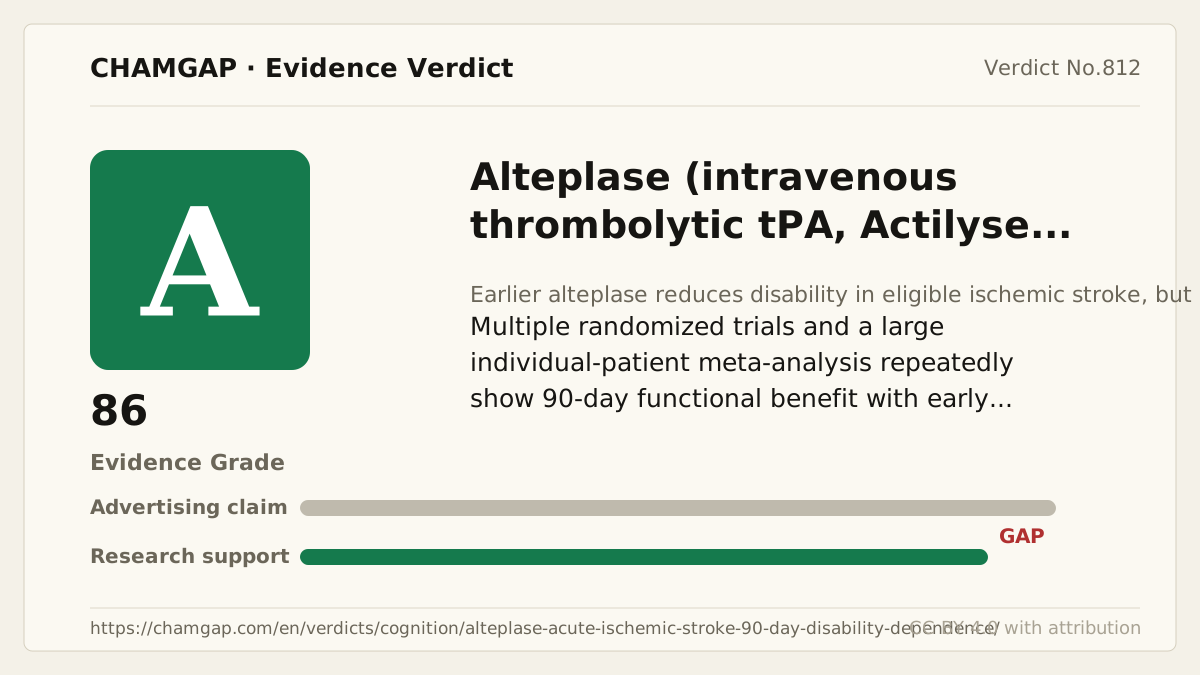
[Chamgap] Alteplase x reduced 90-day disability and dependence after acute ischemic stroke — Evidence Grade A·86. 3 cited sources checked. Source: https://chamgap.com/en/verdicts/cognition/alteplase-acute-ischemic-stroke-90-day-disability-dependence/ · CC BY 4.0CC BY 4.0 — free to use with attribution; do not distort grades, numbers, or verdict meaning.
What this document does and does not do
Chamgap is an information source. It reports what research has and has not confirmed; it does not tell readers what to take or buy. That decision belongs to readers and, when needed, medical or legal professionals. This verdict reflects literature available up to the search date and may change as new research appears. Nothing here is medical advice.