
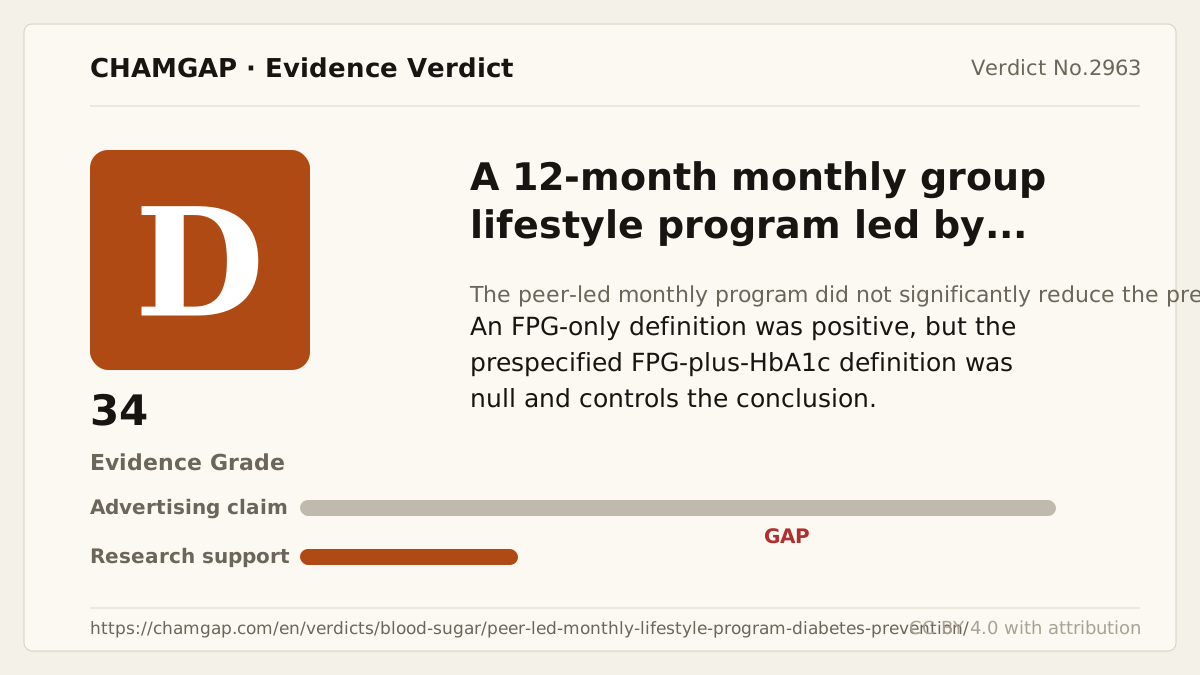
A 12-month monthly group lifestyle program led by trained community peers,
does it really help with Reduced nine-year diabetes incidence in high-risk community residents?
research showsGrade D. The prespecified primary outcome, cumulative diabetes incidence at nine years, was 125/419 (30%) with intervention versus 142/422 (34%) with control, RR 0.88 (95% CI 0.73-1.08), P=.24.
ads claimThis is evidence about a low-cost monthly peer-led program. It does not show that expert-led intensive diet, exercise, and behavioral programs are ineffective.
Useful facts when choosing a product
- Trained community peers delivered monthly group sessions.
- The prespecified nine-year definition combined FPG, HbA1c, physician diagnosis, and medication initiation.
- The positive FPG-only definition does not replace the primary conclusion.
Chamgap Semantic Classification Code
Candidate index · review held
X.group-lifestyle-program-led-by-trained-community-peers.behavioral.diabetes-incidence-in-high-risk-community-residents.reduce.noneBehaviors, exposures and policies > group lifestyle program led by trained community peers > Behavioral delivery > diabetes incidence in high-risk community residents > Reduction claim > No intervention
An automated migration candidate, not an issued permanent code; exact claim scope remains under review. This machine-generated migration candidate helps retrieval but is not a permanent assignment. The original verdict ID and URL remain authoritative.
What the research actually shows
Sixty polling areas in Kerala, India, were cluster randomized. Among 1,007 adults aged 30-60 with IDRS at least 60 and no diabetes, 500 received monthly peer-led sessions for 12 months and 507 received an education booklet. Nine-year data were analyzed for 841, 419/422. Loss to follow-up was 144/1,007 (14.3%), below 15%. The prespecified primary definition combined FPG at least 126 mg/dL or HbA1c at least 6.5% and included physician diagnosis or starting glucose-lowering medication. At 24 months, the same trial found 68/456 (14.9%) versus 79/463 (17.1%), RR 0.88 (95% CI 0.66-1.16), P=.36. The nine-year abstract reported no separate safety counts, while the 24-month report stated no intervention-related adverse events. The Australian National Health and Medical Research Council funded the study, and no commercial product was used.
Why this is classified as D (34)
This publicly funded hard-outcome cluster trial had a null prespecified nine-year primary result and used available cases, giving D with 34 points.
Counterpoint. Prevention with expert-led intensive programs is supported separately.
Rejudgment record. Cross-check applied — Null prespecified composite diabetes definition at nine years, a same-direction null 24-month result, and available-case analysis
| Endpoint | H | Hard endpoint - actual events such as death |
| Replication | R1 | Single confirmatory trial |
| Independence | I2 | Decisive evidence is publicly or non-profit funded |
| Effect size | E0 | Null |
| Precision | C0 | The confidence interval leaves room for benefit |
Stored derived and displayed grades match; this is not a current recalculation or validity check (D).
Sub-claim grades by effect
This ingredient is marketed for several effects. A single overall grade blends strong and weak claims together, so each effect is graded separately here. The overall grade reflects the strongest disconfirming or core claim.
| Effect (sub-claim) | Grade | Basis |
|---|---|---|
| Reduced diabetes incidence by the prespecified nine-year definition | D | RR was 0.88, P=.24, a null result. |
| Reduced incidence by FPG alone | C | RR was 0.72, P=.036, but this was not the prespecified primary definition. |
Cross-check — AI research and Codex final gate
Evidence Table
| Study | Design | Sample | Funding | Endpoint | Result | Weight |
|---|---|---|---|---|---|---|
| Jeemon P et al. 2026 K-DPP nine-year follow-up | Long-term follow-up of a 60-cluster randomized controlled trial | 1,007 randomized, 500/507; 841 in the primary result, 419/422 | Australian National Health and Medical Research Council | Cumulative diabetes incidence at nine years | 125/419 (30%) vs 142/422 (34%), RR 0.88 (95% CI 0.73-1.08), P=.24 | Pivotal long-term hard-outcome evidence |
Receipt — 2 References
All 2 cited sources were verified for existence at the original page (as of 2026-08-26).
Final verification and publication gate: Codex · Evidence date: 2026-08-26 · Corrections: none
Cite this verdict
[Chamgap] No Benefit of a Peer-Led Monthly Lifestyle Program for Nine-Year Diabetes Incidence — Evidence Grade D·34. 2 cited sources checked. Source: https://chamgap.com/en/verdicts/blood-sugar/peer-led-monthly-lifestyle-program-diabetes-prevention/ · CC BY 4.0CC BY 4.0 — free to use with attribution; do not distort grades, numbers, or verdict meaning.
What this document does and does not do
Chamgap is an information source. It reports what research has and has not confirmed; it does not tell readers what to take or buy. That decision belongs to readers and, when needed, medical or legal professionals. This verdict reflects literature available up to the search date and may change as new research appears. Nothing here is medical advice.