
Canagliflozin,
does it really help with Reduced end-stage kidney disease, doubling of creatinine, and kidney or cardiovascular death in albuminuric type 2 diabetic chronic kidney disease?
research showsCanagliflozin is rated A because it reduces kidney failure and kidney and cardiovascular events in albuminuric type 2 diabetic chronic kidney disease. CREDENCE randomized 4,401 participants receiving renin-angiotensin system blockade with an eGFR of 30 to less than 90 and a urinary albumin-to-creatinine ratio above 300 to 5,000 mg/g. The composite of end-stage kidney disease, doubling of creatinine, or kidney or cardiovascular death fell with a hazard ratio of 0.70 (95% CI 0.59 to 0.82, P=.00001). The kidney-specific composite hazard ratio was 0.66, end-stage kidney disease 0.68, and heart-failure hospitalization 0.61; the trial stopped early for efficacy at a planned interim analysis. A prespecified exploratory kidney analysis of 10,142 CANVAS participants had already shown a hazard ratio of 0.53 for doubling of creatinine, end-stage kidney disease, or kidney death. Direct hard outcomes, a large dedicated trial, and consistency across the program and class support A with 88 points.
ads claimPromotion may imply that lower glucose restores kidney function or prevents dialysis in every form of CKD. The evidence concerns reduced event risk in patients with moderate-to-severe albuminuric type 2 diabetic CKD receiving renin-angiotensin system blockade; it does not mean that already lost kidney function returns to normal.
Useful facts when choosing a product
- Canagliflozin is an oral prescription drug that inhibits proximal-tubule SGLT2 and increases urinary glucose and sodium excretion. Its kidney-protective effect is not explained solely by lowering glycated hemoglobin.
- CREDENCE added canagliflozin 100 mg once daily to standard renin-angiotensin system blockade. Current eGFR, volume status, concomitant diuretics, and the product label should guide prescribing.
- A small early dip in eGFR can occur after initiation, while the long-term slope was protective. A large acute decline, dehydration, hypotension, or acute illness requires evaluation for other causes rather than automatic continuation or discontinuation.
- Treatment should be held around surgery, prolonged fasting, or severe acute illness according to clinical instructions because of euglycemic ketoacidosis risk. Patients should be educated about genital infection and ketoacidosis symptoms and should inspect foot and lower-limb wounds.
Chamgap Semantic Classification Code
Candidate index · review held
M.canagliflozin.UNK.end-stage-kidney-disease-doubling-of-creatinine-and-kidney-or-cardiovascular-death-in-albuminuric-type-2-diabetic-chronic-kidney-disease.reduce.placeboMedicinal interventions > Canagliflozin > Unknown > end-stage kidney disease, doubling of creatinine, and kidney or cardiovascular death in albuminuric type 2 diabetic chronic kidney disease > Reduction claim > Placebo
An automated migration candidate, not an issued permanent code; exact claim scope remains under review. This machine-generated migration candidate helps retrieval but is not a permanent assignment. The original verdict ID and URL remain authoritative.
What the research actually shows
CREDENCE assigned 4,401 participants with type 2 diabetes, eGFR 30 to less than 90 mL/min/1.73 m², urinary albumin-to-creatinine ratio above 300 to 5,000 mg/g, and stable renin-angiotensin system blockade to canagliflozin 100 mg/day or placebo. At a median 2.62 years, primary-composite event rates were 43.2 versus 61.2 per 1,000 patient-years, hazard ratio 0.70. Hazard ratios were 0.66 for the kidney-specific composite, 0.68 for end-stage kidney disease, 0.80 for cardiovascular death, myocardial infarction, or stroke, and 0.61 for heart-failure hospitalization. Amputation and fracture did not differ significantly in CREDENCE. The preceding prespecified exploratory CANVAS Program analysis in 10,142 participants found a hazard ratio of 0.53 for doubling of creatinine, end-stage kidney disease, or kidney death and a slower eGFR decline, but CANVAS was not a dedicated kidney-outcome trial and multiplicity did not permit confirmatory interpretation. CREDENCE then confirmed that signal in a dedicated hard-outcome trial.
Why this is classified as A (88)
CREDENCE provides a direct hard primary-outcome hazard ratio of 0.70 in 4,401 participants, a kidney-specific hazard ratio of 0.66, an end-stage kidney disease hazard ratio of 0.68, and a heart-failure hospitalization hazard ratio of 0.61, consistent with preceding CANVAS kidney findings. The population, intervention, and outcomes directly match albuminuric type 2 diabetic CKD, and the manufacturer ceiling does not apply to a large prescription-drug hard-outcome trial. Janssen sponsorship and early stopping for efficacy are reflected in A with 88 points. Infections, ketoacidosis, volume depletion, and discussion of the CANVAS amputation signal remain separate safety issues.
Counterpoint. Absolute benefit varies with baseline kidney risk and albuminuria. Kidney and cardiovascular protection can be relevant even when glycemia is controlled, but canagliflozin does not replace renin-angiotensin system blockade, blood-pressure management, smoking cessation, or other standard CKD care.
Rejudgment record. New verdict — Applied A based on the CREDENCE primary composite hazard ratio of 0.70 for end-stage kidney disease, doubling of creatinine, or kidney or cardiovascular death in 4,401 participants, kidney-specific hazard ratio of 0.66, end-stage kidney disease hazard ratio of 0.68, and consistency with the preceding CANVAS kidney signal
Sub-claim grades by effect
This ingredient is marketed for several effects. A single overall grade blends strong and weak claims together, so each effect is graded separately here. The overall grade reflects the strongest disconfirming or core claim.
| Effect (sub-claim) | Grade | Basis |
|---|---|---|
| Reduced composite of end-stage kidney disease, doubling of creatinine, or kidney or cardiovascular death | A | CREDENCE directly reduced this hard outcome in 4,401 participants with a hazard ratio of 0.70 (95% CI 0.59-0.82). |
| Reduced end-stage kidney disease | A | The hazard ratio for end-stage kidney disease in CREDENCE was 0.68 (95% CI 0.54-0.86). |
| Reduced hospitalization for heart failure | A | A prespecified hierarchically tested secondary outcome directly showed fewer hospitalizations, hazard ratio 0.61 (95% CI 0.47-0.80). |
Cross-check — AI research and Codex final gate
Evidence Table
| Study | Design | Sample | Funding | Endpoint | Result | Weight |
|---|---|---|---|---|---|---|
| Perkovic V et al.; CREDENCE Trial Investigators. 2019 | Multinational randomized double-blind placebo-controlled event-driven kidney outcome trial | 4,401 participants with albuminuric type 2 diabetic chronic kidney disease | Sponsored by Janssen Research and Development with employee coauthors | Composite of end-stage kidney disease, doubling of serum creatinine, or kidney or cardiovascular death | The primary-outcome hazard ratio was 0.70 (95% CI 0.59-0.82, P=.00001), kidney-specific composite 0.66, and end-stage kidney disease 0.68; the trial stopped early for efficacy. | Pivotal large randomized trial with direct kidney and cardiovascular hard outcomes |
| Perkovic V et al. 2018 CANVAS Program kidney analysis | Prespecified exploratory kidney analysis of two randomized placebo-controlled cardiovascular trials | 10,142 participants with type 2 diabetes at high cardiovascular risk | Sponsored by Janssen Research and Development with employee coauthors | Composite of doubling of creatinine, end-stage kidney disease, or kidney death and eGFR slope | The kidney-composite hazard ratio was 0.53 (95% CI 0.33-0.84) with a slower eGFR decline, but multiplicity made the result exploratory. | Consistent kidney signal preceding CREDENCE |
| Jardine MJ et al.; CREDENCE Study Investigators. 2020 | Prespecified CREDENCE secondary analysis across eGFR subgroups | 4,401 participants; 1,313 with eGFR 30 to <45, 1,279 with 45 to <60, and 1,809 with 60 to <90 | Janssen Research and Development | Kidney and cardiovascular efficacy and safety by baseline eGFR | Relative effects were consistent across eGFR subgroups, with larger absolute kidney benefits at lower eGFR. | Supports consistency across the studied kidney-function range |
Receipt — 3 References
All 3 cited sources were verified for existence at the original page (as of 2026-07-22).
Final verification and publication gate: Codex · Evidence date: 2026-07-22 · Corrections: none
Cite this verdict
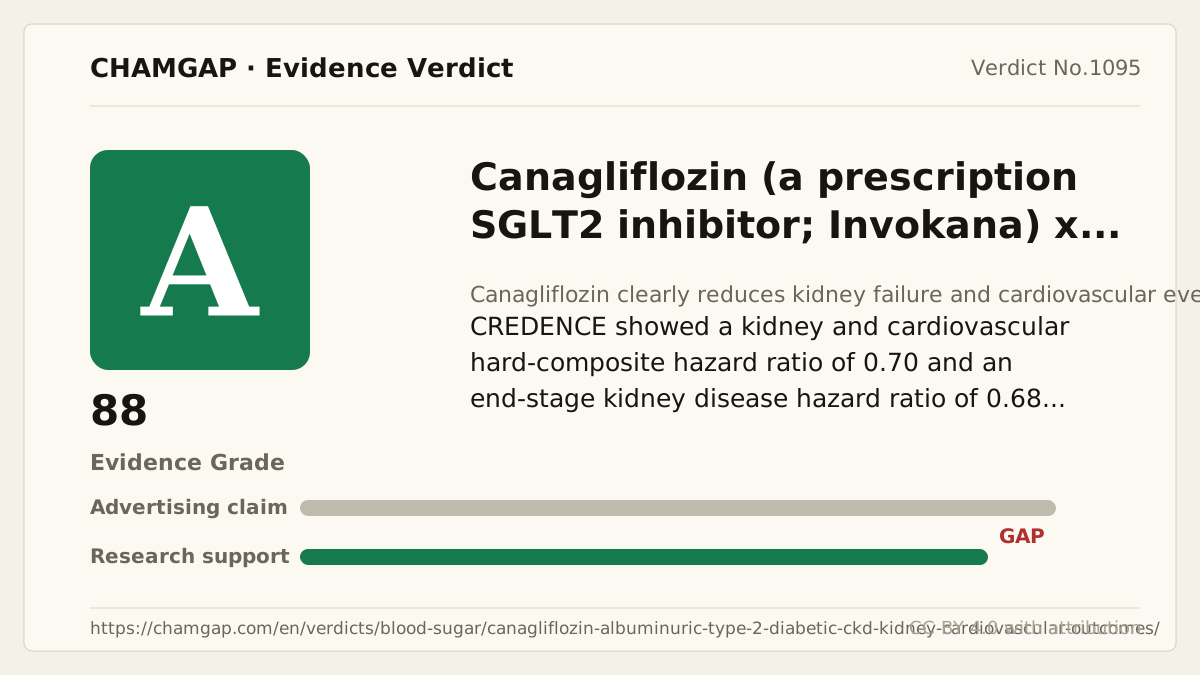
[Chamgap] Canagliflozin x reduced kidney and cardiovascular events in albuminuric type 2 diabetic chronic kidney disease — Evidence Grade A·88. 3 cited sources checked. Source: https://chamgap.com/en/verdicts/blood-sugar/canagliflozin-albuminuric-type-2-diabetic-ckd-kidney-cardiovascular-outcomes/ · CC BY 4.0CC BY 4.0 — free to use with attribution; do not distort grades, numbers, or verdict meaning.
What this document does and does not do
Chamgap is an information source. It reports what research has and has not confirmed; it does not tell readers what to take or buy. That decision belongs to readers and, when needed, medical or legal professionals. This verdict reflects literature available up to the search date and may change as new research appears. Nothing here is medical advice.