
Ground dried bay leaf,
does it really help with Lower fasting glucose in people with type 2 diabetes?
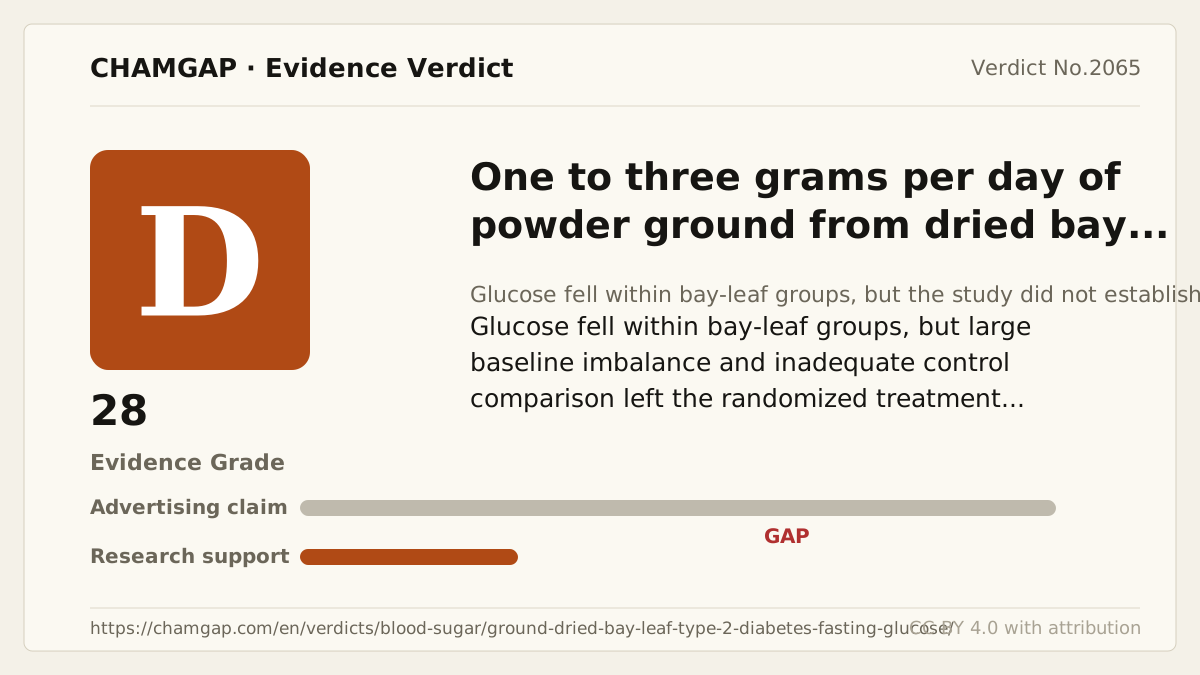
research showsThe grade is D with 28 points. In a 30-day trial splitting 40 people with type 2 diabetes into four groups, fasting glucose fell within bay-leaf groups. The paper did not provide an appropriate treatment-versus-control contrast or confidence interval, and a simple endpoint comparison for the 1-g group was only 8.9 versus 9.3 mmol/L with wide uncertainty. Within-group change alone does not establish efficacy.
ads claimSwallowing 1-3 g of dried-leaf powder is factual; lowering glucose versus control is a separate claim. Verdict 093 is B with 66 points for cinnamon and glucose; this verdict concerns a different plant, bay leaf, and one small trial.
Useful facts when choosing a product
- The study used whole dried Laurus nobilis leaves finely ground into 500-mg capsules, not an extract or oil.
- Using the USDA value of about 0.6 g per teaspoon of crumbled bay leaf, 1-3 g is about 1.7-5 teaspoons, 0.56-1.67 tablespoons, or roughly 13-40 pinches if a pinch is defined as 1/8 teaspoon. A pinch is not standardized.
- Cooks usually remove leaves after flavoring food, whereas participants swallowed a large amount of powder in capsules.
Chamgap Semantic Classification Code
Candidate index · review held
S.one-to-three-grams-of-powder-ground-from-dried-bay-leaves.UNK.fasting-glucose-with-type-2-diabetes.reduce.placeboSupplements and nutraceuticals > One to three grams of powder ground from dried bay leaves > Unknown > fasting glucose with type 2 diabetes > Reduction claim > Placebo
An automated migration candidate, not an issued permanent code; exact claim scope remains under review. This machine-generated migration candidate helps retrieval but is not a permanent assignment. The original verdict ID and URL remain authoritative.
What the research actually shows
Forty people with type 2 diabetes were assigned ten each to 1, 2, or 3 g ground bay leaf or corn-flour control for 30 days followed by ten days off treatment. Results for all 40 appeared in tables and diabetes medicines continued. Blinding and allocation were insufficiently described. No trial registration was identified within the checked sources, and the prespecified primary outcome, research funding source, and conflict-of-interest information could not be confirmed. Sample size relied on an earlier cinnamon study.
Why this is classified as D (28)
Positive within-group changes did not establish a control-group effect, and ten per group, 30 days, baseline imbalance, and unclear blinding give D with 28 points.
Counterpoint. D is not a precise refutation of glucose lowering. A trial with baseline adjustment and between-group confidence intervals is needed.
Rejudgment record. Cross-check applied — The original table's baseline and day-30 means and standard deviations, significance markers, statistical methods, dose, analyzed population, continued medicines, and the existing cinnamon verdict were cross-checked
| Endpoint | S | Surrogate marker - laboratory or imaging measures |
| Replication | R1 | Single confirmatory trial |
| Independence | I1 | Mixed funding sources |
| Effect size | E0 | Null |
| Precision | C0 | The confidence interval leaves room for benefit |
Stored derived and displayed grades match; this is not a current recalculation or validity check (D).
Sub-claim grades by effect
This ingredient is marketed for several effects. A single overall grade blends strong and weak claims together, so each effect is graded separately here. The overall grade reflects the strongest disconfirming or core claim.
| Effect (sub-claim) | Grade | Basis |
|---|---|---|
| Fasting glucose fell from baseline within bay-leaf groups | C | Observed within groups, but it is not controlled efficacy. |
| Bay leaf lowers fasting glucose versus control | D | No proper treatment contrast or confidence interval was reported, and the simple endpoint difference was small. |
Cross-check — AI research and Codex final gate
Evidence Table
| Study | Design | Sample | Funding | Endpoint | Result | Weight |
|---|---|---|---|---|---|---|
| Khan A et al. 2009 | Four-arm placebo-controlled parallel trial described as randomized | 40 participants, ten per group; all reported in tables | Research funding source not identified in the article | Fasting glucose at 30 days | The 1-g group changed from 12.0 +/- 3.6 to 8.9 +/- 2.6 versus control 9.7 +/- 4.1 to 9.3 +/- 3.9 mmol/L; markers were within-group time comparisons and no between-group CI was reported | Direct whole-spice trial limited by tiny groups, short duration, baseline imbalance, and absent treatment contrast |
Receipt — 2 References
All 2 cited sources were verified for existence at the original page (as of 2026-08-03).
Final verification and publication gate: Codex · Evidence date: 2026-08-03 · Corrections: none
Cite this verdict
[Chamgap] Ground dried bay leaf x lower fasting glucose in type 2 diabetes — Evidence Grade D·28. 2 cited sources checked. Source: https://chamgap.com/en/verdicts/blood-sugar/ground-dried-bay-leaf-type-2-diabetes-fasting-glucose/ · CC BY 4.0CC BY 4.0 — free to use with attribution; do not distort grades, numbers, or verdict meaning.
What this document does and does not do
Chamgap is an information source. It reports what research has and has not confirmed; it does not tell readers what to take or buy. That decision belongs to readers and, when needed, medical or legal professionals. This verdict reflects literature available up to the search date and may change as new research appears. Nothing here is medical advice.