
Whole date fruit, 100 g,
does it really help with Reduced bleeding during 24 hours after vaginal delivery?
research showsThe verdict is C with 54 points. In a 98-person randomized trial after vaginal delivery, women given 100 g of whole dates two hours postpartum had lower 24-hour bleeding scores. Prospective registration, a matching primary outcome, and a between-group confidence interval are uncommon strengths in this batch, but it remains one small unblinded study.
ads claimFamiliar claims about jujube for women can blur distinct species. The tested food was whole Phoenix dactylifera date fruit, not Korean jujube, and it cannot replace hospital postpartum observation or standard treatment.
Useful facts when choosing a product
- The intervention was 100 g of whole Mazafati Bam Phoenix dactylifera fruit taken once, two hours after delivery.
- Date palm fruit and Korean jujube, Ziziphus jujuba, are different species. Verdict 293 is ? and concerns wild-jujube seed, another different material.
- A PBLAC score of 100 was originally a screening threshold for menstrual blood loss above 80 mL. It is not a linear conversion from score to milliliters and was not validated as a severity threshold for postpartum bleeding.
- Menstrual screening validity cannot simply be transferred to postpartum lochia and pad use; the paper also acknowledges the limitation of self-reported measurement.
Chamgap Semantic Classification Code
Candidate index · review held
F.whole-date-fruit.food.bleeding-during-after-vaginal-delivery.reduce.UNKFoods and beverages > Whole date fruit > Food consumption > bleeding during after vaginal delivery > Reduction claim > Unknown
An automated migration candidate, not an issued permanent code; exact claim scope remains under review. This machine-generated migration candidate helps retrieval but is not a permanent assignment. The original verdict ID and URL remain authoritative.
What the research actually shows
Niknami and colleagues compared 100 g of whole Mazafati Bam dates two hours after delivery with no-date control. They used sequentially numbered opaque envelopes, modified intention-to-treat analysis, and an exact nonparametric confidence interval. The Research and Technology Vice-Chancellor of Guilan University of Medical Sciences funded the study; there was no grower or seller funding and the authors declared no competing interests.
Why this is classified as C (54)
The trial measured clinically important postpartum bleeding with a prospectively registered matching primary outcome, but the converted effect was below the conventional medium threshold. One small unblinded trial using an indirect score of uncertain postpartum validity yields C with 54 points.
Counterpoint. This was the only trial in the batch to report a between-group confidence interval and it also had public funding, allocation concealment, and modified intention-to-treat analysis.
Rejudgment record. Cross-check applied — Verified analyzed sample, between-group estimate, confidence interval, and effect size in the article and cross-checked prospective IRCT registration, primary-outcome agreement, and public funding
| Endpoint | H | Hard endpoint - actual events such as death |
| Replication | R1 | Single confirmatory trial |
| Independence | I2 | Decisive evidence is publicly or non-profit funded |
| Effect size | E~ | Statistically positive but below the threshold |
Stored derived and displayed grades match; this is not a current recalculation or validity check (C).
Sub-claim grades by effect
This ingredient is marketed for several effects. A single overall grade blends strong and weak claims together, so each effect is graded separately here. The overall grade reflects the strongest disconfirming or core claim.
| Effect (sub-claim) | Grade | Basis |
|---|---|---|
| One hundred grams of whole date fruit reduces 24-hour postpartum bleeding | C | One prospectively registered trial was positive, but it was unblinded, indirect, and unreplicated. |
Cross-check — AI research and Codex final gate
Evidence Table
| Study | Design | Sample | Funding | Endpoint | Result | Weight |
|---|---|---|---|---|---|---|
| Niknami M et al., BMC Women's Health, 2023 | Unblinded randomized controlled trial with prospective registration | 98 randomized; modified intention-to-treat 93, 48 versus 45 | Research and Technology Vice-Chancellor of Guilan University of Medical Sciences | Primary 24-hour postpartum PBLAC bleeding score | Medians 35.0 versus 39.0; Hodges–Lehmann 9.0 points lower, 95% CI 2.0 to 18.0, P=0.009 | Prospective registration, matching primary outcome, between-group CI, and public funding are strengths; one small unblinded indirect assessment |
Receipt — 2 References
All 2 cited sources were verified for existence at the original page (as of 2026-08-02).
Final verification and publication gate: Codex · Evidence date: 2026-08-02 · Corrections: none
Cite this verdict
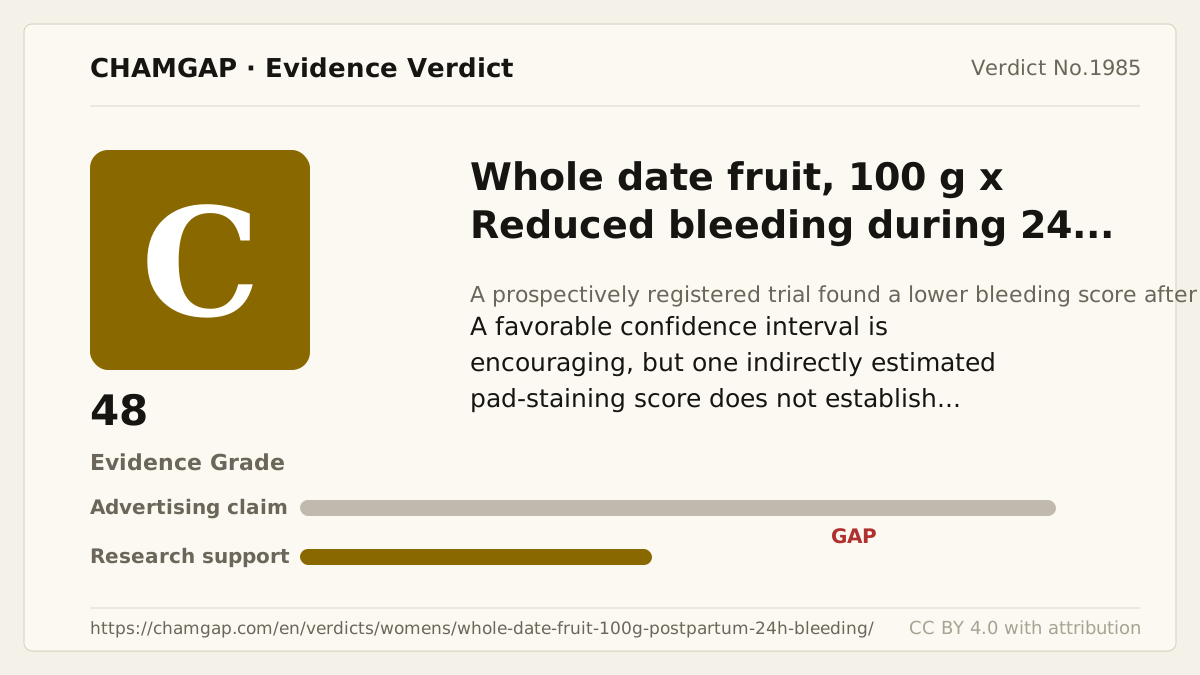
[Chamgap] Whole date fruit, 100 g x 24-hour postpartum bleeding — Evidence Grade C·54. 2 cited sources checked. Source: https://chamgap.com/en/verdicts/womens/whole-date-fruit-100g-postpartum-24h-bleeding/ · CC BY 4.0CC BY 4.0 — free to use with attribution; do not distort grades, numbers, or verdict meaning.
What this document does and does not do
Chamgap is an information source. It reports what research has and has not confirmed; it does not tell readers what to take or buy. That decision belongs to readers and, when needed, medical or legal professionals. This verdict reflects literature available up to the search date and may change as new research appears. Nothing here is medical advice.