
Oral vitamin B6-only tablets,
does it really help with Reduction of overall symptom severity in diagnosed PMS?
research showsThere is a signal of improvement, but a reliable treatment benefit is not established. Overall symptom scores favored B6 in placebo-controlled trials using prospective PMS records, but older instruments, missing analysis details and conflicting dose/sample descriptions limit the current evidence to C, 50 points. This is not a verdict on pregnancy nausea or PMDD. [S02][S03]
ads claimThe 9 trials and 940 participants in the 1999 review do not all represent the same B6-only PMS comparison. They include multivitamins and mastalgia-only trials. The B6-only subgroup odds ratio for improvement, 2.15 (confidence interval 1.79–2.59), is not a percentage reduction in total symptom severity or an individual probability of benefit. [S01]
Four separate assessment dimensions
| Effect direction and size | There is a signal of improvement, but a reliable treatment benefit is not established. Overall symptom scores favored B6 in placebo-controlled trials using prospective PMS records, but older instruments, missing analysis details and conflicting dose/sample descriptions limit the current evidence to C, 50 points. This is not a verdict on pregnancy nausea or PMDD. [S02][S03] |
|---|---|
| Evidence certainty | Axes are B/P/R1/I1/E+/B2/CX. Terminal Hedges g=-0.53 is used only for the supplied rubric statistical-magnitude classification, not as a validated between-group clinically important difference. The single main trial family and bias cap yield C; the fixed anchor for 1 strength (E+) is 50 points. No arbitrary additive points or deductions are used. [S03][C08] B2 reflects internally inconsistent participant accounting and insufficiently reproducible total-score construction/normalization. Unverified concealment or registration is not asserted to have been absent. |
| Applicability | The single claim concerns overall symptom severity in nonpregnant adults with PMS. The main evidence compares two treatment cycles after two diagnostic cycles at ages 18–45; its B6 arm is separate from Hypericum, not a combination. Exact salt and a confirmed daily total dose have not been guessed. [S03] |
| Safety | Caution. Trial doses are not dosing instructions. B6 supplements can cause sensory neuropathy, reported below 50 mg/day, and injury may be irreversible. Add up B6 across products; stop the supplement and seek medical advice for tingling, burning or reduced sensation. EFSA adult upper intake of 12 mg/day concerns chronic total intake, not a PMS treatment dose. The Australian pharmacist-only change above 50 through 200 mg/day starts on 2027-06-01 and is still future at the cutoff. No serious events reported in a short trial does not establish long-term neurological safety. Review medicines, supplements and special populations with a clinician; pregnancy safety is not assessed here. [S03][S12][S13][S14][S16] |
C, 50 is the evidence tier for the fixed overall PMS symptom-improvement claim, not proof of a clinically certain benefit, individual success probability, safety or document quality.
Useful facts when choosing a product
- B6 is not one molecular name. Pyridoxine, pyridoxal and PLP are not treated as chemically identical. [S12][S15]
- Salt, origin, brand, batch, release form and exact daily total in the key trials are unverified or inconsistently described. Common commercial product information has not been substituted. [S02][S03]
- Magnesium+B6, multivitamins, an active comparator containing riboflavin, and PMDD, pregnancy nausea or isolated mastalgia outcomes are separate. [S01][S08][S10]
Chamgap Semantic Classification Code
Permanent code issued
S.vitamin-b6.oral.diagnosed-pms-overall-symptom-severity.improve.placeboSubstances and nutrients > Vitamin B6 monotherapy > Oral > Overall symptom severity in diagnosed PMS > Improvement claim > Placebo
Technically bound to the ChatGPT-fixed comparison of oral vitamin B6 monotherapy over two treatment cycles versus placebo for overall symptom severity in nonpregnant adults with diagnosed PMS. Exact vitamer, salt, daily total dose and registered outcome hierarchy remain unresolved in multidimensional fields. The code identifies the intervention and claim; it never contains the evidence grade, score, or safety result.
Exact Claim Classification
These independent facets prevent evidence from different forms, routes, populations, effects, and comparators from being mixed.
| Intervention class | S · Supplement or nutraceutical |
|---|---|
| Canonical ingredient or intervention | Vitamin B6 alone; main-trial vitamer and salt unverified |
| Source or part used | Not verified: manufacturing or biological origin not established |
| Formulation or processing | Oral tablets; brand, crystal, release and batch unverified |
| Route | Oral |
| Dose | Daily total unverified: conflicting tablet-strength wording in main trial; B6 dose unreported in supportive trial |
| Duration | 2 diagnostic cycles followed by 2 treatment cycles; administration throughout the cycle |
| Population | Nonpregnant adults with PMS, main trial ages 18–45 with prospective symptom diaries; deficiency and detailed PMDD adjudication unverified |
| Effect or condition | Improvement in overall PMS symptom severity |
| Primary endpoint | Main trial 12-symptom diary total; registered hierarchy and aggregation range unverified; lower is better |
| Comparator | Placebo; lactose and cellulose in main trial; fixed common drug regimen unverified |
| Duplicate-detection key | Not issued: precise identity contains unresolved facets; not identical to composite claim in 127 |
What the research actually shows
Another prospective-diary trial reported B6 36.51 to 22.84 and placebo 35.80 to 28.41. Its arithmetic change contrast of -6.28 points uses a different scale and is not pooled with -3.05 points. Completion counts are 36 for B6 and 37 for placebo, but endpoint-specific analysis denominators were not explicitly verified. B6 dose was not found in the report; 250 mg refers to magnesium. [S02][C05] A separately restored 80 mg/day trial record preserves changes of -1.80 with B6 and -0.93 with placebo; from an initial sample of 160, 94 were analysed. The arithmetic contrast is -0.87 points. These are prior collected values carried in the recovery request; the saved files do not retain the exact original Results location, scale or dispersion. They are not labelled newly primary-verified or used for grading. The 160 are not relabelled randomized and the 94 are not per-arm denominators. [S06][C10]
Why this is classified as C (50)
Axes are B/P/R1/I1/E+/B2/CX. Terminal Hedges g=-0.53 is used only for the supplied rubric statistical-magnitude classification, not as a validated between-group clinically important difference. The single main trial family and bias cap yield C; the fixed anchor for 1 strength (E+) is 50 points. No arbitrary additive points or deductions are used. [S03][C08] B2 reflects internally inconsistent participant accounting and insufficiently reproducible total-score construction/normalization. Unverified concealment or registration is not asserted to have been absent.
Counterpoint. This is not a finding of no effect. Conversely, nominal significance and a statistically medium-sized estimate do not establish clinically important improvement. A formal change-contrast confidence interval, modern instrument validation and sustained long-term benefit remain unverified. [S02][S03]
Rejudgment record. Limited improvement signal with major reporting limitations — Original rubric caps and fixed anchor; clinical importance unverified
| Endpoint | P | Symptom or function itself is the target - including patient reports and performance tests |
| Replication | R1 | Single confirmatory trial |
| Independence | I1 | Mixed funding sources |
| Effect size | E+ | Meets the clinically important threshold |
| Precision | CX | No pooled confidence interval could be confirmed |
Review performed and remaining limitations
Exact vitamer, salt, main-trial daily dose, allocation and analysis flow, total-score normalization, formal change-contrast CI, validated MCID and long-term safety remain unverified. The restored 80 mg/day values were not graded because their original result location was not recovered.
Search scope and limitations. R01-017 verified package: search_log.json; selection_log.json; sources.json
Evidence Table
| Study | Design | Sample | Funding | Endpoint | Result | Weight |
|---|---|---|---|---|---|---|
| Ghazanfarpour: B6-only arm versus placebo | Parallel B6-only, Hypericum and placebo arms; only B6 versus placebo contributes to this effect | Table analysis headers: B6 78 and placebo 78; overall recruitment/allocation descriptions conflict | Specific funding and B6 supplier unverified; no-conflict declaration is not proof of independent funding | Total of the 12-symptom diary; lower is better; total normalization unverified | Baseline to end: B6 33.93 to 20.92, placebo 33.86 to 23.90; arithmetic change contrast -3.05 points; formal change CI unverified | Principal evidence, limited by bias/measurement reporting |
| Ebrahimi: B6-only arm versus placebo | Separate magnesium, B6-only and placebo arms; B6 dose not reported | Allocated 42 per group; completed B6 36 and placebo 37; endpoint denominator unverified | Coded tablets supplied by university pharmacy; funding and author COI unverified | Total of a separate 30-symptom diary; not the main-trial scale | B6 36.51 to 22.84, placebo 35.80 to 28.41; arithmetic change contrast -6.28 points; between-group change CI unverified | Supportive evidence; not pooled across scales |
| Doll: pyridoxine crossover trial | Pyridoxine 50 mg/day versus placebo; crossover design | Entered 63; 32 completed the full 7 months; endpoint denominators unverified | Funding and COI unverified in accessed abstract | Nine-symptom diary; emotional-domain signal distinguished from whole PMS | Emotional-domain result not transferred to overall symptom improvement | Qualitative, scope-limited evidence |
| Kendall: pyridoxine study | Pyridoxine 150 mg/day versus placebo | Review reports 55 completers; original endpoint denominator unverified | Unverified; independence not assumed | Mixed domains; original global mean unverified | Global symptom mean and confidence interval not verified | Secondary extraction and limited qualitative evidence |
| Kashanian: pyridoxine trial and authorship correction | Preserved pyridoxine 80 mg/day versus placebo record; salt and exact formulation unverified | Preserved initial sample of 160 and analysed 94; stage and arm denominators unverified | Funding, product supply and COI unverified; author added by correction in 2020 | Values carried as overall PMS change; exact scale and original location not recovered | Preserve -1.80 versus -0.93, arithmetic contrast -0.87; no SD, CI or p value invented | Carry-forward preservation only; not newly primary-verified or used for grading/replication |
| Retallick-Brown: active-comparator study | Broad-spectrum micronutrients versus B6 comparator; review also describes riboflavin | Not used as a denominator for the fixed B6-only versus placebo effect | Original funding/COI unverified; no independence credit | Modified DRSP not mixed with other scales/comparator contracts | No placebo and strict monotherapy mismatch; excluded from direct effect | Excluded evidence |
| De Souza: magnesium/B6 material | Separate magnesium, B6, combination and placebo crossover material | Not counted as a new denominator for this overall-severity effect | Unverified | Anxiety domain and overall severity are separate | Combination anxiety result not transferred to B6-only global symptoms | Scope-limited; excluded from direct effect |
| Fathizadeh: combination study | Magnesium and magnesium+B6 comparisons | Not added as independent B6-only replication participants | Unverified | Not a B6-only global effect | Combination intervention; excluded from direct effect | Excluded; overlap with S02 unverified |
| Vitagnus/soy study | Vitagnus, soy and combination; no B6 arm | Not counted as B6-effect participants | Funding not separately extracted for excluded study | Not the present B6 endpoint | Excluded as a wrong-intervention search result | Excluded |
Receipt — 21 References
Evidence access cutoff: 2026-09-15. Each citation states its actual access level (full-text transcription, abstract, index, or other) and remaining limitations. Bibliographic checking does not certify the study results or treatment efficacy.
Technical integration by: Codex · Evidence date: 2026-09-15 · Corrections: none
Cite this verdict
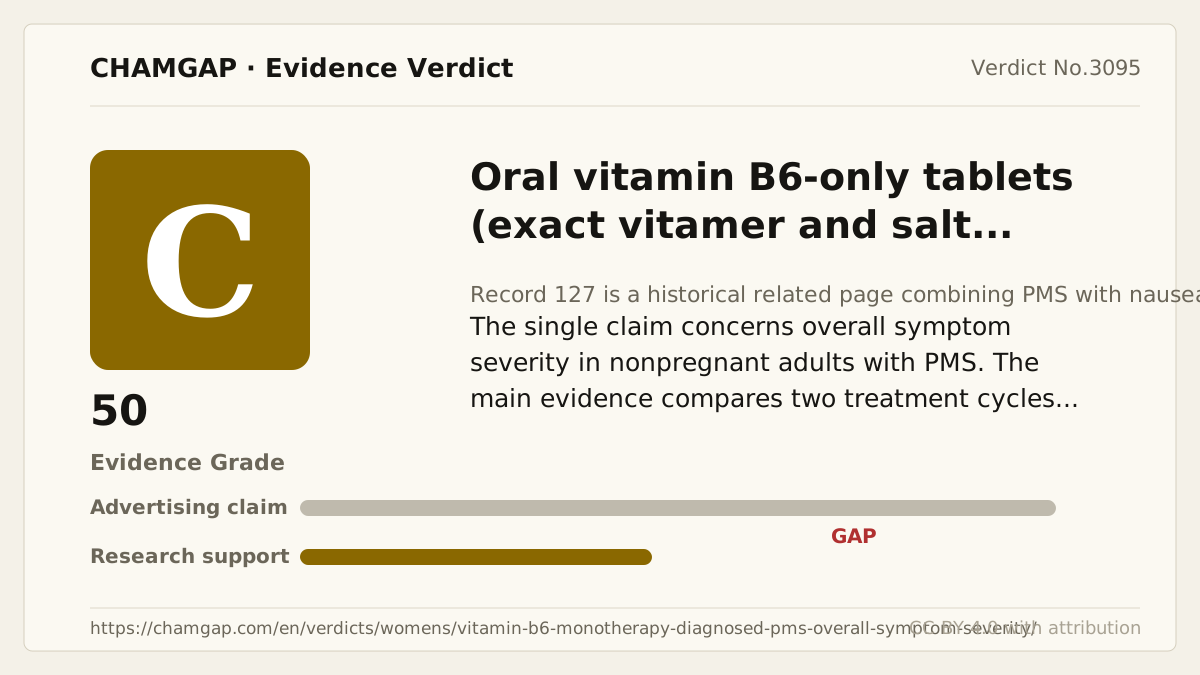
[Chamgap] Does vitamin B6 monotherapy reduce overall symptoms in diagnosed PMS? — Evidence Grade C·50. 21 cited sources checked. Source: https://chamgap.com/en/verdicts/womens/vitamin-b6-monotherapy-diagnosed-pms-overall-symptom-severity/ · CC BY 4.0CC BY 4.0 — free to use with attribution; do not distort grades, numbers, or verdict meaning.
What this document does and does not do
Chamgap is an information source. It reports what research has and has not confirmed; it does not tell readers what to take or buy. That decision belongs to readers and, when needed, medical or legal professionals. This verdict reflects literature available up to the search date and may change as new research appears. Nothing here is medical advice.