
Vaginal hyaluronic acid,
does it really help with Relief of vaginal dryness, atrophy, and dyspareunia in genitourinary syndrome of menopause?
research showsVaginal hyaluronic acid is rated C because it may provide short-term relief of vaginal dryness and dyspareunia in genitourinary syndrome of menopause. A 2021 systematic review summarized positive signals for dryness, pH, dyspareunia, and cell maturation across five studies and 335 women, but heterogeneity prevented meta-analysis. In a 2024 United States pilot randomized trial of 49 women, symptoms improved over 12 weeks with both hyaluronic acid and vaginal estrogen, but there was no placebo arm and the objective vaginal maturation index improved more with estrogen. Inability to pool the five studies, weak ingredient specificity, and results generally inferior to estrogen give C with 46 points.
ads claimMarketing expands the water-binding property of hyaluronic acid into vaginal mucosal regeneration, complete equivalence to hormones, and permanent treatment of painful sex. The evidence more narrowly supports that formulation-dependent nonhormonal vaginal moisturizers may provide short-term relief of dryness and discomfort for some users.
Useful facts when choosing a product
- Vaginal hyaluronic acid is a nonhormonal vaginal moisturizer and is not interchangeable with skin serum, oral hyaluronic acid, or injectable filler.
- Concentration, inactive ingredients, and dosing frequency differ across gels, creams, and inserts, so follow the specific intravaginal product instructions rather than converting a research dose.
- Transient local burning, irritation, or a change in discharge can occur, while persistent pain, odor, bleeding, or dysuria requires evaluation for infection or another condition.
- Being nonhormonal does not establish long-term tissue restoration or safety for every patient; moderate or severe symptoms and recurrent urinary problems warrant discussion of established options including vaginal estrogen.
Chamgap Semantic Classification Code
Candidate index · review held
UNK.vaginal-hyaluronic-acid.MULTI.vaginal-dryness-atrophy-and-dyspareunia-in-genitourinary-syndrome-of-menopause.relieve.UNKUnknown > Vaginal hyaluronic acid > Multiple: primary unresolved > vaginal dryness, atrophy, and dyspareunia in genitourinary syndrome of menopause > Symptom-relief claim > Unknown
An automated migration candidate, not an issued permanent code; exact claim scope remains under review. This machine-generated migration candidate helps retrieval but is not a permanent assignment. The original verdict ID and URL remain authoritative.
What the research actually shows
The 2021 review screened 833 records and included five primary studies with 335 women; dryness, dyspareunia, vaginal pH, and cell maturation were reported with incompatible methods, preventing meta-analysis. The 2024 pilot randomized 49 women with GSM to a vaginal hyaluronic-acid insert or estrogen cream, with 45 providing 12-week data. The between-group P value for the overall symptom score was .81 and both groups improved, but the vaginal maturation index improved by a mean 33.9 points more with estrogen. The AHRQ-linked 2024 review concluded that vaginal moisturizers may improve dryness with low certainty, while evidence for dyspareunia, long-term effects, and uncommon harms remained very limited.
Why this is classified as C (46)
The systematic review of five studies and 335 women and the 49-participant pilot randomized trial support a short-term signal for dryness and dyspareunia. Meta-analysis was impossible because of heterogeneity, broader vaginal-moisturizer evidence has weak ingredient specificity for hyaluronic acid, and objective maturation favored estrogen. The latest synthesis also rated moisturizer evidence low to very low certainty, giving C with 46 points.
Counterpoint. People with mild symptoms who prefer a nonhormonal approach can consider a trial following product instructions. Symptoms that fail to improve within several weeks, or bleeding, pain, or recurrent infection, should not be assumed to be simple dryness and require clinical evaluation.
Rejudgment record. Cross-check applied — Applied the rule ① ceiling of C because a five-study review of 335 women and a 49-participant pilot randomized trial provide short-term dryness and dyspareunia signals, while heterogeneity prevented meta-analysis, placebo-controlled long-term and histologic evidence is sparse, and the latest AHRQ synthesis rated certainty low to very low
Sub-claim grades by effect
This ingredient is marketed for several effects. A single overall grade blends strong and weak claims together, so each effect is graded separately here. The overall grade reflects the strongest disconfirming or core claim.
| Effect (sub-claim) | Grade | Basis |
|---|---|---|
| Relief of vaginal dryness and discomfort in menopausal GSM | C | Short-term improvement signals exist, but samples are small, outcomes are subjective, and the latest synthesis has low certainty. |
| Relief of dyspareunia in menopausal GSM | C | Small comparative trials found improvement, but placebo-controlled evidence and consistent quantitative synthesis are lacking. |
| Durable long-term restoration of vaginal epithelial atrophy | ? | Long-term placebo-controlled histologic data are absent, and estrogen produced greater vaginal maturation in the 12-week pilot. |
Cross-check — AI research and Codex final gate
Evidence Table
| Study | Design | Sample | Funding | Endpoint | Result | Weight |
|---|---|---|---|---|---|---|
| dos Santos CCM et al. 2021 | Systematic review of hyaluronic acid for postmenopausal vaginal atrophy | Five primary studies and 335 women | Academic research with no direct product sponsorship reported in the citation | Vaginal dryness, atrophy, dyspareunia, vaginal pH, and cell maturation | Several outcomes were directionally similar between hyaluronic acid and vaginal estrogen, but heterogeneity prevented meta-analysis. | Key but limited synthesis |
| Agrawal S et al. 2024 | Twelve-week randomized parallel-group pilot comparative trial | 49 women with GSM randomized and 45 analyzed | Academic pilot study with author disclosures reported | Vulvovaginal symptom score, dryness, dyspareunia, vaginal pH, and maturation index | Symptoms improved in both groups and the between-group overall symptom P value was .81, while estrogen improved the vaginal maturation index by 33.9 points more. | Recent direct but small comparative randomized trial |
| Danan ER et al. 2024 | Systematic review of randomized trials of hormonal treatments and vaginal moisturizers for GSM | Forty-six randomized trials, including four vaginal-moisturizer trials | Public research support from the United States AHRQ and PCORI | Dryness, dyspareunia, most bothersome symptom, satisfaction, and harms | Vaginal moisturizers may improve short-term dryness with low certainty, while long-term efficacy, comparative effectiveness, and safety data were sparse. | Recent independent certainty assessment, indirect for hyaluronic acid specifically |
Receipt — 3 References
All 3 cited sources were verified for existence at the original page (as of 2026-07-24).
Final verification and publication gate: Codex · Evidence date: 2026-07-24 · Corrections: none
Cite this verdict
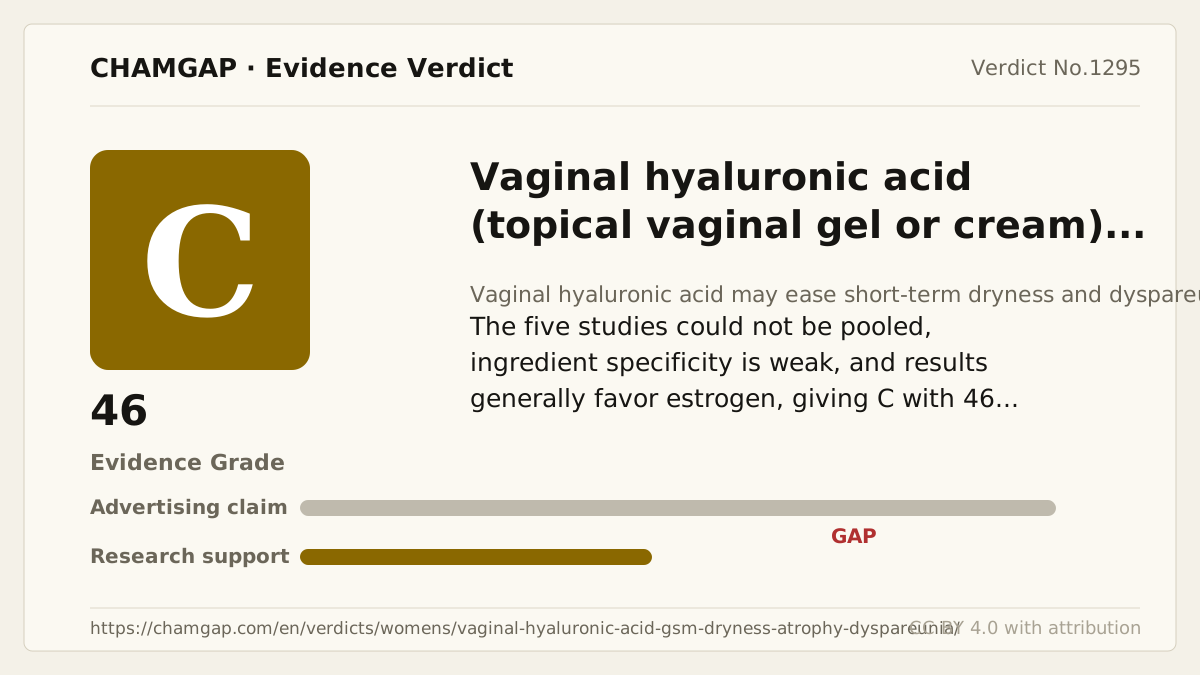
[Chamgap] Vaginal hyaluronic acid x relief of genitourinary syndrome of menopause symptoms — Evidence Grade C·46. 3 cited sources checked. Source: https://chamgap.com/en/verdicts/womens/vaginal-hyaluronic-acid-gsm-dryness-atrophy-dyspareunia/ · CC BY 4.0CC BY 4.0 — free to use with attribution; do not distort grades, numbers, or verdict meaning.
What this document does and does not do
Chamgap is an information source. It reports what research has and has not confirmed; it does not tell readers what to take or buy. That decision belongs to readers and, when needed, medical or legal professionals. This verdict reflects literature available up to the search date and may change as new research appears. Nothing here is medical advice.