
Vaginal estrogen,
does it really help with Prevention of recurrent urinary tract infection after menopause?
research showsVaginal estrogen has a clear positive signal from two placebo-controlled trials but is rated C. The 1993 trial randomized 93 women but analyzed only 60 completers; urinary tract infection incidence over eight months was 0.5 versus 5.9 episodes per patient-year. A contemporary trial randomized 35 and found infection by six months in 11 of 18 versus 16 of 17 in an intention-to-treat analysis, but nine participants dropped out. Both trials were small and had substantial attrition, producing a B2 ceiling of C.
ads claimMarketing may present local estrogen as immediate antibiotic-equivalent treatment or merge it with all effects and risks of systemic hormone therapy. This evidence concerns local vaginal administration for recurrence prevention, not acute cystitis treatment or systemic cardiovascular prevention.
Useful facts when choosing a product
- Vaginal cream and rings use a local route with exposure and indications distinct from systemic menopausal hormone therapy. Evidence was not transferred from the separately assigned systemic cardiovascular-prevention verdict.
- Verdict 058, which is B with 74 points, concerns cranberry for recurrent urinary tract infection risk; verdict 1287, which is D with 30 points, concerns D-mannose for six-month prevention; verdict 1795, which is C with 56 points, concerns methenamine hippurate prophylaxis.
- Verdict 1793, which is B with 70 points, concerns nitrofurantoin treatment of acute uncomplicated cystitis. Vaginal estrogen here prevents recurrence rather than treating an established acute infection.
- Verdict 1028, which is D with 29 points, evaluates cranberry proanthocyanidins as an antibiotic substitute for acute cystitis and is distinct from prevention.
Chamgap Semantic Classification Code
Candidate index · review held
M.vaginal-estrogen.vaginal.recurrent-urinary-tract-infection-after-menopause.prevent.MULTIMedicinal interventions > Vaginal estrogen > Vaginal > recurrent urinary tract infection after menopause > Occurrence-prevention claim > Multiple: primary unresolved
An automated migration candidate, not an issued permanent code; exact claim scope remains under review. This machine-generated migration candidate helps retrieval but is not a permanent assignment. The original verdict ID and URL remain authoritative.
What the research actually shows
Raz and Stamm randomized 93 women to intravaginal estriol cream, 50, or placebo, 43, but only 36 and 24 completed eight months. The trial was jointly supported by Organon B.V. International and NIH grant DK-40045. Monthly cultures and symptom-triggered testing yielded infection rates of 0.5 versus 5.9 episodes per patient-year, P<0.001, meeting the clinical primary endpoint. Ferrante 2021 was an investigator-initiated multicenter single-blind trial that randomized 35 to ring, cream, or placebo. Slow recruitment led to a prespecified revision combining the estrogen arms. Intention-to-treat analysis counting dropouts as failures found infection by six months in 11 of 18 versus 16 of 17, P=0.041, meeting the primary endpoint. The actual completer analysis included 26 women, 8 of 15 versus 10 of 11. These pivotal comparisons used placebo; a 2003 active comparison found estriol pessaries less effective than nitrofurantoin prophylaxis.
Why this is classified as C (56)
Clinical infection events give R2, I1, and E+: the Raz trial mixed Organon and NIH support, while the Ferrante trial was investigator-led. The 93-person trial analyzed 60 completers after 35% attrition, and the contemporary trial randomized 35 with 26 completers. The B2 ceiling yields C with 56 points.
Counterpoint. A postmenopausal patient with recurrent infection can compare vaginal estrogen with antibiotic or methenamine strategies after culture confirmation and assessment of vaginal symptoms, contraindications, and preferences. Fever, flank pain, or systemic illness requires acute evaluation.
Rejudgment record. Cross-check applied — Clinical infection outcomes were positive in a jointly industry- and publicly funded trial and an investigator-led placebo-controlled trial, but completer analysis, substantial attrition, and small samples accumulated to H, R2, I1, E+, and B2
| Endpoint | H | Hard endpoint - actual events such as death |
| Replication | R2 | Independently replicated across trials |
| Independence | I1 | Mixed funding sources |
| Effect size | E+ | Meets the clinically important threshold |
Stored derived and displayed grades match; this is not a current recalculation or validity check (C).
Sub-claim grades by effect
This ingredient is marketed for several effects. A single overall grade blends strong and weak claims together, so each effect is graded separately here. The overall grade reflects the strongest disconfirming or core claim.
| Effect (sub-claim) | Grade | Basis |
|---|---|---|
| Prevention of recurrent urinary tract infection over six to eight months with vaginal estrogen | C | Two placebo-controlled trials were positive but had small samples, substantial attrition, and completer analysis. |
| Six-month prevention with contemporary vaginal cream or ring regimens | C | The 35-person intention-to-treat primary endpoint succeeded, but only 26 completed follow-up. |
| Replacement of antibiotic prophylaxis by vaginal estrogen | D | An active-control trial found estriol pessaries less effective than nitrofurantoin. |
Cross-check — AI research and Codex final gate
Evidence Table
| Study | Design | Sample | Funding | Endpoint | Result | Weight |
|---|---|---|---|---|---|---|
| Raz R and Stamm WE. 1993 | Randomized double-blind placebo-controlled trial | 93 randomized (50/43); actual completer analysis 60 (36/24) | Joint support from Organon B.V. International and United States NIH grant DK-40045 | Eight-month incidence of urinary tract infection confirmed by symptoms and midstream culture | 0.5 versus 5.9 episodes per patient-year, P<0.001, meeting the clinical primary endpoint; 33 of 93 did not complete. | Pivotal placebo-controlled efficacy trial with completer and attrition limitations |
| Ferrante KL et al. 2021 | Investigator-initiated multicenter single-blind randomized placebo-controlled trial | 35 randomized and 35 in intention-to-treat analysis (18 estrogen/17 placebo); actual completers 26 (15/11) | Investigator-initiated trial; no external funding source reported in the public abstract and no manufacturer sponsorship identified | Occurrence of clinical urinary tract infection within six months | Intention-to-treat counting dropouts as failures was 11/18 versus 16/17, P=0.041, meeting the primary endpoint; completers were 8/15 versus 10/11. | Contemporary independent replication with a very small sample |
Receipt — 3 References
All 3 cited sources were verified for existence at the original page (as of 2026-07-24).
Final verification and publication gate: Codex · Evidence date: 2026-07-24 · Corrections: none
Cite this verdict
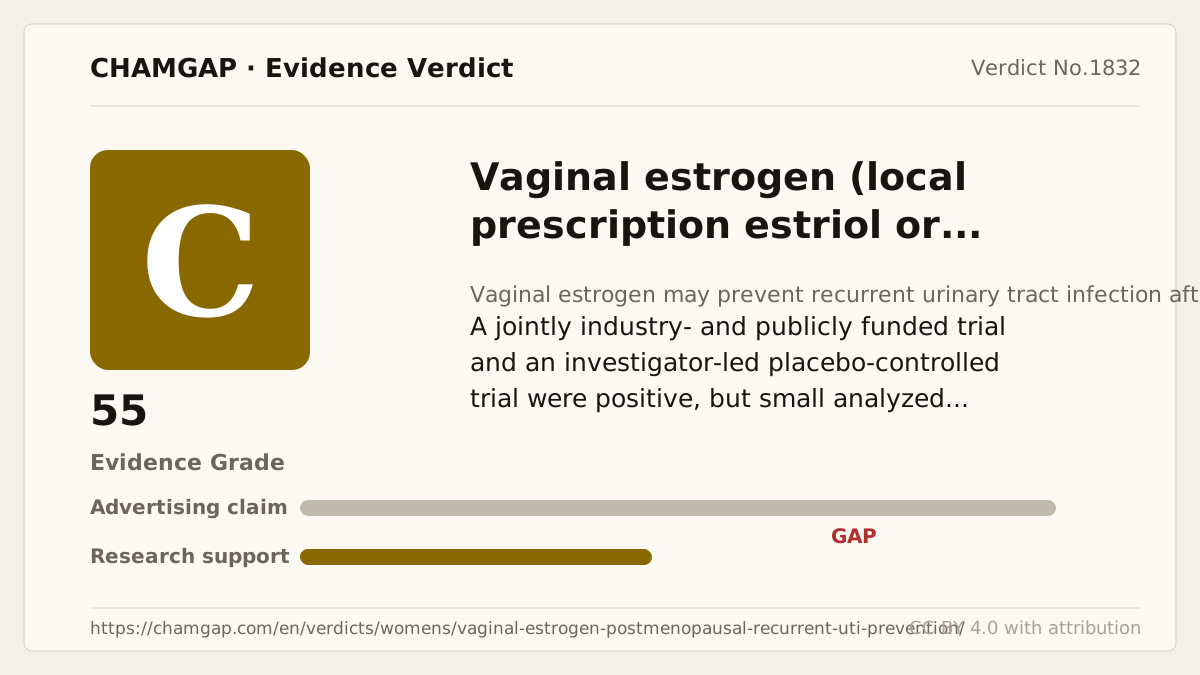
[Chamgap] Vaginal estrogen x prevention of recurrent urinary tract infection after menopause — Evidence Grade C·56. 3 cited sources checked. Source: https://chamgap.com/en/verdicts/womens/vaginal-estrogen-postmenopausal-recurrent-uti-prevention/ · CC BY 4.0CC BY 4.0 — free to use with attribution; do not distort grades, numbers, or verdict meaning.
What this document does and does not do
Chamgap is an information source. It reports what research has and has not confirmed; it does not tell readers what to take or buy. That decision belongs to readers and, when needed, medical or legal professionals. This verdict reflects literature available up to the search date and may change as new research appears. Nothing here is medical advice.