
Aluminum deodorant and underarm shaving,
does it really help with Higher breast-cancer incidence?
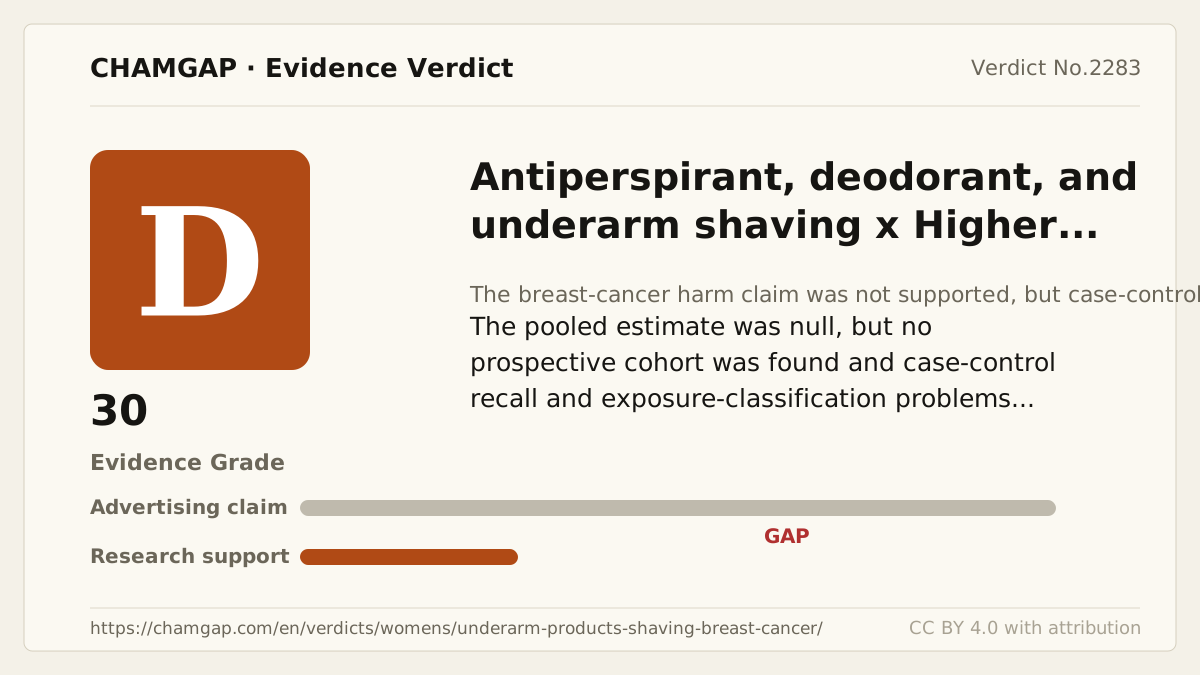
research showsThe grade is D. A population-based case-control study separately assessed antiperspirant, deodorant, shaving, and use soon after shaving and found no increase in breast cancer. A later synthesis of seven case-control studies was also null at OR 0.96. Retrospective recall, uncertain aluminum content, and between-study exposure differences mean this is absence of demonstrated harm, not counterproof.
ads claimAluminum measured in breast tissue is biomarker or mechanistic evidence, not human evidence that antiperspirant causes incident breast cancer. Aluminum-containing antiperspirant, potentially aluminum-free deodorant, and shaving are distinct exposures.
Useful facts when choosing a product
- Antiperspirant and deodorant were separate questions, but product-specific aluminum content was not verified.
- Blade shaving and application within one hour after shaving were separately analyzed.
- The core evidence is case-control; no prospective cohort was found.
- The pooled confidence interval still permitted increased harm.
Chamgap Semantic Classification Code
Candidate index · review held
UNK.antiperspirant.UNK.higher-breast-cancer-incidence.increase.UNKUnknown > Antiperspirant > Unknown > Higher breast-cancer incidence > Increase claim > Unknown
An automated migration candidate, not an issued permanent code; exact claim scope remains under review. This machine-generated migration candidate helps retrieval but is not a permanent assignment. The original verdict ID and URL remain authoritative.
What the research actually shows
Mirick and colleagues conducted in-person interviews with 813 cases aged 20-74 diagnosed in 1992-1995 and 793 age-frequency-matched controls selected by random-digit dialing. Antiperspirant, deodorant, blade shaving, and application within one hour after shaving were asked separately, but product-specific aluminum content was not verified. A diagnosed case may reconstruct past use differently from a control. No quantitative sensitivity analysis for differential recall appeared in the directly verified report. No prospective cohort following this specific exposure to breast-cancer incidence was found. Funding disclosures and manufacturer-funding wording for every component study could not be fully verified.
Why this is classified as D (30)
The overall synthesis of case-control studies was null. Postdiagnosis recall, control selection, heterogeneous exposure definitions, and moderate heterogeneity remain, with no prospective evidence, giving D with 30 points.
Counterpoint. D means the breast-cancer harm claim is not supported. It does not prove the absence of risk or establish the safety of all products.
Rejudgment record. Cross-check applied — Cross-check of the population case-control paper and meta-analysis with recall, control selection, and exposure definition considered
| Endpoint | H | Hard endpoint - actual events such as death |
| Replication | R1 | Single confirmatory trial |
| Independence | I1 | Mixed funding sources |
| Effect size | E0 | Null |
| Precision | C0 | The confidence interval leaves room for benefit |
Stored derived and displayed grades match; this is not a current recalculation or validity check (D).
Sub-claim grades by effect
This ingredient is marketed for several effects. A single overall grade blends strong and weak claims together, so each effect is graded separately here. The overall grade reflects the strongest disconfirming or core claim.
| Effect (sub-claim) | Grade | Basis |
|---|---|---|
| Antiperspirant use and breast cancer | D | The main study reported OR 0.9 and did not verify product-specific aluminum content. |
| Deodorant use and breast cancer | D | The main study reported OR 1.2, P=0.19, a null result. |
| Shaving and use soon after shaving | D | No increase was found among blade shavers or users applying products within one hour. |
Cross-check — AI research and Codex final gate
Evidence Table
| Study | Design | Sample | Funding | Endpoint | Result | Weight |
|---|---|---|---|---|---|---|
| Mirick et al. 2002 case-control study | Population-based case-control study | 813 cases and 793 controls | Funding source could not be confirmed from the publicly checked report | Breast-cancer diagnosis | Antiperspirant OR 0.9 and deodorant OR 1.2; use soon after shaving was also null | Large population-based study with postdiagnosis exposure recall |
| Trinh et al. 2024 meta-analysis | Meta-analysis of case-control studies | Seven case-control studies | Complete funding verification for all component studies was unavailable | Breast cancer | OR 0.96, 95% CI 0.78-1.17, I-squared 60% | Overall null result with observational design and moderate heterogeneity |
Receipt — 3 References
All 3 cited sources were verified for existence at the original page (as of 2026-08-05).
Final verification and publication gate: Codex · Evidence date: 2026-08-05 · Corrections: none
Cite this verdict
[Chamgap] Aluminum deodorant and underarm shaving x breast cancer — Evidence Grade D·30. 3 cited sources checked. Source: https://chamgap.com/en/verdicts/womens/underarm-products-shaving-breast-cancer/ · CC BY 4.0CC BY 4.0 — free to use with attribution; do not distort grades, numbers, or verdict meaning.
What this document does and does not do
Chamgap is an information source. It reports what research has and has not confirmed; it does not tell readers what to take or buy. That decision belongs to readers and, when needed, medical or legal professionals. This verdict reflects literature available up to the search date and may change as new research appears. Nothing here is medical advice.