
Tdap during pregnancy,
does it really help with Prevention of pertussis and pertussis hospitalization in early infancy through vaccination at 27 to 36 weeks of pregnancy?
research showsTdap at 27 to 36 weeks of pregnancy is rated A because it markedly reduces pertussis and severe hospitalization in newborn infants. The English national program estimated 91% effectiveness against pertussis before three months, and a United States cohort of 148,981 newborns estimated 91.4% during the first two months. A multistate United States case-control evaluation estimated 90.5% effectiveness against hospitalized pertussis after third-trimester vaccination, and an Australian study estimated 94%. Large real-world datasets from different countries and designs are consistent on laboratory-confirmed pertussis and hospitalization, both direct clinical outcomes, with very large effects. Although no randomized placebo trial exists, vaccine ethics and feasibility plus parity with existing A-rated vaccines support A. Local reactions and pregnancy safety are assessed separately from efficacy.
ads claimVaccine promotion can be misunderstood as 100% protection or a replacement for the infant DTaP series. Maternal vaccination provides strong protection during the most vulnerable early months but is not perfect, and infants still need DTaP on schedule.
Useful facts when choosing a product
- Tdap is not a live vaccine; it contains tetanus and diphtheria toxoids plus purified acellular pertussis antigens. Product-specific labeling applies to vaccines such as Boostrix.
- United States guidance recommends Tdap during every pregnancy at 27 to 36 weeks, preferably toward the earlier part of that window to allow placental antibody transfer. Local national schedules take priority.
- Injection-site pain, redness, swelling, fatigue, headache, muscle aches, and low-grade fever are the most common reactions and are usually transient. Severe allergic reactions are rare.
- A history of unexplained encephalopathy after a pertussis-containing vaccine or severe allergy to a vaccine component requires specialist review. Maternal Tdap does not replace the infant DTaP series.
Chamgap Semantic Classification Code
Candidate index · review held
M.tdap-vaccine.UNK.pertussis-and-pertussis-hospitalization-in-early-infancy-through-vaccination-at-of-pregnancy.prevent.UNKMedicinal interventions > Tdap vaccine > Unknown > pertussis and pertussis hospitalization in early infancy through vaccination at of pregnancy > Occurrence-prevention claim > Unknown
An automated migration candidate, not an issued permanent code; exact claim scope remains under review. This machine-generated migration candidate helps retrieval but is not a permanent assignment. The original verdict ID and URL remain authoritative.
What the research actually shows
Amirthalingam 2014 analyzed surveillance after the English maternal pertussis program and estimated 91% effectiveness against laboratory-confirmed disease before three months, with a 68% decline in hospitalization. Baxter 2017 followed 148,981 newborns and estimated 91.4% effectiveness during the first two months. The six-state United States case-control evaluation by Skoff 2017 estimated 77.7% effectiveness against pertussis before two months and 90.5% against hospitalized cases after third-trimester vaccination. Saul 2018 estimated 69% effectiveness against disease before three months and 94% against hospitalization in Australia. In a cohort of 123,494 pregnancies, Kharbanda 2014 found no association with increased preterm birth, small-for-gestational-age birth, or hypertensive disorders, while a small increase in coded chorioamnionitis warranted continued surveillance.
Why this is classified as A (91)
Roughly 90% prevention of laboratory-confirmed early-infant pertussis and more than 90% prevention of pertussis hospitalization recur across large cohort, case-control, and national-surveillance studies in England, the United States, and Australia. Although a randomized placebo trial is absent, effect magnitude, consistency, independent public-health data, direct clinical endpoints, and parity with A-rated HPV, hepatitis, COVID-19, and zoster vaccines support A with 91 points. Local reactions and pregnancy safety remain separate safety judgments.
Counterpoint. Families should still reduce pertussis exposure and begin the infant DTaP series on time. Prior vaccine reactions, acute illness, or uncertain records should be reviewed with obstetric or vaccination clinicians.
Rejudgment record. New verdict — Although no placebo randomized trial exists, large independent cohort, case-control, and surveillance studies in England, the United States, and Australia repeatedly found very large effects on direct endpoints of laboratory-confirmed early-infant pertussis and hospitalization, with parity to the existing A-rated vaccine corpus
Sub-claim grades by effect
This ingredient is marketed for several effects. A single overall grade blends strong and weak claims together, so each effect is graded separately here. The overall grade reflects the strongest disconfirming or core claim.
| Effect (sub-claim) | Grade | Basis |
|---|---|---|
| Prevention of pertussis during the first two to three months of infancy | A | Across countries, effectiveness against directly confirmed disease ranged about 69% to 93%, with roughly 90% repeated in large datasets. |
| Prevention of pertussis hospitalization in early infancy | A | United States and Australian case-control evaluations estimated 90.5% and 94% effectiveness against hospitalization. |
| Prevention of pertussis across the entire first year of life | B | Protection persists but overlaps with infant DTaP, and first-year effectiveness was 69.0% in one large cohort, lower than early protection. |
Cross-check — AI research and Codex final gate
Evidence Table
| Study | Design | Sample | Funding | Endpoint | Result | Weight |
|---|---|---|---|---|---|---|
| Amirthalingam G et al. 2014 | Observational effectiveness evaluation using English national surveillance | Coverage cohort of 26,684 pregnancies and effectiveness based on 82 confirmed cases before three months | Public Health England | Laboratory-confirmed infant pertussis and hospitalization | Effectiveness before three months was 91% (95% CI 84 to 95), and hospitalization declined 68% year over year. | Large national direct-outcome evidence |
| Baxter R et al. 2017 | Retrospective birth cohort | 148,981 newborns | Kaiser Permanente; disclosed conflicts related to manufacturers of vaccines used | Pertussis during the first two months and first year | Effectiveness was 91.4% (95% CI 19.5 to 99.1) during the first two months and 69.0% during the first year. | Large-cohort direct disease endpoint |
| Skoff TH et al. 2017 | Hospital-matched case-control evaluation across six United States states | 240 cases and 535 controls younger than two months | United States CDC and public-health agencies; authors reported no conflicts | Pertussis and pertussis hospitalization | Third-trimester effectiveness was 77.7% against pertussis and 90.5% (95% CI 65.2 to 97.4) against hospitalized cases. | Independent direct severe-outcome evidence |
| Kharbanda EO et al. 2014 | Retrospective Vaccine Safety Datalink pregnancy cohort | 123,494 singleton pregnancies; 26,229 received Tdap during pregnancy | United States CDC Vaccine Safety Datalink | Preterm birth, small-for-gestational-age birth, hypertensive disorders, and chorioamnionitis | No increase was found for preterm birth, small-for-gestational-age birth, or hypertensive disorders; coded chorioamnionitis was modestly increased. | Large pregnancy-safety evidence |
Receipt — 5 References
All 5 cited sources were verified for existence at the original page (as of 2026-07-21).
Final verification and publication gate: Codex · Evidence date: 2026-07-21 · Corrections: none
Cite this verdict
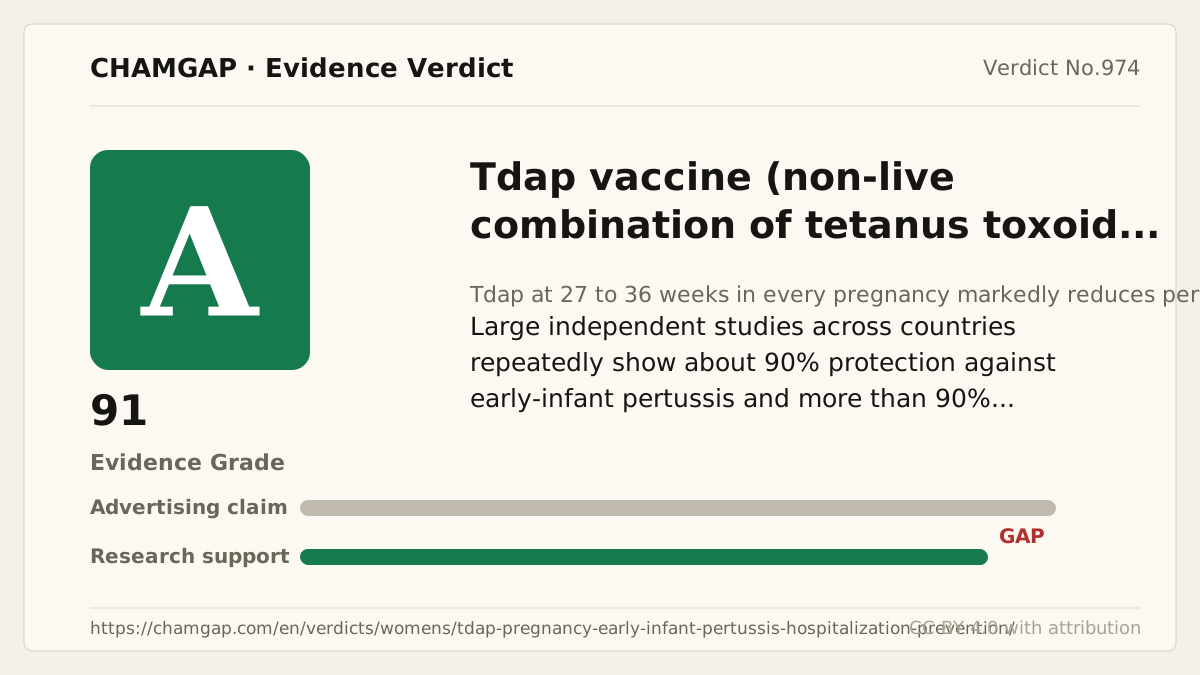
[Chamgap] Tdap during pregnancy x prevention of early-infant pertussis and hospitalization — Evidence Grade A·91. 5 cited sources checked. Source: https://chamgap.com/en/verdicts/womens/tdap-pregnancy-early-infant-pertussis-hospitalization-prevention/ · CC BY 4.0CC BY 4.0 — free to use with attribution; do not distort grades, numbers, or verdict meaning.
What this document does and does not do
Chamgap is an information source. It reports what research has and has not confirmed; it does not tell readers what to take or buy. That decision belongs to readers and, when needed, medical or legal professionals. This verdict reflects literature available up to the search date and may change as new research appears. Nothing here is medical advice.