
Preventive tamoxifen,
does it really help with Reduced breast-cancer incidence in high-risk women without breast cancer?
research showsThe grade is A. Independent large double-blind randomized trials, NSABP P-1 and IBIS-I, replicated lower breast-cancer incidence. In P-1, cumulative invasive-cancer incidence through 69 months was 43.4 per 1,000 with placebo versus 22.0 with tamoxifen. In IBIS-I, breast cancer over a median sixteen years occurred in 350/3,575 (9.8%) versus 251/3,579 (7.0%), HR 0.71 (95% CI 0.60-0.83).
ads claimVerdict 1041 is A with 96 points but concerns recurrence and breast-cancer death after diagnosed estrogen-receptor-positive early cancer. This verdict concerns primary prevention in high-risk women who do not have breast cancer.
Useful facts when choosing a product
- P-1 eligibility used age, Gail five-year risk of at least 1.66%, or lobular carcinoma in situ.
- Long-term IBIS-I incidence was 7.0% versus 9.8%.
- Initial IBIS-I harms were 0.31% versus 0.14% for endometrial cancer and 1.20% versus 0.48% for venous thromboembolism.
Chamgap Semantic Classification Code
Candidate index · review held
UNK.tamoxifen.UNK.breast-cancer-incidence-without-breast-cancer.reduce.placeboUnknown > Tamoxifen > Unknown > breast-cancer incidence without breast cancer > Reduction claim > Placebo
An automated migration candidate, not an issued permanent code; exact claim scope remains under review. This machine-generated migration candidate helps retrieval but is not a permanent assignment. The original verdict ID and URL remain authoritative.
What the research actually shows
The P-1 funding statement reads: “This investigation was supported by Public Health Service grants U10-CA-37377 and U10-CA-69974 from the National Cancer Institute, National Institutes of Health, Department of Health and Human Services.” The IBIS-I statement reads: “Funding: Cancer Research UK (UK) and the National Health and Medical Research Council (Australia).” Independent teams and funders produced the same direction. Although P-1 disclosed results early for benefit, long-term IBIS-I independently sustains the incidence conclusion.
Why this is classified as A (88)
Actual cancer incidence, independent publicly funded replication, and a large absolute and relative reduction give A with 88 points. Harms and null mortality remain essential to prescribing but are separate from the incidence-efficacy grade.
Counterpoint. Net benefit rises with baseline breast-cancer risk and may be unfavorable when uterine-cancer or clotting risk is high.
Rejudgment record. Cross-check applied — Direct cross-check of P-1 and IBIS-I eligibility, absolute cancer incidence, long-term mortality, absolute uterine and thromboembolic harms, and funding
| Endpoint | H | Hard endpoint - actual events such as death |
| Replication | R2 | Independently replicated across trials |
| Independence | I2 | Decisive evidence is publicly or non-profit funded |
| Effect size | E+ | Meets the clinically important threshold |
Stored derived and displayed grades match; this is not a current recalculation or validity check (A).
Sub-claim grades by effect
This ingredient is marketed for several effects. A single overall grade blends strong and weak claims together, so each effect is graded separately here. The overall grade reflects the strongest disconfirming or core claim.
| Effect (sub-claim) | Grade | Basis |
|---|---|---|
| Reduced breast-cancer incidence in high-risk women without cancer | A | P-1 and IBIS-I independently replicated benefit. |
| Reduced all-cause mortality | D | Long-term IBIS-I found 5.1% versus 4.6%, with no reduction. |
| Reduced incidence of estrogen-receptor-negative breast cancer | D | IBIS-I reported an HR of 1.05 and did not show a reduction. |
Cross-check — AI research and Codex final gate
Evidence Table
| Study | Design | Sample | Funding | Endpoint | Result | Weight |
|---|---|---|---|---|---|---|
| NSABP P-1 | Multicenter double-blind placebo-controlled randomized trial | 13,388 women, 6,681 tamoxifen and 6,707 placebo | This investigation was supported by Public Health Service grants U10-CA-37377 and U10-CA-69974 from the National Cancer Institute, National Institutes of Health, Department of Health and Human Services. | Incidence of invasive breast cancer | Cumulative incidence through 69 months was 22.0 versus 43.4 per 1,000, a 49% reduction | Pivotal large prevention trial |
| IBIS-I long-term follow-up | International multicenter double-blind placebo-controlled randomized trial | 7,154 women, 3,579/3,575, median follow-up 16.0 years | Funding: Cancer Research UK (UK) and the National Health and Medical Research Council (Australia). | Occurrence of invasive breast cancer and ductal carcinoma in situ | 251/3,579 (7.0%) versus 350/3,575 (9.8%), HR 0.71 (0.60-0.83) | Independent long-term replication |
Receipt — 2 References
All 2 cited sources were verified for existence at the original page (as of 2026-08-06).
Final verification and publication gate: Codex · Evidence date: 2026-08-06 · Corrections: none
Cite this verdict
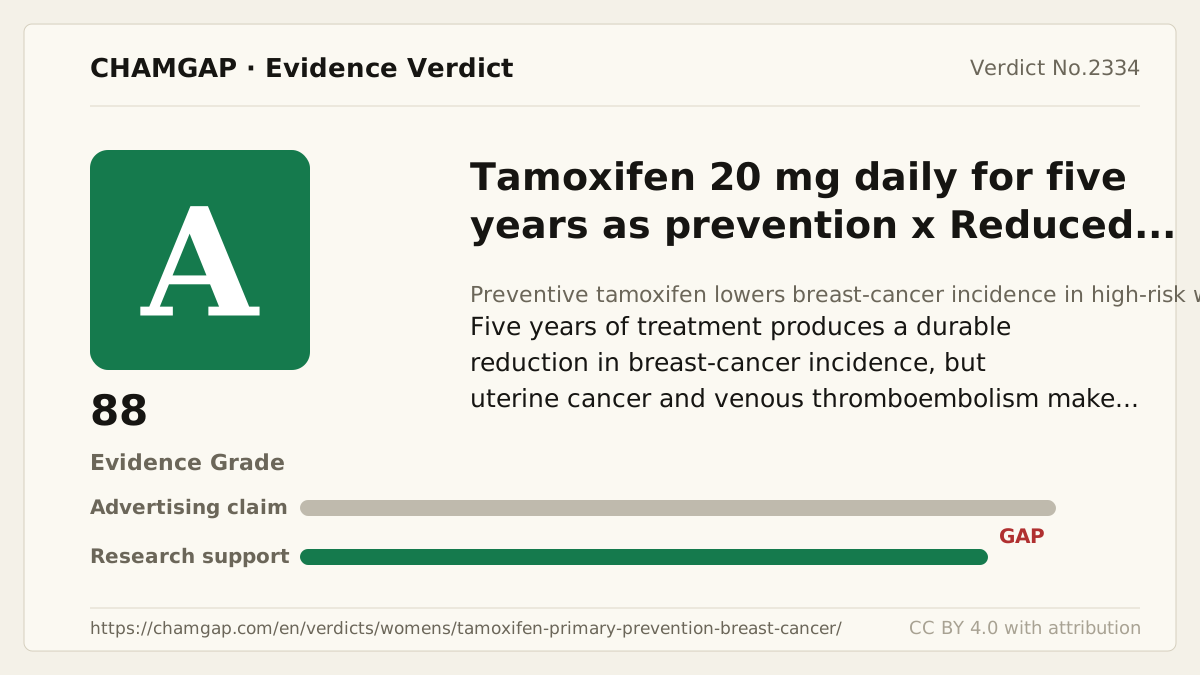
[Chamgap] Preventive tamoxifen x breast-cancer incidence — Evidence Grade A·88. 2 cited sources checked. Source: https://chamgap.com/en/verdicts/womens/tamoxifen-primary-prevention-breast-cancer/ · CC BY 4.0CC BY 4.0 — free to use with attribution; do not distort grades, numbers, or verdict meaning.
What this document does and does not do
Chamgap is an information source. It reports what research has and has not confirmed; it does not tell readers what to take or buy. That decision belongs to readers and, when needed, medical or legal professionals. This verdict reflects literature available up to the search date and may change as new research appears. Nothing here is medical advice.