
Soy foods,
does it really help with Lower breast-cancer recurrence and mortality?
research showsThe grade is C. In a Shanghai survivor cohort, the highest versus lowest quartile of soy protein was associated with total mortality HR 0.71, 95% CI 0.54 to 0.92, and recurrence HR 0.68, 0.54 to 0.87. The study did not support the claim that phytoestrogens increase cancer risk and instead found inverse associations, but it was not randomized and cannot establish prevention or treatment.
ads claimThe fact that soy foods contain isoflavones does not establish cancer promotion, and this cohort's inverse association does not establish treatment or prevention.
Useful facts when choosing a product
- Soy foods including tofu, soy milk, and whole soybeans do contain isoflavones.
- Isoflavone content varies substantially by food and processing, and this cohort used no standardized study product or direct assay of participants' foods.
- General USDA composition ranges cannot be presented as administered cohort doses.
- The study received public funding including the US National Cancer Institute. The lead author disclosed a small 2005 research-development grant from the United Soybean Board.
- Verdict 063 is C with 46 points for isolated soy isoflavones and menopausal symptoms, while verdict 513 is C with 58 points for soy protein and LDL reduction. Their formulations and outcomes differ from whole soy foods and breast-cancer survival here.
- Soybeans have long been documented in ancient East Asian sources, but no chapter, volume, or quotation is asserted.
Chamgap Semantic Classification Code
Candidate index · review held
F.soy-foods-after-breast-cancer-diagnosis.food.breast-cancer-recurrence-and-mortality.reduce.UNKFoods and beverages > Soy foods after breast-cancer diagnosis > Food consumption > breast-cancer recurrence and mortality > Reduction claim > Unknown
An automated migration candidate, not an issued permanent code; exact claim scope remains under review. This machine-generated migration candidate helps retrieval but is not a permanent assignment. The original verdict ID and URL remain authoritative.
What the research actually shows
The 2009 JAMA paper was cross-checked with Shanghai dietary-validation studies. Soy-food group food-frequency-questionnaire reproducibility was 0.37, and a separate urinary-isoflavone validation correlation was about 0.5. Multiple mortality, recurrence, receptor, and tamoxifen analyses lacked a verified multiplicity correction.
Why this is classified as C (56)
Confidence intervals for mortality and recurrence both excluded 1 and showed inverse rather than harmful associations. This was one observational cohort with exposure-measurement limitations and many potentially selective analyses, yielding C with 56 points.
Counterpoint. Soy foods should not replace tamoxifen or other standard treatment. Food safety and treatment efficacy are different questions.
Rejudgment record. Cross-check applied — Assessed recurrence and mortality hazard ratios, clinical adjustment, repeated diet assessment, FFQ reproducibility, and urinary-biomarker validity
| Endpoint | H | Hard endpoint - actual events such as death |
| Replication | R1 | Single confirmatory trial |
| Independence | I2 | Decisive evidence is publicly or non-profit funded |
| Effect size | E+ | Meets the clinically important threshold |
Stored derived and displayed grades match; this is not a current recalculation or validity check (C).
Sub-claim grades by effect
This ingredient is marketed for several effects. A single overall grade blends strong and weak claims together, so each effect is graded separately here. The overall grade reflects the strongest disconfirming or core claim.
| Effect (sub-claim) | Grade | Basis |
|---|---|---|
| Soy foods reduce breast-cancer recurrence and mortality | C | Inverse associations were observed, but causation is unconfirmed. |
| Soy foods increase breast cancer because of phytoestrogens | C | This cohort found no increased risk among ER-positive women or tamoxifen users. |
Cross-check — AI research and Codex final gate
Evidence Table
| Study | Design | Sample | Funding | Endpoint | Result | Weight |
|---|---|---|---|---|---|---|
| Shu XO et al., 2009 | Prospective cohort of breast-cancer survivors | 5,042 enrolled; 5,033 surgically treated women analyzed | Public funding including the US National Cancer Institute; lead author disclosed a prior small United Soybean Board grant | Total mortality and recurrence or breast-cancer death | Highest versus lowest soy-protein quartile: mortality HR 0.71 (0.54 to 0.92), recurrence HR 0.68 (0.54 to 0.87) | Large observational cohort not supporting increased risk |
Receipt — 3 References
All 3 cited sources were verified for existence at the original page (as of 2026-08-03).
Final verification and publication gate: Codex · Evidence date: 2026-08-03 · Corrections: none
Cite this verdict
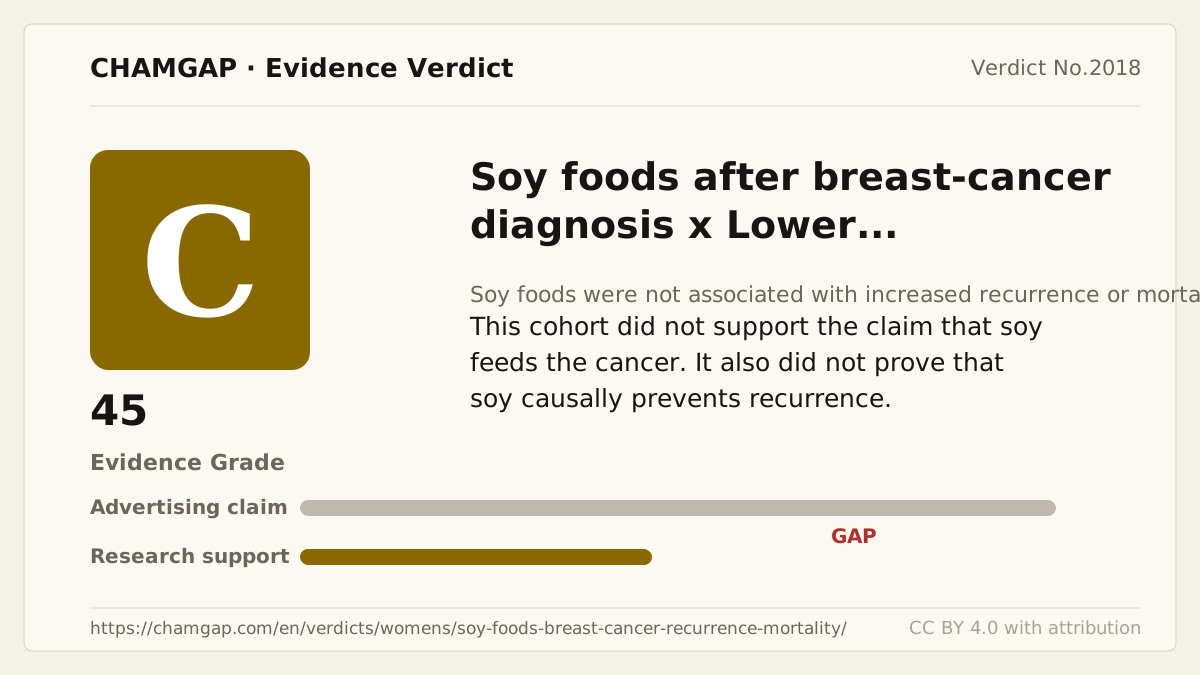
[Chamgap] Soy foods x breast-cancer recurrence and mortality — Evidence Grade C·56. 3 cited sources checked. Source: https://chamgap.com/en/verdicts/womens/soy-foods-breast-cancer-recurrence-mortality/ · CC BY 4.0CC BY 4.0 — free to use with attribution; do not distort grades, numbers, or verdict meaning.
What this document does and does not do
Chamgap is an information source. It reports what research has and has not confirmed; it does not tell readers what to take or buy. That decision belongs to readers and, when needed, medical or legal professionals. This verdict reflects literature available up to the search date and may change as new research appears. Nothing here is medical advice.