
Sacral neuromodulation,
does it really help with Improvement of refractory overactive bladder and urgency urinary incontinence?
research showsSacral neuromodulation is rated B. InSite, Siegel 2015, Neurourol Urodyn 34(3):224-230, included 147 participants and found 61% versus 42%; Medtronic sponsored it in full. ROSETTA, Amundsen 2016, JAMA 316(13):1366-1374, analyzed 364 participants and found -3.3 versus -3.9 episodes/day; NIH/NICHD supported it. Independent sham evidence exists: Liao et al., Eur Urol Focus 2022;8(6):1823-1830, included 73 participants and found SNM-on 56.8% versus off/sham 11.1%. That trial received partial GeneralStim support and was not a Medtronic or Axonics trial. Patient-selection dependence, unmasked InSite and ROSETTA, and implant revision and infection risks give B with 64 points.
ads claimMarketing can generalize outcomes in test-responsive selected patients to every form of frequency and incontinence and imply a permanent cure. This is staged symptom control for refractory disease and may require maintenance or revision.
Useful facts when choosing a product
- A temporary test phase commonly identifies responders before permanent implantation of a pulse generator and lead.
- The goal is reduction, not guaranteed cure, of urgency incontinence and frequency, with programming and follow-up required.
- Infection, pain, lead migration or failure, loss of benefit, battery replacement, and revision surgery can occur.
Chamgap Semantic Classification Code
Candidate index · review held
UNK.sacral-neuromodulation-with-an-implanted-interstim-type-neurostimulator.UNK.refractory-overactive-bladder-and-urgency-urinary-incontinence.improve.MULTIUnknown > Sacral neuromodulation with an implanted InterStim-type neurostimulator > Unknown > refractory overactive bladder and urgency urinary incontinence > Improvement claim > Multiple: primary unresolved
An automated migration candidate, not an issued permanent code; exact claim scope remains under review. This machine-generated migration candidate helps retrieval but is not a permanent assignment. The original verdict ID and URL remain authoritative.
What the research actually shows
InSite, Siegel 2015, Neurourol Urodyn 34(3):224-230, randomized and analyzed 147 participants and found six-month therapeutic success of 61% versus 42%, P=.02; Medtronic sponsored it in full. ROSETTA, Amundsen 2016, JAMA 316(13):1366-1374, actually analyzed 364 participants and found -3.3 episodes/day with sacral neuromodulation versus -3.9 with onabotulinumtoxinA; NIH/NICHD supported it. Liao et al., Eur Urol Focus 2022;8(6):1823-1830, is a genuine 73-person sham-controlled trial and found SNM-on response of 56.8% versus off/sham 11.1%. It received partial GeneralStim support and was not a Medtronic or Axonics trial, providing independent sham evidence. Because ROSETTA had public funding and the sham trial was non-Medtronic and non-Axonics, rule ②-b does not apply.
Why this is classified as B (64)
Direct symptom signals from InSite, ROSETTA, and an independent sham trial support B with 64 points. Patient-selection dependence, lack of masking in InSite and ROSETTA, and implant revision and infection risks prevent A.
Counterpoint. For people who have failed medication and behavioral treatment, it can provide meaningful symptom and quality-of-life improvement.
Rejudgment record. Cross-check applied — InSite, publicly funded ROSETTA, and a non-Medtronic, non-Axonics sham trial converge, so rule ②-b does not apply; patient-selection dependence, lack of masking, revision, and infection risks limit confidence
Sub-claim grades by effect
This ingredient is marketed for several effects. A single overall grade blends strong and weak claims together, so each effect is graded separately here. The overall grade reflects the strongest disconfirming or core claim.
| Effect (sub-claim) | Grade | Basis |
|---|---|---|
| Reduction in urgency urinary incontinence episodes | B | A large active-control trial showed a reduction of 3.3 episodes per day. |
| Reduced frequency or at least 50% bladder-diary improvement | B | Primary therapeutic success was 61% versus 42% in 147 intention-to-treat participants. |
| Improved overactive-bladder-related quality of life | B | Patient-reported outcomes were positive in the pivotal trial and ROSETTA, although neither was masked. |
Cross-check — AI research and Codex final gate
Evidence Table
| Study | Design | Sample | Funding | Endpoint | Result | Weight |
|---|---|---|---|---|---|---|
| Siegel S et al. 2015 | Prospective multicenter randomized active-control trial | 147 randomized, 70/77; actual primary intention-to-treat analysis 147 | Sponsored in full by Medtronic, Inc. | Primary: overactive-bladder therapeutic success at six months | Primary endpoint succeeded; 61% versus 42%, P=.02. | Pivotal direct-symptom randomized trial, manufacturer-led |
| Amundsen CL et al. 2016 ROSETTA | Multicenter open-label randomized active-control trial | 381 randomized, 192/189; actual primary intention-to-treat analysis 364, 190/174 | Public NIH/NICHD and Office of Research on Women's Health funding, with product support from Allergan and Medtronic | Primary: change in mean daily urgency-incontinence episodes over six months | Sacral neuromodulation -3.3 episodes/day and onabotulinumtoxinA -3.9; between-group difference 0.63, P=.01. | Large active-control replication |
| Liao et al. 2022 | Randomized SNM-on versus off/sham controlled trial | 73 participants | Partial GeneralStim support; not a Medtronic or Axonics trial | Therapeutic response | SNM-on 56.8% versus off/sham 11.1%. | Independent sham evidence |
Receipt — 3 References
All 3 cited sources were verified for existence at the original page (as of 2026-07-24).
Final verification and publication gate: Codex · Evidence date: 2026-07-24 · Corrections: none
Cite this verdict
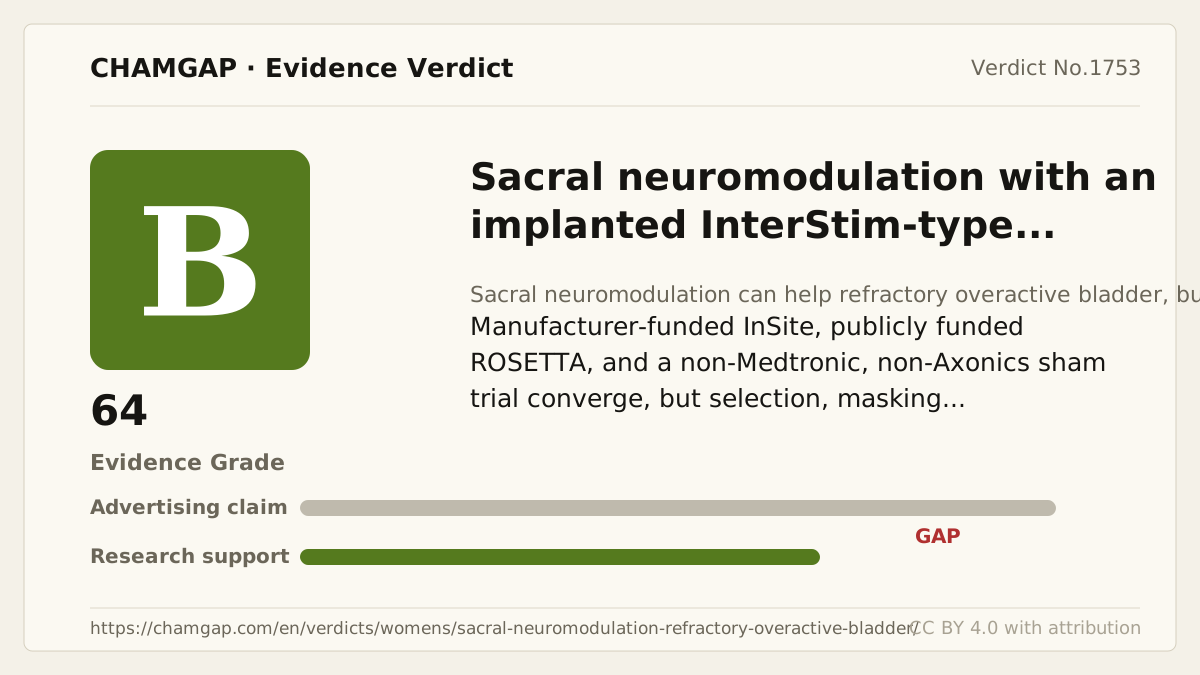
[Chamgap] Sacral neuromodulation x refractory overactive-bladder symptom improvement — Evidence Grade B·64. 3 cited sources checked. Source: https://chamgap.com/en/verdicts/womens/sacral-neuromodulation-refractory-overactive-bladder/ · CC BY 4.0CC BY 4.0 — free to use with attribution; do not distort grades, numbers, or verdict meaning.
What this document does and does not do
Chamgap is an information source. It reports what research has and has not confirmed; it does not tell readers what to take or buy. That decision belongs to readers and, when needed, medical or legal professionals. This verdict reflects literature available up to the search date and may change as new research appears. Nothing here is medical advice.