
Risk-based breast cancer screening,
does it really help with Noninferior stage IIB or higher breast cancer versus annual screening?
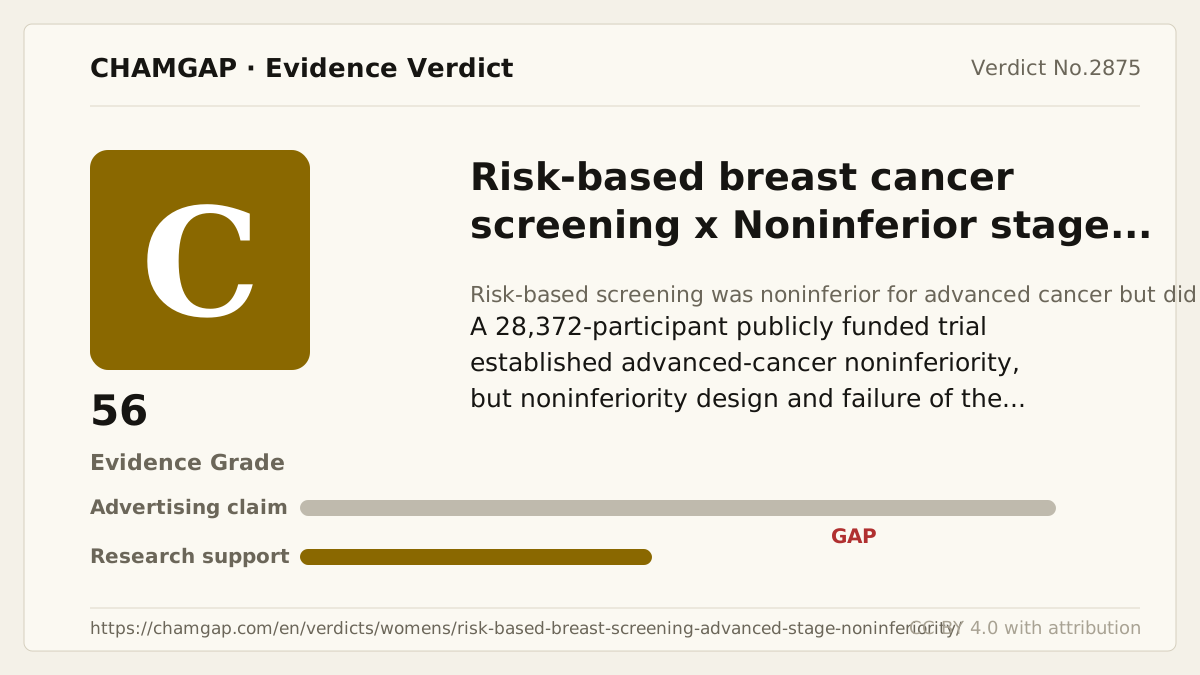
research showsThe grade is C. This asks whom to screen, when, and how often, not whether to screen at all. In WISDOM's randomized cohort, stage IIB or higher cancer rates were 30.0 versus 48.0 per 100,000 person-years; difference -18.0 (95% CI -40.2 to 4.1), below the +50 margin. The coprimary biopsy-reduction endpoint failed.
ads claimKorea's national program offers mammography every 2 years from age 40, making this highly relevant. Yet US genetic-risk scores, MRI access, an annual-screening control, and participant demographics differ from Korea, so the WISDOM schedule cannot be transplanted directly.
Useful facts when choosing a product
- Highest-risk women alternated MRI and mammography every 6 months; average-risk women started biennial mammography at 50; low-risk women in their 40s deferred screening.
- The primary analysis used 28,372 randomized women.
- The 18,031-person preference cohort was not pooled into primary efficacy analysis.
Chamgap Semantic Classification Code
Candidate index · review held
P.risk-based-breast-cancer-screening.diagnostic.stage-iib-or-higher-breast-cancer.noninferior.UNKProcedures, devices and tests > Risk-based breast cancer screening > Diagnostic or screening > stage IIB or higher breast cancer > Noninferiority claim > Unknown
An automated migration candidate, not an issued permanent code; exact claim scope remains under review. This machine-generated migration candidate helps retrieval but is not a permanent assignment. The original verdict ID and URL remain authoritative.
What the research actually shows
Among 46,403 US women aged 40 to 74, 28,372 chose randomization and 18,031 entered the preference observational cohort. Primary outcomes used only the "as-randomized population"; the observational cohort contributed only its 89% preference result here. Exponential regression with inverse probability of censoring weights handled informative censoring in disease-verified exposure time, so survival-analysis censoring is not fixed-time attrition. ① Defect name: noninferiority design. ② Listed item: noninferiority design. ③ Original evidence that its requirement was met: "The noninferiority margin ... was set to 50 stage ≥IIB cancers per 100,000 person-years" and upper limit 4.1<50. ④ Avoidable: yes. Superiority for fewer advanced cancers was possible, but the selected question allowed loss within a margin. Funding was "supported by PCORI (PCS-1402-10749), NCI (R01CA237533), BCRF ..." and other public or nonprofit sources; funders had no role in design, analysis, or publication decisions.
Why this is classified as C (56)
Objectively confirmed advanced cancer, a large randomized cohort, public and nonprofit funding, and precise noninferiority are strengths. Noninferiority design and failure of the biopsy coprimary endpoint give C with 56 points.
Counterpoint. Adherence was limited and the annual group screened less than annually, narrowing actual exposure differences. A US sample enriched for college-educated White women also limits transportability.
Rejudgment record. Cross-check applied — Direct review of objectively confirmed stage IIB or higher cancer, randomized primary population, 50-per-100,000 margin, censoring weights, biopsy coprimary endpoint, and public funding
| Endpoint | H | Hard endpoint - actual events such as death |
| Replication | R1 | Single confirmatory trial |
| Independence | I2 | Decisive evidence is publicly or non-profit funded |
| Effect size | E+ | Meets the clinically important threshold |
Stored derived and displayed grades match; this is not a current recalculation or validity check (C).
Sub-claim grades by effect
This ingredient is marketed for several effects. A single overall grade blends strong and weak claims together, so each effect is graded separately here. The overall grade reflects the strongest disconfirming or core claim.
| Effect (sub-claim) | Grade | Basis |
|---|---|---|
| Noninferior stage IIB or higher breast cancer | C | The upper limit of 4.1 per 100,000 person-years did not cross +50. |
| Lower biopsy rate | D | Difference was +98.7 per 100,000 person-years, P=.10, failing superiority. |
Cross-check — AI research and Codex final gate
Evidence Table
| Study | Design | Sample | Funding | Endpoint | Result | Weight |
|---|---|---|---|---|---|---|
| Esserman et al. 2026 WISDOM | US multicenter pragmatic randomized noninferiority trial with a separate preference observational cohort | 28,372 randomized, 14,212 versus 14,160; separate preference cohort 18,031 | Original statement: support from PCORI PCS-1402-10749, NCI R01CA237533, BCRF, and other public or nonprofit sources; funders had no role | Coprimary: noninferiority of stage IIB or higher breast cancer and superiority for lower biopsy rate | Advanced cancer 30.0 versus 48.0 per 100,000 person-years, difference -18.0 (95% CI -40.2 to 4.1), upper limit below +50; biopsy difference +98.7 (95% CI -17.9 to 215.3), P=.10, failure | Pivotal publicly funded hard-outcome evidence |
Receipt — 2 References
All 2 cited sources were verified for existence at the original page (as of 2026-08-18).
Final verification and publication gate: Codex · Evidence date: 2026-08-18 · Corrections: none
Cite this verdict
[Chamgap] Benefit of Risk-Based Breast Cancer Screening for Noninferior Advanced-Stage Breast Cancer versus Annual Screening — Evidence Grade C·56. 2 cited sources checked. Source: https://chamgap.com/en/verdicts/womens/risk-based-breast-screening-advanced-stage-noninferiority/ · CC BY 4.0CC BY 4.0 — free to use with attribution; do not distort grades, numbers, or verdict meaning.
What this document does and does not do
Chamgap is an information source. It reports what research has and has not confirmed; it does not tell readers what to take or buy. That decision belongs to readers and, when needed, medical or legal professionals. This verdict reflects literature available up to the search date and may change as new research appears. Nothing here is medical advice.