
Ribociclib,
does it really help with Prolonged overall survival with first-line ribociclib plus letrozole in HR-positive, HER2-negative advanced breast cancer?
research showsEvidence shows that adding ribociclib to letrozole prolongs overall survival as first-line therapy for postmenopausal patients with HR-positive, HER2-negative advanced breast cancer. In the final analysis of the 668-participant, phase 3 MONALEESA-2 trial, median overall survival was 63.9 versus 51.4 months, with a death hazard ratio of 0.76 (95% CI 0.63 to 0.93; P=0.008); an earlier analysis also improved progression-free survival to 25.3 versus 16.0 months, hazard ratio 0.568. A protocol-specified final survival analysis with hierarchical testing established a direct hard endpoint. The separately recruited MONALEESA-3 (hazard ratio 0.72) and MONALEESA-7 (hazard ratio 0.71) point the same way, but all three are funded by Novartis and share authors, so they are not replication by a different funder, giving B with 72 points. Neutropenia, hepatotoxicity, and QTc prolongation require active monitoring separately from efficacy.
ads claimA 12.5-month difference between median survival estimates does not mean that every patient lives exactly 12.5 months longer, and a 24% mortality-hazard reduction is not a 24-percentage-point absolute survival increase. Evidence concerns first-line ribociclib combined with letrozole, not ribociclib alone.
Useful facts when choosing a product
- MONALEESA-2 used ribociclib 600 mg once daily for 21 days of each 28-day cycle with letrozole 2.5 mg daily.
- The survival evidence applies most directly to first-line systemic treatment of postmenopausal HR-positive, HER2-negative advanced breast cancer.
- Complete blood counts are required because of neutropenia and infection risk, and liver function requires regular monitoring because liver enzymes can rise.
- QTc prolongation requires review of electrocardiograms, electrolytes, and interacting drugs, with interruptions or dose reductions guided by the product label and oncology team.
Chamgap Semantic Classification Code
Candidate index · review held
M.ribociclib.UNK.prolonged-overall-survival-with-first-line-ribociclib-plus-letrozole-in-hr-positive-her2-negative-advanced-breast-cancer.assess.placeboMedicinal interventions > Ribociclib > Unknown > Prolonged overall survival with first-line ribociclib plus letrozole in HR-positive, HER2-negative advanced breast cancer > Association or change assessment > Placebo
An automated migration candidate, not an issued permanent code; exact claim scope remains under review. This machine-generated migration candidate helps retrieval but is not a permanent assignment. The original verdict ID and URL remain authoritative.
What the research actually shows
Hortobagyi and colleagues randomized 668 MONALEESA-2 participants to ribociclib 600 mg for 21 days followed by 7 days off plus daily letrozole 2.5 mg, or placebo plus letrozole. The initial primary analysis showed a progression-free-survival hazard ratio of 0.56, and the updated analysis confirmed median progression-free survival of 25.3 versus 16.0 months, hazard ratio 0.568. At the final analysis after 6.6 years of median follow-up, 181 of 334 patients had died with ribociclib versus 219 of 334 with placebo; median overall survival was 63.9 versus 51.4 months, hazard ratio 0.76. Survival efficacy is strong, while neutropenia, leukopenia, liver-enzyme elevation, and QTc prolongation require separate monitoring.
Why this is classified as B (72)
The 668-participant, double-blind, phase 3 MONALEESA-2 trial significantly improved protocol-specified, hierarchically tested final overall survival to 63.9 versus 51.4 months, hazard ratio 0.76, with a large concordant progression-free-survival benefit. The separately recruited MONALEESA-3 and MONALEESA-7 point the same way, but all three share the sponsor Novartis and overlapping authors, so they do not meet the axis-2 R2 requirement of different investigators and funders. Under the R1 ceiling the grade is B with 72 points. Axis 3 is Novartis-only, but the ceiling does not apply to a large hard-endpoint prescription trial.
Counterpoint. Menopausal status, disease burden, cardiac and hepatic function, and alternative endocrine or targeted treatments can change absolute benefit and suitability.
Rejudgment record. New verdict — Credited the hierarchically tested final overall-survival hazard ratio of 0.76 in the 668-participant double-blind phase 3 MONALEESA-2 trial, but applied the axis-2 R1 ceiling of B because the separately recruited MONALEESA-3 and MONALEESA-7 trials share the same sponsor, Novartis, and overlapping authors, so they do not meet the R2 requirement of different investigators and funders. Axis 3 is Novartis-only, but the ceiling does not apply to a large hard-endpoint prescription trial
| Endpoint | H | Hard endpoint - actual events such as death |
| Replication | R1 | Single confirmatory trial |
| Independence | I0 | Evidence comes only from manufacturer studies |
| Effect size | E+ | Meets the clinically important threshold |
Stored derived and displayed grades match; this is not a current recalculation or validity check (B).
Sub-claim grades by effect
This ingredient is marketed for several effects. A single overall grade blends strong and weak claims together, so each effect is graded separately here. The overall grade reflects the strongest disconfirming or core claim.
| Effect (sub-claim) | Grade | Basis |
|---|---|---|
| Prolonged overall survival with first-line letrozole | A | Final median overall survival was 63.9 versus 51.4 months, with a direct hard-endpoint death hazard ratio of 0.76. |
| Prolonged progression-free survival with first-line letrozole | A | The prespecified primary endpoint was large and consistent at 25.3 versus 16.0 months, hazard ratio 0.568, and the overall-survival benefit mitigates surrogacy concerns. |
| Increased objective tumor response | B | Response increased among patients with measurable disease, but it remains an imaging-based secondary surrogate. |
Cross-check — AI research and Codex final gate
Evidence Table
| Study | Design | Sample | Funding | Endpoint | Result | Weight |
|---|---|---|---|---|---|---|
| Hortobagyi GN et al. 2022 MONALEESA-2 final overall survival | Protocol-specified final overall-survival analysis of a randomized double-blind placebo-controlled phase 3 trial | 668 postmenopausal patients with HR-positive, HER2-negative advanced breast cancer | Novartis | Hierarchically tested key secondary overall survival | Median overall survival was 63.9 versus 51.4 months, with a death hazard ratio of 0.76 (95% CI 0.63 to 0.93; P=0.008). | Pivotal direct survival endpoint |
| Hortobagyi GN et al. 2018 MONALEESA-2 updated efficacy | Updated progression-free-survival analysis of the same randomized double-blind phase 3 trial | 668 participants; median follow-up 26.4 months | Novartis | Primary progression-free survival; secondary response and safety | Median progression-free survival was 25.3 versus 16.0 months, hazard ratio 0.568 (95% CI 0.457 to 0.704). | Support from the primary endpoint; not an independent replication |
| Slamon DJ et al. 2020 MONALEESA-3 | Randomized double-blind placebo-controlled phase 3 trial (NCT02422615) of ribociclib plus fulvestrant versus placebo plus fulvestrant | 726 patients (484 ribociclib, 242 placebo) | Funded by Novartis. It is a sister trial of MONALEESA-2 under the same sponsor with overlapping authors, so it is not independent replication by a different funder. | Overall survival | Overall survival at 42 months was 57.8% (95% CI 52.0 to 63.2) versus 45.9% (36.9 to 54.5), hazard ratio for death 0.72 (0.57 to 0.92), P=0.00455. | Consistency within the same sponsor's program; not counted as independent replication |
| Im SA et al. 2019 MONALEESA-7 | Randomized double-blind placebo-controlled phase 3 trial in premenopausal and perimenopausal women (NCT02278120) adding ribociclib to endocrine therapy versus placebo | 672 in the intention-to-treat population (335 ribociclib, 337 placebo) | Funded by Novartis; a sister trial of MONALEESA-2 and MONALEESA-3 under the same sponsor. | Overall survival | Overall survival at 42 months was 70.2% (95% CI 63.5 to 76.0) versus 46.0% (32.0 to 58.9), hazard ratio for death 0.71 (0.54 to 0.95), P=0.00973. | A different population (premenopausal) but the same sponsor's program; not counted as independent replication |
Receipt — 4 References
All 4 cited sources were verified for existence at the original page (as of 2026-07-22).
Final verification and publication gate: Codex · Evidence date: 2026-07-22 · Corrections: 1
Correction log — 1
Corrections applied to this verdict, in chronological order. Changes are logged, not erased.
- 2026-08-08 · Grade correction for unmet independent-replication requirement — Both cited papers were updated and final analyses of the same 668 participants in MONALEESA-2 (NCT01958021). Ribociclib also has the separately recruited MONALEESA-3 (NCT02422615; 42-month overall survival 57.8% versus 45.9%, hazard ratio 0.72) and MONALEESA-7 (NCT02278120; 70.2% versus 46.0%, hazard ratio 0.71), which have now been added to the citations. All three, however, are funded by Novartis and share authors. Chamgap's axis-2 R2 requires multiple randomized trials by different investigators and funders, so sister trials under one sponsor are not independent replication. Axis 2 is therefore R1 and the ceiling is B. The axes are recorded as H, R1, I0, E+, B1, giving 72 points for three strength axes. The effect itself is not disputed and the consistency across the sister trials is retained in the evidence section. Identified in the 2026-08-08 internal audit. (grade A→B)
Cite this verdict
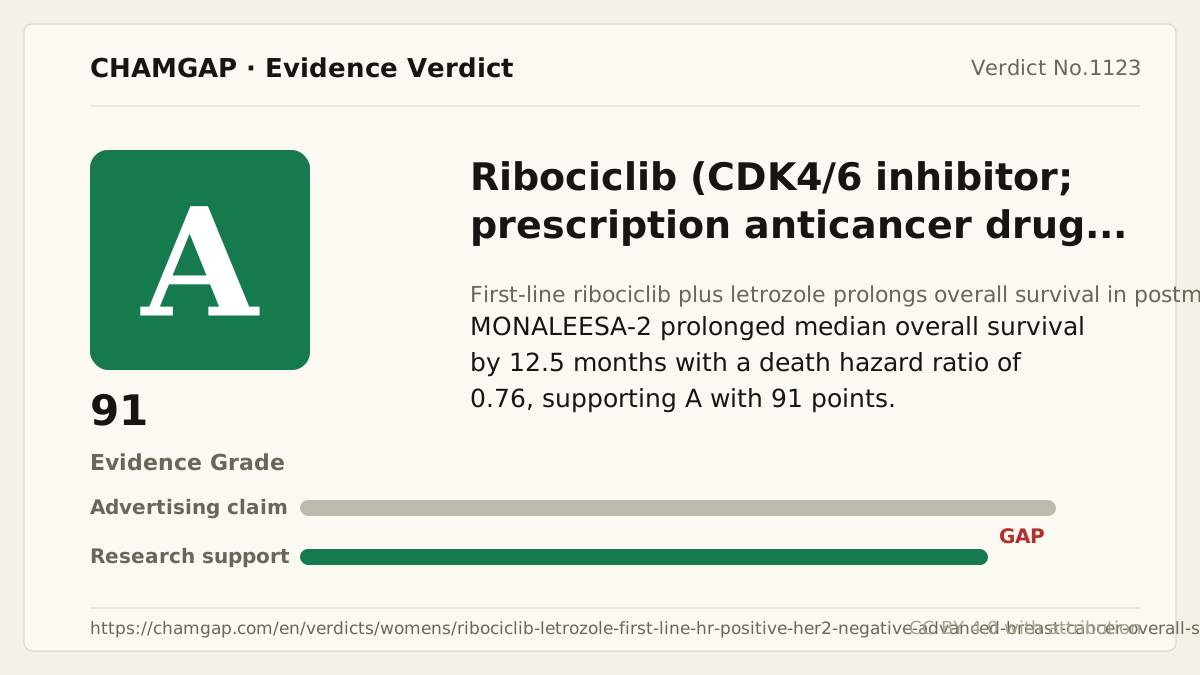
[Chamgap] Ribociclib x prolonged first-line overall survival in HR-positive, HER2-negative advanced breast cancer — Evidence Grade B·72. 4 cited sources checked. Source: https://chamgap.com/en/verdicts/womens/ribociclib-letrozole-first-line-hr-positive-her2-negative-advanced-breast-cancer-overall-survival/ · CC BY 4.0CC BY 4.0 — free to use with attribution; do not distort grades, numbers, or verdict meaning.
What this document does and does not do
Chamgap is an information source. It reports what research has and has not confirmed; it does not tell readers what to take or buy. That decision belongs to readers and, when needed, medical or legal professionals. This verdict reflects literature available up to the search date and may change as new research appears. Nothing here is medical advice.