
Regular breast self-examination,
does it really help with Earlier breast cancer detection and lower breast cancer mortality?
research showsThe claim that monthly breast self-examination lowers breast cancer mortality is rated D. The pooled total of 388,535 women combined 266,064 in Shanghai and 122,471 in Russia and gave breast cancer mortality RR 1.05 (95% CI 0.90 to 1.24). The confidence interval does not exclude a mortality reduction of up to 10%, so this is unproven rather than refuted.
ads claimThe intuition that more frequent palpation must save lives is presented as conclusive mortality evidence.
Useful facts when choosing a product
- Formal self-examination does not replace mammography or assessment of symptoms.
- A new lump, skin retraction, or bloody discharge warrants assessment regardless of a monthly schedule.
Chamgap Semantic Classification Code
Candidate index · review held
P.regular-breast-self-examination-taught-and-performed.diagnostic.earlier-breast-cancer-detection-and-lower-breast-cancer-mortality.reduce.UNKProcedures, devices and tests > Regular breast self-examination taught and performed > Diagnostic or screening > Earlier breast cancer detection and lower breast cancer mortality > Reduction claim > Unknown
An automated migration candidate, not an issued permanent code; exact claim scope remains under review. This machine-generated migration candidate helps retrieval but is not a permanent assignment. The original verdict ID and URL remain authoritative.
What the research actually shows
The pooled total of 388,535 women combined 266,064 in Shanghai and 122,471 in Russia and gave breast cancer mortality RR 1.05 (95% CI 0.90 to 1.24). The point estimate shows no benefit, but the confidence interval does not exclude a mortality reduction of up to 10%.
Why this is classified as D (22)
An F is reserved for repeated refutation in the same indication, whereas this evidence is unproven rather than refuted. The pooled RR 1.05 (95% CI 0.90 to 1.24) in 388,535 women does not exclude up to 10% lower mortality, giving D with 22 points.
Counterpoint. Unproven mortality benefit does not mean ignoring a new breast change.
Rejudgment record. Cross-check applied — An F is reserved for repeated refutation in the same indication, whereas this evidence is unproven rather than refuted. The pooled breast cancer mortality RR was 1.05 (95% CI 0.90 to 1.24) among 388,535 women from Shanghai, 266,064, and Russia, 122,471, and does not exclude up to 10% lower mortality.
Sub-claim grades by effect
This ingredient is marketed for several effects. A single overall grade blends strong and weak claims together, so each effect is graded separately here. The overall grade reflects the strongest disconfirming or core claim.
| Effect (sub-claim) | Grade | Basis |
|---|---|---|
| Lower breast cancer mortality | D | The pooled RR 1.05 (0.90 to 1.24) in 388,535 women did not exclude up to a 10% reduction. |
| Reduction in advanced breast cancer | D | No stage shift was demonstrated in Shanghai. |
| Earlier detection of malignant tumors | D | Benefits in cancer size or stage were not replicated. |
Cross-check — AI research and Codex final gate
Evidence Table
| Study | Design | Sample | Funding | Endpoint | Result | Weight |
|---|---|---|---|---|---|---|
| Thomas DB et al. 2002 | Factory-level cluster randomized trial | 266,064 randomized and analyzed as the full cohort | United States NCI public grant R01CA46823; not manufacturer-led | Primary clinical objective of breast cancer mortality | Failed with RR 1.04, P=.72. | Key direct evidence of nonproof |
| Kösters JP and Gøtzsche PC. 2003 | Cochrane systematic review | Shanghai 266,064 plus Russia 122,471, totaling two trials and 388,535 women | Academic Cochrane review; not manufacturer-led | Breast cancer mortality | RR 1.05 (95% CI 0.90 to 1.24); did not exclude up to a 10% reduction. | Pooled evidence of nonproof |
Receipt — 2 References
All 2 cited sources were verified for existence at the original page (as of 2026-07-24).
Final verification and publication gate: Codex · Evidence date: 2026-07-24 · Corrections: none
Cite this verdict
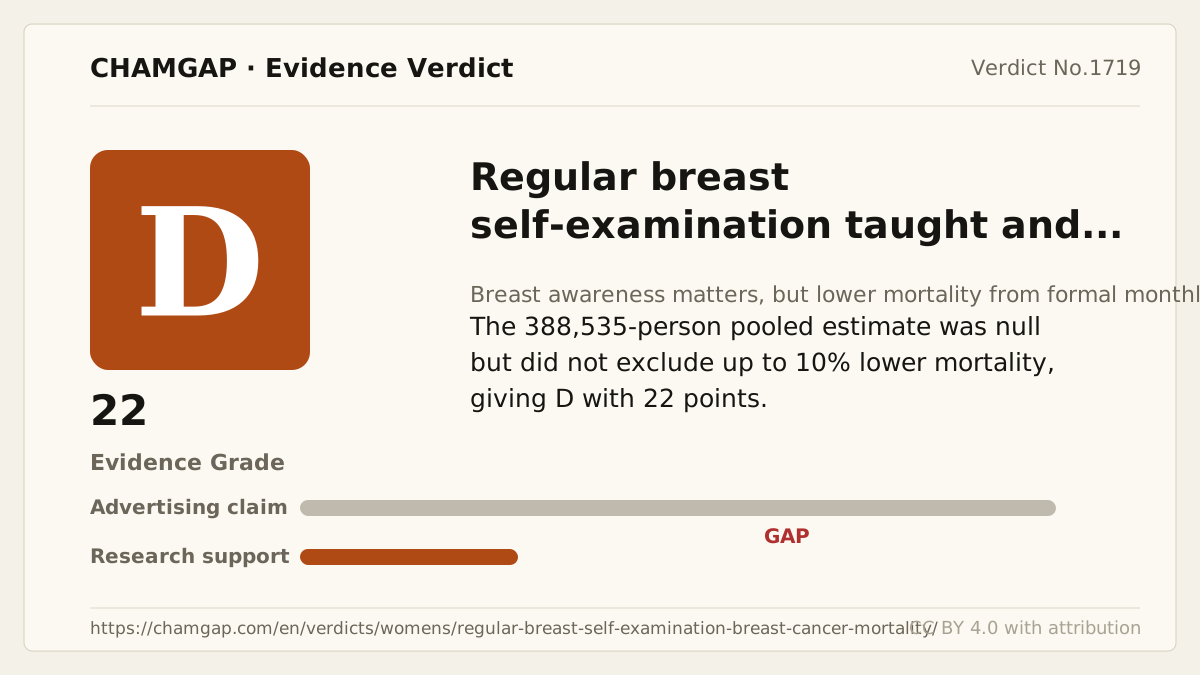
[Chamgap] Regular breast self-examination x lower breast cancer mortality — Evidence Grade D·22. 2 cited sources checked. Source: https://chamgap.com/en/verdicts/womens/regular-breast-self-examination-breast-cancer-mortality/ · CC BY 4.0CC BY 4.0 — free to use with attribution; do not distort grades, numbers, or verdict meaning.
What this document does and does not do
Chamgap is an information source. It reports what research has and has not confirmed; it does not tell readers what to take or buy. That decision belongs to readers and, when needed, medical or legal professionals. This verdict reflects literature available up to the search date and may change as new research appears. Nothing here is medical advice.