
Vitamin B6: pyridoxine monotherapy,
does it really help with Reduced nausea severity in early pregnancy?
research showsThere is a signal that oral pyridoxine 25 mg every 8 hours may reduce nausea, but the retained trial synopses do not establish the overall effect size or a definite clinically important benefit. Improvement described especially in severe nausea is not generalized to the whole group. The current assessment is C, 46 points. It addresses nausea scores versus placebo, not a combined conclusion about PUQE totals, vomiting frequency or hyperemesis treatment.
ads claimNo marketing claim of an established effective dose is made. Pyridoxine, pyridoxal and PLP, and single-ingredient supplements versus fixed doxylamine combinations, are not automatically the same intervention.
Four separate assessment dimensions
| Effect direction and size | There is a signal that oral pyridoxine 25 mg every 8 hours may reduce nausea, but the retained trial synopses do not establish the overall effect size or a definite clinically important benefit. Improvement described especially in severe nausea is not generalized to the whole group. The current assessment is C, 46 points. It addresses nausea scores versus placebo, not a combined conclusion about PUQE totals, vomiting frequency or hyperemesis treatment. |
|---|---|
| Evidence certainty | The 7 axes are B / P / R1 / I1 / EX / B1 / CX. I1 is the supplied rule for unverified funding, not confirmation of manufacturer support. B1 counts 1 small-study limitation in the dose-matched main trial, recorded with a sample of 59. The supportive sample of 342 is not labeled small, and short duration in acute nausea is not separately penalized. Unverified effect and CI are not counted again as bias defects. |
| Applicability | The direct claim compares oral pyridoxine monotherapy, 25 mg every 8 hours, with placebo for nausea severity in early pregnancy. PUQE totals, vomiting frequency, hyperemesis gravidarum and doxylamine combinations are outside the direct claim. |
| Safety | Caution. The retained NVP synopses do not establish maternal/fetal adverse events, serious events, discontinuations or long-term safety. General official B6 safety records describe peripheral neuropathy below 50 mg/day and do not guarantee recovery. The EFSA adult chronic total-intake upper limit of 12 mg/day is not a pregnancy-nausea treatment recommendation. The TGA warning above 10 mg/day is distinguished from the scheduled change for more than 50 to 200 mg/day on 2027-06-01, which is still future at the 2026-09-15 cutoff. Doxylamine sedation information is not transferred to B6-alone adverse effects. Research doses are not personal dosing instructions; treatment changes in pregnancy require the treating obstetric team’s judgment. |
C, 46 is the evidence tier for the fixed early-pregnancy nausea-severity improvement claim, not an established effect size, individual success probability, safety score or document-quality score.
Useful facts when choosing a product
- The retained ingredient is pyridoxine; hydrochloride identity is unverified.
- The 75 mg/day calculated from 25 mg every 8 hours is schedule arithmetic, not actual intake or a recommended dose.
- The supportive 30 mg/day trial is not treated as same-dose replication.
- Placebo composition, common care, prenatal vitamins and rescue medication are unverified.
- Actual PUQE use was not verified, so old nausea scores are not relabeled as a PUQE total.
Chamgap Semantic Classification Code
Permanent code issued
S.pyridoxine.oral.early-pregnancy-nausea-severity.improve.placeboSubstances and nutrients > Pyridoxine monotherapy > Oral > Nausea severity in early pregnancy > Improvement claim > Placebo
Bound to the ChatGPT-fixed comparison of pyridoxine monotherapy 25 mg every 8 hours versus placebo for nausea severity in early pregnancy. Salt, formulation, treatment days, instrument, arm denominators and formal effect remain unresolved in multidimensional fields. The code identifies the intervention and claim; it never contains the evidence grade, score, or safety result.
Exact Claim Classification
These independent facets prevent evidence from different forms, routes, populations, effects, and comparators from being mixed.
| Intervention class | S · Supplement or nutraceutical |
|---|---|
| Canonical ingredient or intervention | Vitamin B6 as pyridoxine monotherapy |
| Source or part used | Unverified: manufacturing origin, manufacturer, purity and batch records not recovered |
| Formulation or processing | Single-ingredient oral preparation; hydrochloride identity, tablet/capsule, release type and excipients unverified |
| Route | Oral |
| Dose | Main regimen 25 mg every 8 hours; schedule-derived 75 mg/day; actual intake/adherence unverified. Supportive 30 mg/day regimen kept separate. |
| Duration | Short-term trial described in retained record; exact treatment days, assessment day and follow-up unverified |
| Population | Patients with early-pregnancy nausea; exact gestational weeks, diagnostic/severity criteria and inpatient status unverified. Severe-nausea subgroup kept separate from the whole group; not generalized to hyperemesis gravidarum. |
| Effect or condition | Reduced nausea severity versus placebo |
| Primary endpoint | Between-group difference in nausea scores. Exact instrument, range, unit, assessment day and endpoint hierarchy unverified; not relabeled as a PUQE total. |
| Comparator | Placebo; composition, common care, concomitant treatment and rescue medication unverified. Doxylamine combinations excluded. |
| Duplicate-detection key | pyridoxine|salt-not-verified|oral|25mg-every8h|early-pregnancy-nausea|nausea-severity|short-term-days-not-verified|placebo |
What the research actually shows
Sahakian 1991 is described in the retained historical record as randomized, double-blind and placebo-controlled, with a reported sample of 59 and improvement especially in severe nausea. Vutyavanich 1995 is recorded with a sample of 342 at 30 mg/day, improved nausea scores and less consistent vomiting findings. The 59 and 342 are stage-unspecified sample labels, not verified arm-level analysis denominators. The different doses are not pooled, and this continuation does not claim a new reading of the primary results tables.
Why this is classified as C (46)
The 7 axes are B / P / R1 / I1 / EX / B1 / CX. I1 is the supplied rule for unverified funding, not confirmation of manufacturer support. B1 counts 1 small-study limitation in the dose-matched main trial, recorded with a sample of 59. The supportive sample of 342 is not labeled small, and short duration in acute nausea is not separately penalized. Unverified effect and CI are not counted again as bias defects.
Counterpoint. This is neither a D/F assessment of demonstrated failure nor a ? statement that human research is absent. It is C: the nausea-reduction signal is retained while its size and certainty are limited. Neither record 127’s combined PMS/pregnancy score nor ACOG recommendations are transferred into the new score.
Rejudgment record. The 7 axes are B / P / R1 / I1 / EX / B1 / CX. I1 is the supplied rule for unverified funding, not confirmation of manufacturer support. B1 counts 1 small-study limitation in the dose-matched main trial, recorded with a sample of 59. The supportive sample of 342 is not labeled small, and short duration in acute nausea is not separately penalized. Unverified effect and CI are not counted again as bias defects.
| Endpoint | P | Symptom or function itself is the target - including patient reports and performance tests |
| Replication | R1 | Single confirmatory trial |
| Independence | I1 | Mixed funding sources |
| Effect size | EX | The clinical size of the effect could not be judged |
| Precision | CX | No pooled confidence interval could be confirmed |
Review performed and remaining limitations
Exact pyridoxine salt, including hydrochloride, origin, manufacturer, purity, dosage/release form, treatment days, gestational range, severity, concomitant/rescue treatment, instrument, timepoint, registered hierarchy, arm denominators, means, dispersion, P values and CI are unverified. Latest guideline, correction, retraction and registry status were not searched again in this continuation. These are limits of the retained record, not claims that the original papers contain no such information.
Search scope and limitations. R01-018 verified package: search_log.json; selection_log.json; sources.json
Evidence Table
| Study | Design | Sample | Funding | Endpoint | Result | Weight |
|---|---|---|---|---|---|---|
| Sahakian 1991: main dose-matched trial | Randomized, double-blind, placebo-controlled as described in the retained synopsis | Recorded sample 59; stage and arm analysis denominators unverified | Unverified | Nausea score; exact instrument, unit and assessment day unverified | 25 mg every 8 hours; improvement described especially in severe nausea. Formal overall effect and CI unverified. | Main evidence, retained synopsis only |
| Vutyavanich 1995: supportive different-dose trial | Randomized, double-blind, placebo-controlled as described in the retained synopsis | Recorded sample 342; stage and arm analysis denominators unverified | Unverified | Nausea score; vomiting frequency kept separate | Retained nausea-improvement summary at 30 mg/day; vomiting less consistent. Effect and CI unverified; no pooling across doses. | Supportive, not independent same-dose replication |
Receipt — 8 References
Evidence access cutoff: 2026-09-15. Each citation states its actual access level (full-text transcription, abstract, index, or other) and remaining limitations. Bibliographic checking does not certify the study results or treatment efficacy.
Technical integration by: Codex · Evidence date: 2026-09-15 · Corrections: none
Cite this verdict
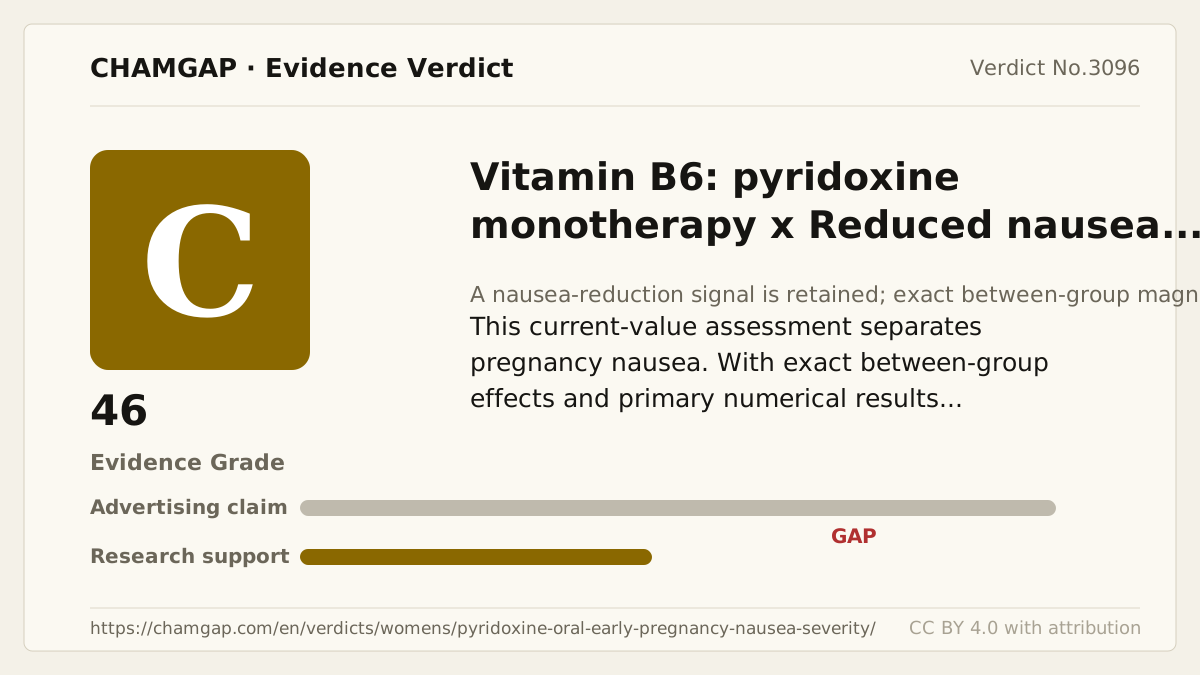
[Chamgap] Oral pyridoxine alone × nausea severity in early pregnancy — Evidence Grade C·46. 8 cited sources checked. Source: https://chamgap.com/en/verdicts/womens/pyridoxine-oral-early-pregnancy-nausea-severity/ · CC BY 4.0CC BY 4.0 — free to use with attribution; do not distort grades, numbers, or verdict meaning.
What this document does and does not do
Chamgap is an information source. It reports what research has and has not confirmed; it does not tell readers what to take or buy. That decision belongs to readers and, when needed, medical or legal professionals. This verdict reflects literature available up to the search date and may change as new research appears. Nothing here is medical advice.