
Switching to decaf during pregnancy,
does it really help with Higher birth weight and longer gestation?
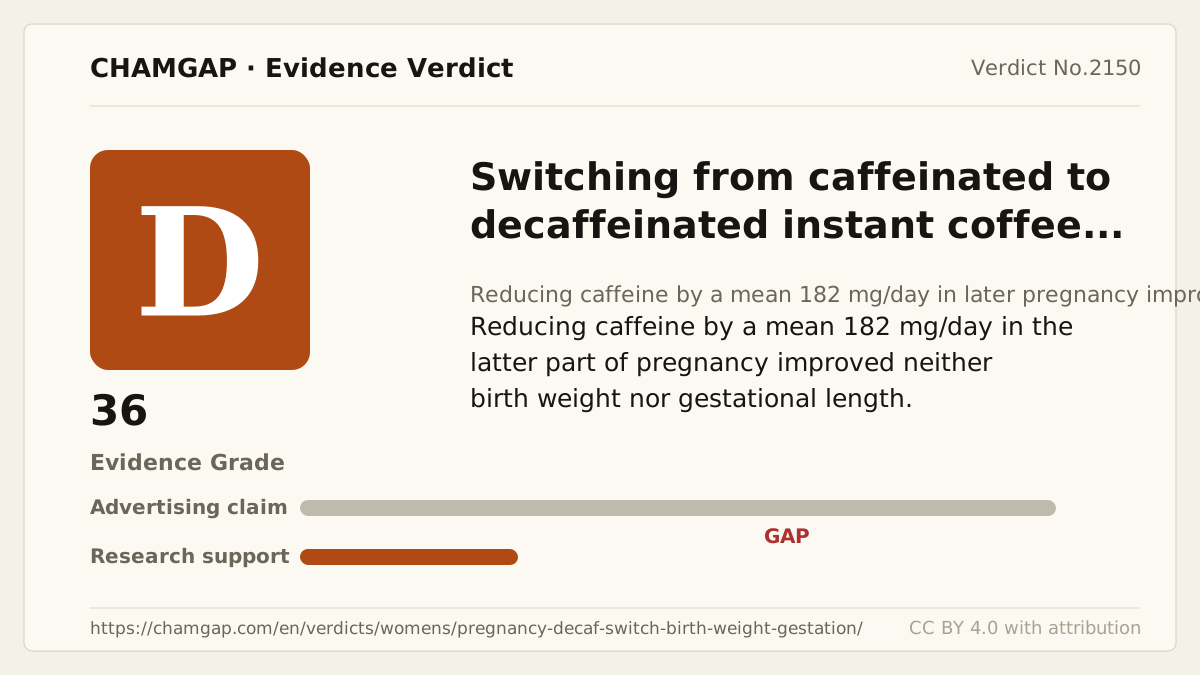
research showsThe grade is D. A double-blind trial randomized 1,207 pregnant women who drank at least three cups daily to caffeinated or decaffeinated instant coffee. Switching to decaf produced an adjusted birth-weight difference of only +16 g (95% CI -40 to 73) and a gestational-length difference of -1.31 days (-2.87 to 0.25); neither improved. This was a large direct-outcome RCT, but it was one trial and not a complete caffeine-abstinence comparison, giving D with 34 points.
ads claimThis trial reduced caffeine by switching from caffeinated to decaf coffee; it did not increase caffeine. A mean 182-mg/day reduction did not improve either birth weight or gestational length.
Useful facts when choosing a product
- Manufacturer information assigned 65 mg caffeine per study cup and 0 mg to the decaf study coffee; this was not an independent laboratory assay.
- Median total caffeine was 317 mg/day (IQR 229 to 461) in the caffeinated group and 117 mg/day (IQR 56 to 228) in the decaf group, including other sources.
- The mean between-group total-caffeine difference was 182 mg/day, and other caffeine beverages were not prohibited.
Chamgap Semantic Classification Code
Candidate index · review held
F.switching-from-caffeinated-to-decaffeinated-instant-coffee-before-gestation.food.higher-birth-weight-and-longer-gestation.increase.UNKFoods and beverages > Switching from caffeinated to decaffeinated instant coffee before ' gestation > Food consumption > Higher birth weight and longer gestation > Increase claim > Unknown
An automated migration candidate, not an issued permanent code; exact claim scope remains under review. This machine-generated migration candidate helps retrieval but is not a permanent assignment. The original verdict ID and URL remain authoritative.
What the research actually shows
Bech randomized 1,207 women below 20 weeks' gestation who drank at least three cups daily: 568 to caffeinated instant coffee and 629 to decaffeinated instant coffee. After 10 allocation errors were excluded, 1,197 remained; birth weight was analyzed in 1,150 and gestational length in 1,153. NCT00131690 lists birth weight and gestational length as main outcomes; results were +16 g (-40 to 73) and -1.31 days (-2.87 to 0.25), both null. Support came from Health Insurance Foundation grants 1105-93 and 11099-96, the Danish National Research Foundation, Pharmacy Foundation, Egmont Foundation, March of Dimes, and Augustinus Foundation. Nestle had no role in design, analysis, or writing.
Why this is classified as D (34)
A relatively large double-blind RCT was null for both birth weight and gestational length, but one trial and intervals allowing some benefit give D with 34 points.
Counterpoint. Miscarriage, complete caffeine abstinence, first-trimester exposure, and women previously drinking under three cups daily remain outside the direct trial scope.
Rejudgment record. Cross-check applied — A 1,207-participant double-blind RCT found no improvement in birth weight or gestational length from later-pregnancy caffeine reduction, while it remained a single trial allowing some benefit
| Endpoint | H | Hard endpoint - actual events such as death |
| Replication | R1 | Single confirmatory trial |
| Independence | I1 | Mixed funding sources |
| Effect size | E0 | Null |
| Precision | C0 | The confidence interval leaves room for benefit |
Stored derived and displayed grades match; this is not a current recalculation or validity check (D).
Sub-claim grades by effect
This ingredient is marketed for several effects. A single overall grade blends strong and weak claims together, so each effect is graded separately here. The overall grade reflects the strongest disconfirming or core claim.
| Effect (sub-claim) | Grade | Basis |
|---|---|---|
| Increased birth weight | D | The adjusted difference was +16 g (-40 to 73), a null result. |
| Longer gestation | D | The difference was -1.31 days (-2.87 to 0.25), showing no extension. |
| Prevention of preterm birth | D | RR was 0.81 (0.48 to 1.37), leaving substantial uncertainty. |
Cross-check — AI research and Codex final gate
Evidence Table
| Study | Design | Sample | Funding | Endpoint | Result | Weight |
|---|---|---|---|---|---|---|
| Bech et al. 2007 | Double-blind randomized controlled trial | 1,207 randomized; 1,197 after allocation-error exclusions; birth weight in 1,150 and gestation in 1,153 | Health Insurance Foundation 1105-93 and 11099-96, Danish National Research Foundation, Pharmacy Foundation, Egmont Foundation, March of Dimes, and Augustinus Foundation; Nestle had no role in design, analysis, or writing | Birth weight and length of gestation | Adjusted birth weight +16 g (95% CI -40 to 73); gestational length -1.31 days (-2.87 to 0.25) | Decisive direct randomized evidence |
| Jahanfar and Jaafar Cochrane review | Systematic review of randomized caffeine-restriction trials in pregnancy | Two eligible trials, one contributing outcome data | Cochrane systematic review | Birth weight, preterm birth, and small for gestational age | Birth weight MD +20 g (-48.68 to 88.68), preterm birth RR 0.81 (0.48 to 1.37), SGA RR 0.97 (0.57 to 1.64) | Confirms reliance on one contributing trial |
Receipt — 3 References
All 3 cited sources were verified for existence at the original page (as of 2026-08-04).
Final verification and publication gate: Codex · Evidence date: 2026-08-04 · Corrections: none
Cite this verdict
[Chamgap] Switching to decaf during pregnancy x improved birth weight and gestational length — Evidence Grade D·34. 3 cited sources checked. Source: https://chamgap.com/en/verdicts/womens/pregnancy-decaf-switch-birth-weight-gestation/ · CC BY 4.0CC BY 4.0 — free to use with attribution; do not distort grades, numbers, or verdict meaning.
What this document does and does not do
Chamgap is an information source. It reports what research has and has not confirmed; it does not tell readers what to take or buy. That decision belongs to readers and, when needed, medical or legal professionals. This verdict reflects literature available up to the search date and may change as new research appears. Nothing here is medical advice.