
Miyeokguk,
does it really help with Faster recovery of postpartum fatigue, pain, anemia, function, or recovery time?
research showsThe verdict is pending. A reproducible search on August 3, 2026 found no human efficacy trial comparing miyeokguk with a control diet for postpartum fatigue, pain, hemorrhage or anemia recovery, function, or recovery time. The soup can provide substantial iodine, but nutrient presence and faster recovery are different claims.
ads claimDried wakame truly supplies iodine, but that fact does not establish faster postpartum fatigue, pain, or functional recovery. Verdict 2031 is C with 46 points for whole wakame and a blood-glucose question, while verdict 091 is C with 50 points for a brown-seaweed polysaccharide extract and immune or anticancer claims. Neither is evidence for postpartum soup.
Useful facts when choosing a product
- A 2026 Korean postpartum study used an analysis of 30 dried-wakame samples at 15,800 micrograms/100 g, or 158 micrograms/g. This is not a direct assay of every retail bowl.
- That study standardized one 250 g bowl as containing 7 g dried wakame, equivalent to about 1,106 micrograms iodine from the pre-cooking seaweed value alone; actual bowls vary with preparation and losses.
- A nationwide survey found mean iodine intake of 3,597 micrograms/day at postpartum weeks 1-2 and 1,847 at weeks 7-8. The early mean exceeds the Korean adult upper level of 2,400 micrograms/day.
- Iodine is required for thyroid hormone synthesis, but excess can also impair thyroid function. Required does not mean more is better.
- Wakame gains several-fold weight when rehydrated, so doses should be compared in grams of dried seaweed rather than cooked soup weight.
- Soy sauce, salt, and stock add recipe-dependent sodium; no standardized finished-soup sodium assay was identified.
- Within the accessible scope of PubMed, ClinicalTrials.gov, Google Scholar, KMbase, RISS, KISS, J-STAGE, and CiNii searches on 2026-08-03, no eligible recovery trial was identified; detailed KISS results were inaccessible.
Chamgap Semantic Classification Code
Candidate index · review held
F.miyeokguk-made-by-rehydrating-and-cooking-dried-wakame.food.faster-recovery-of-postpartum-fatigue-pain-anemia-function-or-recovery-time.improve.UNKFoods and beverages > Miyeokguk made by rehydrating and cooking dried wakame > Food consumption > Faster recovery of postpartum fatigue, pain, anemia, function, or recovery time > Improvement claim > Unknown
An automated migration candidate, not an issued permanent code; exact claim scope remains under review. This machine-generated migration candidate helps retrieval but is not a permanent assignment. The original verdict ID and URL remain authoritative.
What the research actually shows
The reproducible search was run on 2026-08-03 in PubMed, ClinicalTrials.gov, Google Scholar, KMbase, RISS, KISS, J-STAGE, and CiNii. KISS blocked automated access, so detailed results could not be reviewed. No postpartum-recovery comparison trial was identified within the accessible scope. Moon 1999 measured maternal diet and breast-milk iodine, not infant thyroid outcomes. Chung 2009 directly associated excessive breast-milk iodine with subclinical hypothyroidism in preterm infants. Emder and Jack 2011 reported two cases, and Vlaardingerbroek 2021 reported one case, of neonatal hypothyroidism following maternal seaweed exposure; these are case reports, not trials.
Why this is classified as ?
No human comparison directly measuring postpartum recovery outcomes was identified within the accessible scope, leaving the verdict unscored and pending.
Counterpoint. The verdict accepts the tradition and composition facts, while neither converting missing data into benefit nor into a null result.
Rejudgment record. Cross-check applied — Postpartum recovery outcomes were re-searched in Korean, Japanese, and Chinese terms, and iodine-exposure studies were separated from efficacy trials
| Endpoint | P | Symptom or function itself is the target - including patient reports and performance tests |
Stored derived and displayed grades match; this is not a current recalculation or validity check (?).
Sub-claim grades by effect
This ingredient is marketed for several effects. A single overall grade blends strong and weak claims together, so each effect is graded separately here. The overall grade reflects the strongest disconfirming or core claim.
| Effect (sub-claim) | Grade | Basis |
|---|---|---|
| Faster postpartum recovery from miyeokguk | ? | No comparative human study of the specified recovery outcomes was identified. |
Cross-check — AI research and Codex final gate
Evidence Table
| Study | Design | Sample | Funding | Endpoint | Result | Weight |
|---|---|---|---|---|---|---|
| Reproducible literature search on 2026-08-03 | PubMed, ClinicalTrials.gov, Google Scholar, KMbase, RISS, KISS, J-STAGE, and CiNii searches | No eligible efficacy trial identified within accessible scope; KISS details inaccessible | Not applicable | Postpartum fatigue, pain, hemorrhage, anemia, function, or recovery time | No eligible human efficacy comparison of miyeokguk versus a control diet identified within accessible scope | Direct basis for a pending verdict |
Receipt — 7 References
All 7 cited sources were verified for existence at the original page (as of 2026-08-03).
Final verification and publication gate: Codex · Evidence date: 2026-08-03 · Corrections: none
Cite this verdict
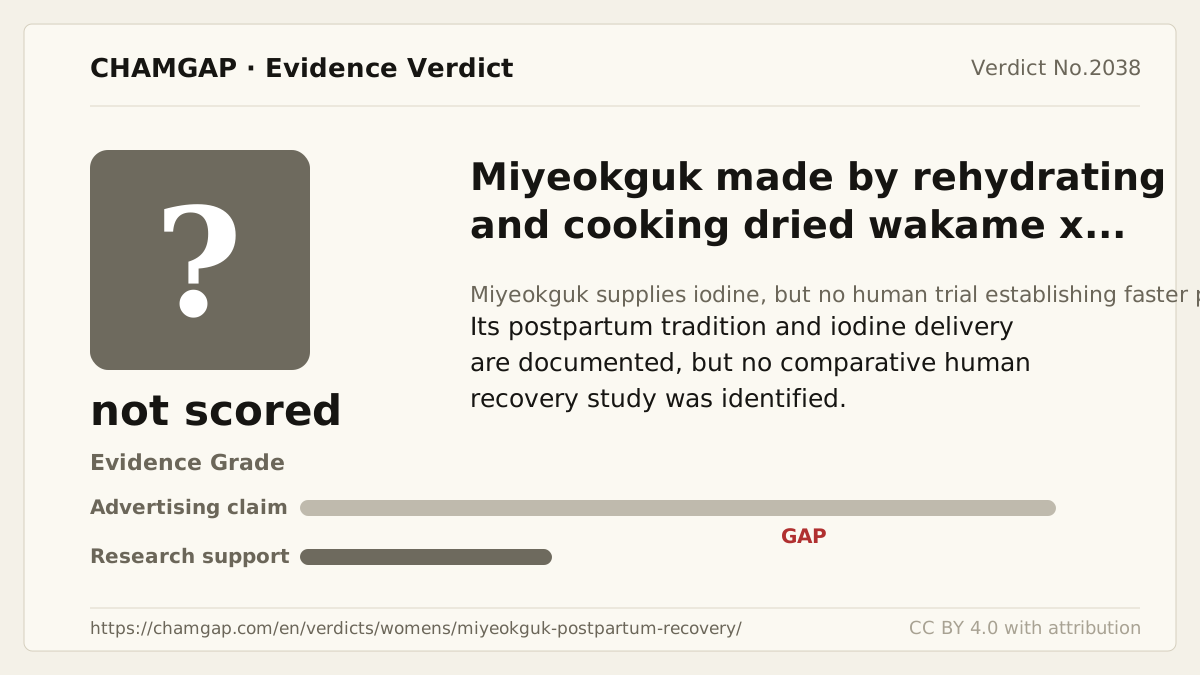
[Chamgap] Miyeokguk x faster postpartum recovery — Evidence Grade ?. 7 cited sources checked. Source: https://chamgap.com/en/verdicts/womens/miyeokguk-postpartum-recovery/ · CC BY 4.0CC BY 4.0 — free to use with attribution; do not distort grades, numbers, or verdict meaning.
What this document does and does not do
Chamgap is an information source. It reports what research has and has not confirmed; it does not tell readers what to take or buy. That decision belongs to readers and, when needed, medical or legal professionals. This verdict reflects literature available up to the search date and may change as new research appears. Nothing here is medical advice.