
Active treatment of mild chronic hypertension in pregnancy,
does it really help with Reduction of a composite of severe preeclampsia, medically indicated preterm birth, placental abruption, or fetal or neonatal death?
research showsThe grade is B with 76 points. Among 2,408 analyzed CHAP participants, active treatment reduced the primary major-pregnancy-outcome composite. In 2,325 with complete outcome data, events occurred in 353/1,170 (30.2%) versus 427/1,155 (37.0%), adjusted RR 0.82 (95% CI 0.74 to 0.92); multiple imputation across all 2,408 gave the same conclusion.
ads claimThis is evidence for fewer major pregnancy events, not merely a lower blood-pressure surrogate. Drug choice and titration require obstetric care and cannot be generalized to unsupervised treatment in nonpregnant adults.
Useful facts when choosing a product
- Preferred drugs were labetalol or extended-release nifedipine, with other pregnancy-compatible agents permitted.
- Control participants deferred treatment until severe hypertension at 160/105 mm Hg or higher.
- The trial registration is NCT02299414.
Chamgap Semantic Classification Code
Candidate index · review held
UNK.antihypertensive-strategy-treating-mild-chronic-hypertension-during-pregnancy-to-below-140-90-mm-hg.UNK.a-composite-of-severe-preeclampsia-medically-indicated-preterm-birth-placental-abruption-or-fetal-or-neonatal-death.reduce.UNKUnknown > antihypertensive strategy treating mild chronic hypertension during pregnancy to below 140/90 mm Hg > Unknown > a composite of severe preeclampsia, medically indicated preterm birth, placental abruption, or fetal or neonatal death > Reduction claim > Unknown
An automated migration candidate, not an issued permanent code; exact claim scope remains under review. This machine-generated migration candidate helps retrieval but is not a permanent assignment. The original verdict ID and URL remain authoritative.
What the research actually shows
At 61 US sites, 2,408 participants were analyzed after assignment to active treatment, 1,208, or deferred treatment, 1,200. The report describes “centralized, computerized randomization.” Its “intention-to-treat” primary analysis included all 2,408 participants, using multiple imputation for the 83 participants (3.4%) lost to follow-up; the report states, “A total of 83 patients were lost to follow-up: 38 (3.1%) … and 45 (3.8%).” Thus the primary analysis was the full ITT analysis with multiple imputation for 3.4% attrition, not a completer analysis. The prespecified registered “primary outcome” composite matched the published primary endpoint. The trial was “open-label,” while clinical-event adjudicators were “unaware of the treatment-group assignments.” Funding was public through NHLBI.
Why this is classified as B (76)
One large publicly funded randomized trial reduced hard pregnancy outcomes, but it remains a single confirmatory trial, giving B with 76 points.
Counterpoint. Antihypertensive treatment requires monitoring for hypotension and fetal growth, and some drug classes are contraindicated in pregnancy.
Rejudgment record. Cross-check applied — Cross-checked the CHAP paper, protocol, and registry for the primary endpoint, analysis denominators, missing-data handling, adjudication masking, and NHLBI funding
| Endpoint | H | Hard endpoint - actual events such as death |
| Replication | R1 | Single confirmatory trial |
| Independence | I2 | Decisive evidence is publicly or non-profit funded |
| Effect size | E+ | Meets the clinically important threshold |
Stored derived and displayed grades match; this is not a current recalculation or validity check (B).
Sub-claim grades by effect
This ingredient is marketed for several effects. A single overall grade blends strong and weak claims together, so each effect is graded separately here. The overall grade reflects the strongest disconfirming or core claim.
| Effect (sub-claim) | Grade | Basis |
|---|---|---|
| Reduction in the major pregnancy-outcome composite | B | Rates were 30.2% versus 37.0%, adjusted RR 0.82. |
| No increase in birth weight below the 10th percentile | D | Rates were 11.2% versus 10.4%, RR 1.04 (0.82 to 1.31), a null result. |
Cross-check — AI research and Codex final gate
Evidence Table
| Study | Design | Sample | Funding | Endpoint | Result | Weight |
|---|---|---|---|---|---|---|
| Tita AT, Szychowski JM, Boggess K, Dugoff L, Sibai B, Lawrence K, Hughes BL, Bell J, Aagaard K, Edwards RK, Gibson K, Haas DM, Plante L, Metz T, Casey B, Esplin S, Longo S, Hoffman M, Saade GR, Hoppe KK, Foroutan J, Tuuli M, Owens MY, Simhan HN, Frey H, Rosen T, Palatnik A, Baker S, August P, Reddy UM, Kinzler W, Su E, Krishna I, Nguyen N, Norton ME, Skupski D, El-Sayed YY, Ogunyemi D, Galis ZS, Harper L, Ambalavanan N, Geller NL, Oparil S, Cutter GR, Andrews WW, Chronic Hypertension and Pregnancy (CHAP) Trial Consortium. 2022 | Multicenter open-label pragmatic randomized superiority trial | 2,419 randomized, 2,408 analyzed after 11 immediate withdrawals; 2,325 with complete outcome data | Public funding from the US National Heart, Lung, and Blood Institute | Composite of severe preeclampsia, medically indicated preterm birth before 35 weeks, placental abruption, or fetal/neonatal death | Complete-outcome analysis 353/1,170 (30.2%) versus 427/1,155 (37.0%), adjusted RR 0.82 (95% CI 0.74 to 0.92), P<0.001; multiple imputation across all participants also RR 0.82 | Pivotal publicly funded large hard-outcome single trial |
Receipt — 1 References
All 1 cited sources were verified for existence at the original page (as of 2026-08-15).
Final verification and publication gate: Codex · Evidence date: 2026-08-15 · Corrections: none
Cite this verdict
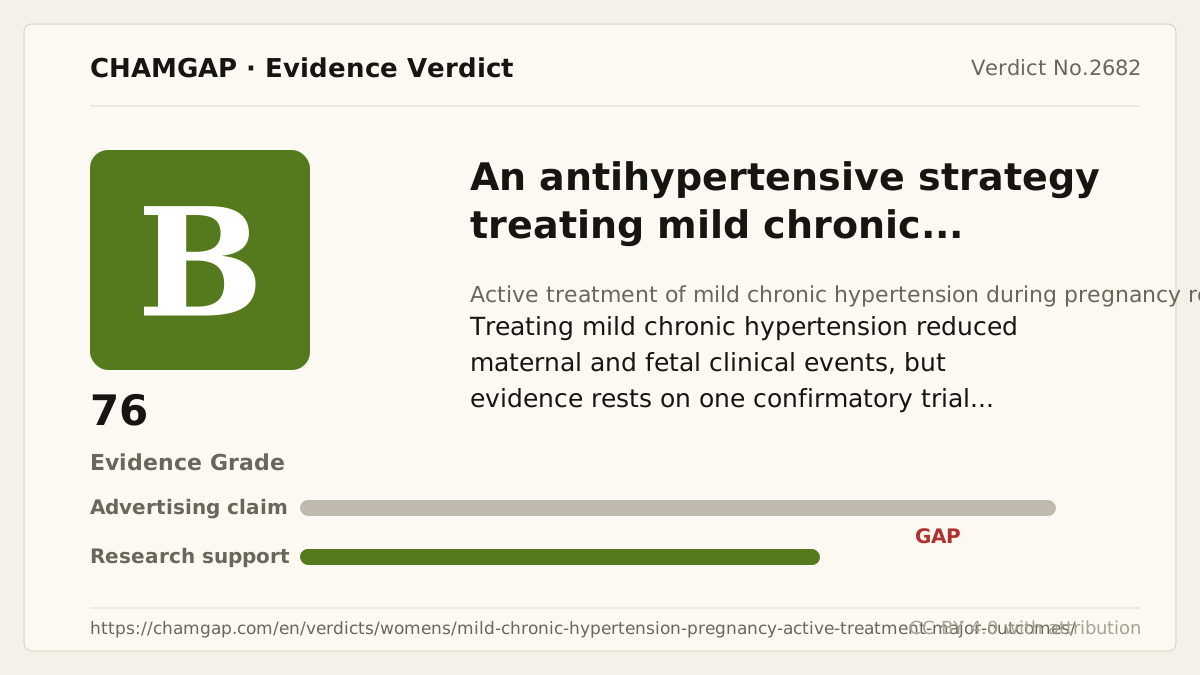
[Chamgap] Active treatment of mild chronic hypertension in pregnancy x fewer major pregnancy complications — Evidence Grade B·76. 1 cited sources checked. Source: https://chamgap.com/en/verdicts/womens/mild-chronic-hypertension-pregnancy-active-treatment-major-outcomes/ · CC BY 4.0CC BY 4.0 — free to use with attribution; do not distort grades, numbers, or verdict meaning.
What this document does and does not do
Chamgap is an information source. It reports what research has and has not confirmed; it does not tell readers what to take or buy. That decision belongs to readers and, when needed, medical or legal professionals. This verdict reflects literature available up to the search date and may change as new research appears. Nothing here is medical advice.