
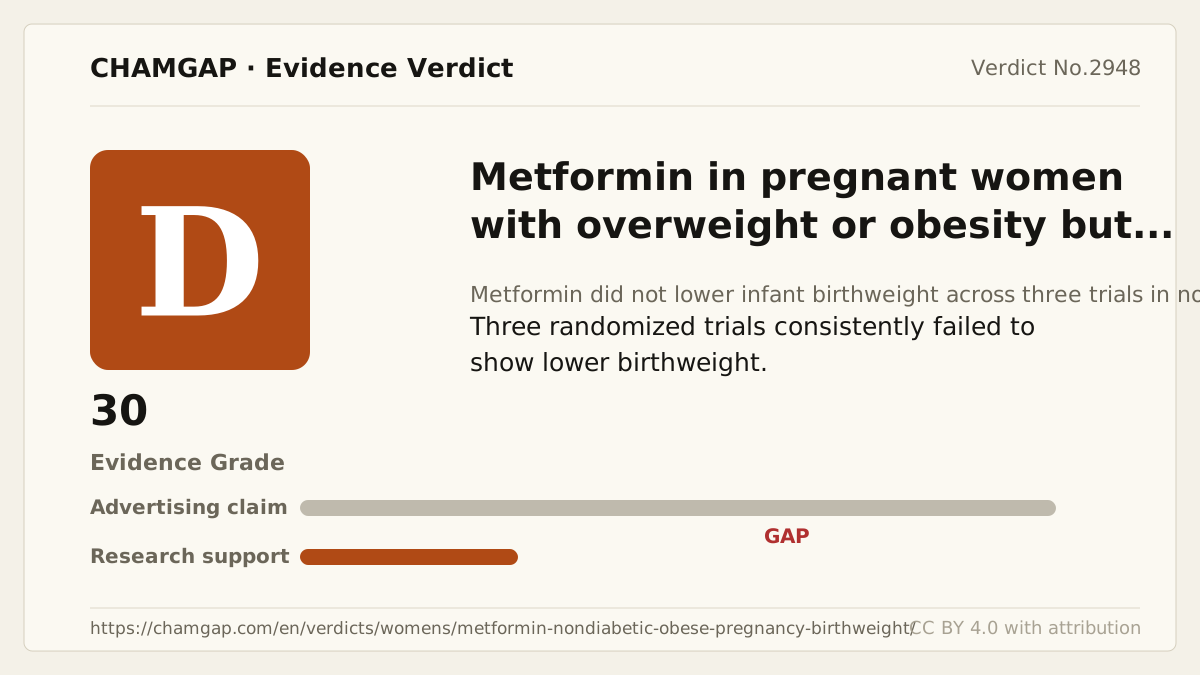
Metformin in pregnant women with overweight or obesity but no diabetes,
does it really help with Lower infant birthweight?
research showsGrade D. In EMPOWaR, mean birthweight was 3463 g with placebo and 3462 g with metformin, a 1-g difference. The adjusted difference in the primary standardized birthweight z score was also null at -0.029 (95% CI -0.217 to 0.158; P=.7597). MOP and GRoW tested the same drug in the same nondiabetic overweight or obese pregnancy context and likewise found no birthweight benefit.
ads claimA mechanistic argument about insulin resistance in pregnancy cannot substitute for lower birthweight. Three trials of the same drug were null, and the result must not be expanded to diabetes treatment.
Useful facts when choosing a product
- EMPOWaR used metformin from 12 to 16 weeks until delivery, up to 2500 mg/day.
- Birthweight z score was a surrogate for later obesity risk, not later obesity itself.
- Gastrointestinal adverse effects contributed to lower adherence.
Chamgap Semantic Classification Code
Candidate index · review held
UNK.metformin-in-pregnant-women-with-overweight-or-obesity-but-no-diabetes.UNK.infant-birthweight.reduce.placeboUnknown > Metformin in pregnant women with overweight or obesity but no diabetes > Unknown > infant birthweight > Reduction claim > Placebo
An automated migration candidate, not an issued permanent code; exact claim scope remains under review. This machine-generated migration candidate helps retrieval but is not a permanent assignment. The original verdict ID and URL remain authoritative.
What the research actually shows
EMPOWaR randomized 449 women at 15 UK NHS hospitals, 226 versus 223, in a double-blind placebo-controlled trial and analyzed 434 by modified intention to treat. MOP, NCT01273584, analyzed about 400 women and found no birthweight-z-score benefit. GRoW, ACTRN12612001277831, randomized 524 and analyzed 514, finding no reduction in birthweight above 4000 g. EMPOWaR received MRC-NIHR partnership funding, with the University of Edinburgh and NHS Lothian as co-sponsors. Merck KGaA supplied active drug and matched placebo at no cost; the paper states that it had no role in design, collection, analysis, interpretation, or writing. Axis 6 B0 evidence ① Allocation concealment: "via a web-based computer-generated block randomisation procedure" ② Masking: "Participants, caregivers, and study personnel were masked to treatment assignment." ③ Analysis set and missing data: "We did analysis by modified intention to treat." The final modified intention-to-treat set included 434 participants (97%). ④ Prespecified primary endpoint: "The primary outcome was Z score corresponding to the gestational age, parity, and sex-standardised birthweight percentile" — consistent with ISRCTN51279843
Why this is classified as D (30)
Three randomized trials in the same nondiabetic overweight or obese pregnancy context repeatedly failed to show birthweight benefit, but lacked a validated threshold to exclude meaningful benefit, giving D with 30 points.
Counterpoint. The rare fatal-outcome composite numerically favored placebo but was highly imprecise and not statistically significant.
Rejudgment record. Cross-check applied — Repeated null findings across EMPOWaR, MOP, and GRoW without a validated clinical exclusion threshold
| Endpoint | S | Surrogate marker - laboratory or imaging measures |
| Replication | RX | Repeatedly refuted in the same indication |
| Independence | I1 | Mixed funding sources |
| Effect size | E0 | Null |
| Precision | C0 | The confidence interval leaves room for benefit |
Stored derived and displayed grades match; this is not a current recalculation or validity check (D).
Sub-claim grades by effect
This ingredient is marketed for several effects. A single overall grade blends strong and weak claims together, so each effect is graded separately here. The overall grade reflects the strongest disconfirming or core claim.
| Effect (sub-claim) | Grade | Basis |
|---|---|---|
| Lower birthweight z score | D | EMPOWaR and MOP were null. |
| Fewer births above 4000 g | D | GRoW found adjusted RR 0.97, P=.899. |
Cross-check — AI research and Codex final gate
Evidence Table
| Study | Design | Sample | Funding | Endpoint | Result | Weight |
|---|---|---|---|---|---|---|
| Chiswick C et al. 2015 EMPOWaR | Multicenter double-blind placebo-controlled randomized trial | 449 randomized, 226 versus 223; modified intention-to-treat 434 | MRC-NIHR EME 08/246/09; free active drug and placebo from Merck KGaA | Standardized birthweight-percentile z score | 0.2464 vs 0.2680; adjusted difference -0.029 (95% CI -0.217 to 0.158), P=.7597; raw means 3462 g vs 3463 g | Pivotal repeated null evidence |
| Syngelaki A et al. MOP | Double-blind placebo-controlled randomized trial | 400 analyzed | Funding as reported in the source publication | Birthweight z score | 0.05 vs 0.17, P=.66 | Second null trial in the same indication |
| Dodd JM et al. 2019 GRoW | Multicenter double-blind placebo-controlled randomized trial | 524 randomized, 514 analyzed | Australian National Health and Medical Research Council | Birthweight above 4000 g | 40 (16%) vs 37 (14%), adjusted RR 0.97 (95% CI 0.65 to 1.47), P=.899 | Independent repeated null evidence |
Receipt — 3 References
All 3 cited sources were verified for existence at the original page (as of 2026-08-26).
Final verification and publication gate: Codex · Evidence date: 2026-08-26 · Corrections: none
Cite this verdict
[Chamgap] No Benefit of Metformin for Infant Birthweight in Nondiabetic Pregnancy With Obesity — Evidence Grade D·30. 3 cited sources checked. Source: https://chamgap.com/en/verdicts/womens/metformin-nondiabetic-obese-pregnancy-birthweight/ · CC BY 4.0CC BY 4.0 — free to use with attribution; do not distort grades, numbers, or verdict meaning.
What this document does and does not do
Chamgap is an information source. It reports what research has and has not confirmed; it does not tell readers what to take or buy. That decision belongs to readers and, when needed, medical or legal professionals. This verdict reflects literature available up to the search date and may change as new research appears. Nothing here is medical advice.