
Menstrual cup use,
does it really help with Associated with increased copper intrauterine-device expulsion?
research showsThe grade is C. In a secondary observational analysis of 1,046 participants in a three-year copper-IUD trial, expulsion occurred in 58/250 cup users (23.2%) and 75/796 nonusers (9.4%): an absolute difference of 13.8 points and crude OR 2.90 (95% CI 1.99-4.24). Cup use itself was not randomized, and the adjusted increase was confirmed only with NTCu380-Mini.
ads claimMenstrual cups are sold in Korea and copper IUDs are clinician-inserted. Counseling should discuss breaking the seal and avoiding traction on strings, but the same risk multiplier cannot be assigned to every copper-IUD design.
Useful facts when choosing a product
- The parent trial compared TCu380A with the smaller Nova-T-frame NTCu380-Mini.
- The overall 36-month absolute difference was 13.8 percentage points, but device-specific results differed.
- Accidental self-removal was 3/53 vs 0/150 with TCu380A and 20/197 vs 7/646 with NTCu380-Mini.
Chamgap Semantic Classification Code
Candidate index · review held
UNK.menstrual-cup-use.intrauterine.associated-with-increased-copper-intrauterine-device-expulsion.increase.UNKUnknown > Menstrual cup use > Intrauterine > Associated with increased copper intrauterine-device expulsion > Increase claim > Unknown
An automated migration candidate, not an issued permanent code; exact claim scope remains under review. This machine-generated migration candidate helps retrieval but is not a permanent assignment. The original verdict ID and URL remain authoritative.
What the research actually shows
Brown et al. analyzed NCT03124160 secondarily. Of 1,105 randomized in the parent IUD trial, 1,046 with successful placement, follow-up, and menstrual-product data were analyzed. Expulsion included spontaneous partial or complete expulsion and accidental self-removal; IUD presence was checked at scheduled visits by digital, speculum, or sonographic examination. Exposure meant any reported cup use, with disc-only users included in the primary exposure definition. After the signal appeared, investigators added menstrual-product tracking and advised against cup use, leaving 19.3% of early visits without product-use documentation. The registered randomized comparison concerned IUD type, not cup use. Original funding was from the Bill & Melinda Gates Foundation, NICHD, and Mona Lisa N.V.
Why this is classified as C (54)
A hard-event signal and large absolute difference support the harm claim, but this was one nonrandomized secondary exposure analysis with protocol-dependent measurement, residual confounding, and no frequency or timing analysis, giving C with 54 points.
Counterpoint. The grade reflects evidence strength, not moderate severity. Overall expulsion was not increased for TCu380A itself.
Rejudgment record. Cross-check applied — Absolute and device-specific odds from a nonrandomized cup-exposure analysis nested within an IUD trial, with confounding and mid-study measurement changes
| Endpoint | H | Hard endpoint - actual events such as death |
| Replication | R1 | Single confirmatory trial |
| Independence | I1 | Mixed funding sources |
| Effect size | E+ | Meets the clinically important threshold |
Stored derived and displayed grades match; this is not a current recalculation or validity check (C).
Sub-claim grades by effect
This ingredient is marketed for several effects. A single overall grade blends strong and weak claims together, so each effect is graded separately here. The overall grade reflects the strongest disconfirming or core claim.
| Effect (sub-claim) | Grade | Basis |
|---|---|---|
| Increased expulsion with NTCu380-Mini and cup use | C | Rates were 25.4% vs 8.5%, adjusted OR 3.13. |
| Increased overall expulsion with TCu380A and cup use | D | Rates were 15.1% vs 13.3%, OR 1.16, not confirming an increase. |
Cross-check — AI research and Codex final gate
Evidence Table
| Study | Design | Sample | Funding | Endpoint | Result | Weight |
|---|---|---|---|---|---|---|
| Brown et al. 2024 | Nonrandomized secondary observational analysis within a copper-IUD randomized trial | 1,046 analyzed; 250 cup users and 796 nonusers | Bill & Melinda Gates Foundation, NICHD, and Mona Lisa N.V. | Partial or complete expulsion and accidental self-removal through 12 and 36 months | At 36 months, 23.2% vs 9.4%, absolute difference 13.8 points, crude OR 2.90 (1.99-4.24); NTCu380-Mini adjusted OR 3.13 (1.16-8.46) | Pivotal single observational analysis |
Receipt — 2 References
All 2 cited sources were verified for existence at the original page (as of 2026-08-08).
Final verification and publication gate: Codex · Evidence date: 2026-08-08 · Corrections: none
Cite this verdict
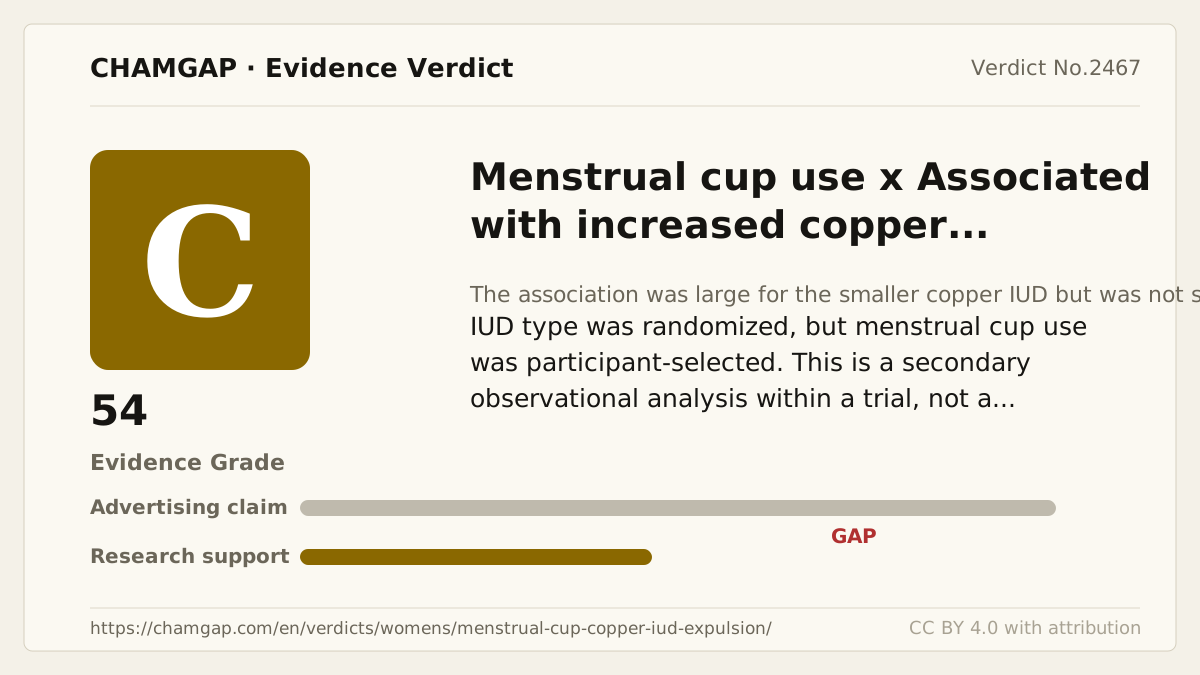
[Chamgap] Menstrual cup use x associated with increased copper-IUD expulsion — Evidence Grade C·54. 2 cited sources checked. Source: https://chamgap.com/en/verdicts/womens/menstrual-cup-copper-iud-expulsion/ · CC BY 4.0CC BY 4.0 — free to use with attribution; do not distort grades, numbers, or verdict meaning.
What this document does and does not do
Chamgap is an information source. It reports what research has and has not confirmed; it does not tell readers what to take or buy. That decision belongs to readers and, when needed, medical or legal professionals. This verdict reflects literature available up to the search date and may change as new research appears. Nothing here is medical advice.