
Maternal RSVpreF vaccine,
does it really help with Prevention of severe RSV lower respiratory tract illness in infants through 6 months of age by maternal vaccination?
research showsThe maternal bivalent RSVpreF vaccine receives B for preventing severe RSV lower respiratory tract illness in infants through 6 months of age after vaccination during pregnancy. In the Pfizer-sponsored phase 3 MATISSE trial, 7,392 participants were randomized and vaccine efficacy against severe medically attended RSV lower respiratory tract illness was 81.8% through 90 days and 69.4% through 180 days. This is a large effect on a clinically important infectious-disease endpoint, but pivotal confirmation is concentrated in one manufacturer trial and the co-primary endpoint of medically attended RSV lower respiratory tract illness of any severity did not meet its prespecified success criterion. Preterm birth occurred in 5.7% versus 4.7%, a numerical but non-significant imbalance with unproven causality, so the authorized and recommended vaccination window of 32 weeks 0 days through 36 weeks 6 days remains an important safety constraint.
ads claimMarketing can turn prevention of severe disease into a promise of complete protection against every infant RSV infection. The strongest evidence applies to severe medically attended RSV lower respiratory tract illness through 6 months, while the endpoint for illness of any severity was weaker.
Useful facts when choosing a product
- Abrysvo is a bivalent, nonadjuvanted protein vaccine containing stabilized prefusion F antigens from RSV A and RSV B, administered as one 0.5-mL intramuscular dose during pregnancy.
- United States guidance uses one dose at 32 weeks 0 days through 36 weeks 6 days, generally from September through January in most of the continental United States. Authorization and RSV seasonality differ by country, so the local label and immunization guidance take priority.
- Most infants do not need both maternal vaccination and a long-acting infant RSV monoclonal antibody. Infant antibody prophylaxis may be selected according to vaccination timing, prior maternal vaccination, and timing of birth.
- Injection-site pain is common. In MATISSE, preterm birth occurred in 5.7% versus 4.7%, RR 1.20 (95% CI 0.98 to 1.46), which is not a statistically established harm and must be distinguished from the preterm-birth signal in the trial of GSK's different vaccine. Administration before 32 weeks or after 36 weeks 6 days falls outside the recommended United States window.
Chamgap Semantic Classification Code
Candidate index · review held
M.maternal-bivalent-rsv-prefusion-f-vaccine.intramuscular.severe-rsv-lower-respiratory-tract-illness-through-of-age-by-maternal-vaccination.prevent.placeboMedicinal interventions > Maternal bivalent RSV prefusion-F vaccine > Intramuscular > severe RSV lower respiratory tract illness through of age by maternal vaccination > Occurrence-prevention claim > Placebo
An automated migration candidate, not an issued permanent code; exact claim scope remains under review. This machine-generated migration candidate helps retrieval but is not a permanent assignment. The original verdict ID and URL remain authoritative.
What the research actually shows
The phase 3 MATISSE trial by Kampmann and colleagues assigned healthy participants with singleton pregnancies in 18 countries to one 120-microgram dose of RSVpreF or placebo at 24 to 36 weeks of gestation. The 2023 prespecified interim analysis succeeded for the severe RSV lower respiratory illness co-primary endpoint but not for the co-primary endpoint of medically attended illness of any severity. Final follow-up confirmed severe-disease efficacy of 82.4% through 90 days and 70.0% through 180 days, but it remains a later analysis of the same trial. Preterm birth in MATISSE occurred in 5.7% versus 4.7% (RR 1.20, 95% CI 0.98 to 1.46), leaving causality unresolved; the United States FDA and CDC use a seasonal window of 32 weeks 0 days through 36 weeks 6 days to reduce potential risk. The GSK monovalent RSVPreF3-Mat trial that was stopped early for a preterm-birth and neonatal-death signal was a different vaccine and trial from Pfizer's bivalent RSVpreF MATISSE study.
Why this is classified as B (77)
Through 90 days, severe medically attended RSV lower respiratory tract illness occurred in 6 versus 33 infants, for 81.8% vaccine efficacy on a direct hard infectious-disease prevention endpoint. The event count was small, pivotal evidence remains concentrated in one Pfizer-sponsored trial, and the co-primary endpoint for illness of any severity missed its prespecified success criterion. The large direct effect supports the upper B range, while the limited events and single pivotal trial yield B with 77 points.
Counterpoint. For an eligible pregnant person vaccinated at the correct time, maternal antibody transfer is a practical way to protect an infant during the most vulnerable first RSV season. When preterm-birth risk is high or the vaccination window has passed, maternal and pediatric clinicians can consider long-acting infant RSV antibody prophylaxis instead.
Rejudgment record. Cross-check applied — Placed the verdict in the upper B range because 6 versus 33 severe cases and 81.8% efficacy through 90 days constitute a large effect on a direct hard infectious-disease prevention endpoint, while retaining B because events were few, evidence centers on one Pfizer-sponsored pivotal trial, and the co-primary endpoint for illness of any severity missed its prespecified success criterion
Sub-claim grades by effect
This ingredient is marketed for several effects. A single overall grade blends strong and weak claims together, so each effect is graded separately here. The overall grade reflects the strongest disconfirming or core claim.
| Effect (sub-claim) | Grade | Basis |
|---|---|---|
| Prevention of severe medically attended RSV lower respiratory tract illness through 90 days | B | There were 6 versus 33 cases, for 81.8% vaccine efficacy, a large clinical effect from one manufacturer pivotal trial. |
| Prevention of severe medically attended RSV lower respiratory tract illness through 180 days | B | There were 19 versus 62 cases, for 69.4% vaccine efficacy sustained through 6 months. |
| Prevention of medically attended RSV lower respiratory tract illness of any severity through 90 days | C | Vaccine efficacy was 57.1%, but the prespecified multiplicity-adjusted statistical success criterion was not met. |
Cross-check — AI research and Codex final gate
Evidence Table
| Study | Design | Sample | Funding | Endpoint | Result | Weight |
|---|---|---|---|---|---|---|
| Kampmann B et al.; MATISSE Study Group. 2023 | Prespecified interim analysis of a multinational phase 3 randomized double-blind placebo-controlled trial | 7,392 pregnant participants randomized, 7,358 vaccinated, and 7,128 infants evaluated for efficacy | Sponsored by Pfizer | Severe and any medically attended RSV lower respiratory tract illness through 90 to 180 days | Vaccine efficacy against severe illness was 81.8% through 90 days and 69.4% through 180 days; 57.1% efficacy through 90 days for medically attended illness of any severity did not meet the prespecified success criterion. | Pivotal large direct efficacy evidence |
| Fleming-Dutra KE et al. 2023 ACIP recommendation | Systematic evidence assessment and United States immunization recommendation | Evidence assessment of the 7,392-participant phase 3 trial and a 581-participant phase 2b trial | United States CDC and public funding | Infant RSV lower respiratory illness, hospitalization, preterm birth, and hypertensive disorders of pregnancy | Recommended one seasonal dose at 32 to 36 weeks of gestation. Preterm birth in MATISSE was 5.7% versus 4.7%, RR 1.20 (95% CI 0.98 to 1.46), not a statistically established harm, and continued safety surveillance was advised. | Independent policy context and safety assessment |
Receipt — 2 References
All 2 cited sources were verified for existence at the original page (as of 2026-07-24).
Final verification and publication gate: Codex · Evidence date: 2026-07-24 · Corrections: none
Cite this verdict
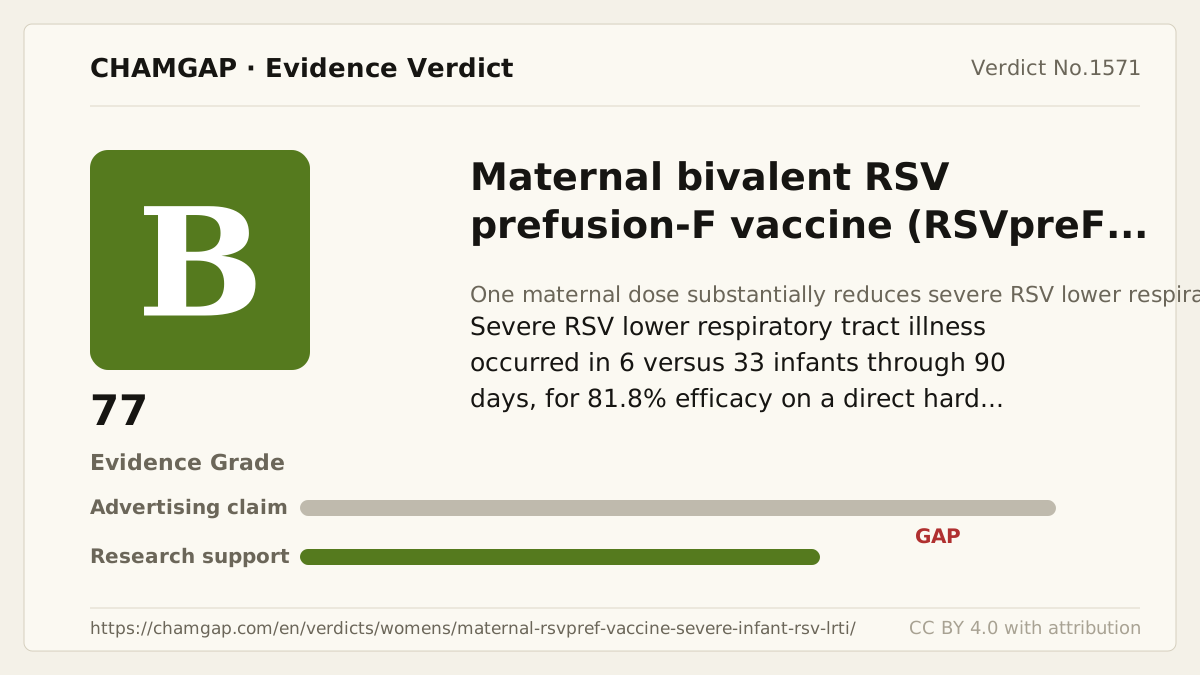
[Chamgap] Maternal RSVpreF vaccine x prevention of severe infant RSV lower respiratory tract illness through 6 months — Evidence Grade B·77. 2 cited sources checked. Source: https://chamgap.com/en/verdicts/womens/maternal-rsvpref-vaccine-severe-infant-rsv-lrti/ · CC BY 4.0CC BY 4.0 — free to use with attribution; do not distort grades, numbers, or verdict meaning.
What this document does and does not do
Chamgap is an information source. It reports what research has and has not confirmed; it does not tell readers what to take or buy. That decision belongs to readers and, when needed, medical or legal professionals. This verdict reflects literature available up to the search date and may change as new research appears. Nothing here is medical advice.