
Local heat therapy,
does it really help with Relief of pain from primary dysmenorrhea?
research showsThe fact that a patch transfers heat is separated from the claim that menstrual pain improves. Akin randomized 84 participants among four double-dummy combinations of heated or unheated sham patch and ibuprofen or placebo tablets in a two-day trial. Among 81 analyzed participants, cumulative pain relief was 3.27 with heat plus placebo tablets versus 1.95 with the unheated patch plus placebo, meeting the primary endpoint. A meta-analysis of 57 trials and 5,359 participants found a longer-term visual-analog-scale weighted mean difference of -1.85 cm. No established disease-specific minimal important difference was identified, and the pivotal trial was small and short, yielding C.
ads claimIt is physically true that a heat product transfers thermal energy, but this alone does not prove pain efficacy. Randomized trials separately support efficacy, and they do not establish identical effects for every product, temperature, or duration.
Useful facts when choosing a product
- The Akin trial used a thin abdominal patch delivering 38.9 degrees Celsius over 180 square centimeters for about 12 hours daily over two days. This is a measured device and temperature fact.
- The pivotal comparator was a visually matching unheated patch plus placebo tablet, not simply no treatment. Many longer-term comparisons in the 2026 synthesis used no-treatment controls.
- Verdict 1034, which is B with 70 points, concerns mefenamic acid, and verdict 857, which is B with 75 points, concerns ibuprofen for primary dysmenorrhea. This verdict concerns a nonpharmacologic local heat intervention.
- Verdict 1547, which is C with 43 points, concerns paraffin baths for hand osteoarthritis; verdict 1459, which is D with 27 points, concerns far-infrared sauna for inflammatory arthritis; verdict 1488, which is D with 36 points, concerns heated eye masks. A shared heat label does not transfer evidence across indications.
Chamgap Semantic Classification Code
Candidate index · review held
UNK.local-superficial-heat-therapy.UNK.pain-from-primary-dysmenorrhea.relieve.MULTIUnknown > Local superficial heat therapy > Unknown > pain from primary dysmenorrhea > Symptom-relief claim > Multiple: primary unresolved
An automated migration candidate, not an issued permanent code; exact claim scope remains under review. This machine-generated migration candidate helps retrieval but is not a permanent assignment. The original verdict ID and URL remain authoritative.
What the research actually shows
Akin 2001 randomized 84 participants to four double-dummy combinations of heated or unheated patch and ibuprofen or placebo tablets; 81 completed the protocol and were analyzed. Two-day cumulative pain relief was 3.27 with heat plus placebo tablets versus 1.95 with unheated patch plus placebo, P<0.001, meeting the prespecified primary comparison, and was similar to 3.07 with ibuprofen. Yuan 2026 synthesized 57 trials and 5,359 participants. Versus no treatment, the visual-analog-scale weighted mean difference at three months or longer was -1.85 cm (95% CI -2.29 to -1.41) across 25 trials and 2,393 participants; within 24 hours it was -3.52 cm (-5.01 to -2.02) across three trials and 248 participants. No established disease-specific minimal important difference for dysmenorrhea was identified. Participant masking occurred in 5%, allocation concealment in 30%, with high heterogeneity and funnel asymmetry, so certainty was low.
Why this is classified as C (50)
The 57-trial pooled visual-analog-scale difference of -1.85 cm was statistically positive, but no established disease-specific minimal important difference was identified, giving E~. The sham-controlled Akin trial was limited to 84 participants and two days, creating both small-sample and short-duration defects and B2. P, R2, I1, E~, and B2 yield C with 50 points.
Counterpoint. Avoid prolonged high temperature directly on skin, especially with sensory or circulation impairment. New, severe, or nonmenstrual pain warrants assessment for a secondary cause such as endometriosis.
Rejudgment record. Cross-check applied — Pain reduction was statistically positive, but no disease-specific minimal important difference was established and the pivotal sham-patch trial was limited to 84 participants and two days, giving P, R2, I1, E~, and B2
| Endpoint | P | Symptom or function itself is the target - including patient reports and performance tests |
| Replication | R2 | Independently replicated across trials |
| Independence | I1 | Mixed funding sources |
| Effect size | E~ | Statistically positive but below the threshold |
Stored derived and displayed grades match; this is not a current recalculation or validity check (C).
Sub-claim grades by effect
This ingredient is marketed for several effects. A single overall grade blends strong and weak claims together, so each effect is graded separately here. The overall grade reflects the strongest disconfirming or core claim.
| Effect (sub-claim) | Grade | Basis |
|---|---|---|
| Acute dysmenorrhea relief with a low-level abdominal heat patch | C | The primary endpoint succeeded against an unheated patch, but only 81 participants were analyzed. |
| Pain reduction after three months or longer of repeated local heat | C | The 25-trial pooled difference was statistically positive, but no disease-specific minimal important difference was established, and masking and heterogeneity lowered certainty. |
| Dysmenorrhea relief with local heat compared with nonsteroidal anti-inflammatory drugs | C | Pooled estimates were similar or favorable, but active-control heterogeneity and lack of masking were substantial. |
Cross-check — AI research and Codex final gate
Evidence Table
| Study | Design | Sample | Funding | Endpoint | Result | Weight |
|---|---|---|---|---|---|---|
| Akin MD et al. 2001 | Randomized double-dummy unheated-patch, placebo, and active-controlled trial | 84 randomized; 81 actually completed the protocol and were analyzed | Product-development evaluation context with several authors from Health Quest Therapy and Research Institute; specific funding not reported in the public abstract | Cumulative pain relief and pain intensity across 17 time points over two days | Heat plus placebo tablets 3.27 versus unheated patch plus placebo 1.95, P<0.001, meeting the primary endpoint; ibuprofen 3.07. | Pivotal sham-device-controlled trial |
| Yuan D et al. 2026 | Systematic review and meta-analysis of randomized trials | 57 randomized trials and 5,359 participants; 25 trials and 2,393 in the longer-term no-treatment comparison | Chengdu University of Traditional Chinese Medicine University-Institute Joint Innovation Fund LH202402049 and Sichuan provincial project 2022YFS0401; no commercial conflict declared | Pain intensity on a 10-cm visual analog scale within 24 hours and at three months or longer | Longer-term WMD -1.85 cm (95% CI -2.29 to -1.41), a statistical reduction; no disease-specific minimal important difference was established, and certainty was low because of masking and heterogeneity. | Independent multiple-trial synthesis |
Receipt — 2 References
All 2 cited sources were verified for existence at the original page (as of 2026-07-24).
Final verification and publication gate: Codex · Evidence date: 2026-07-24 · Corrections: none
Cite this verdict
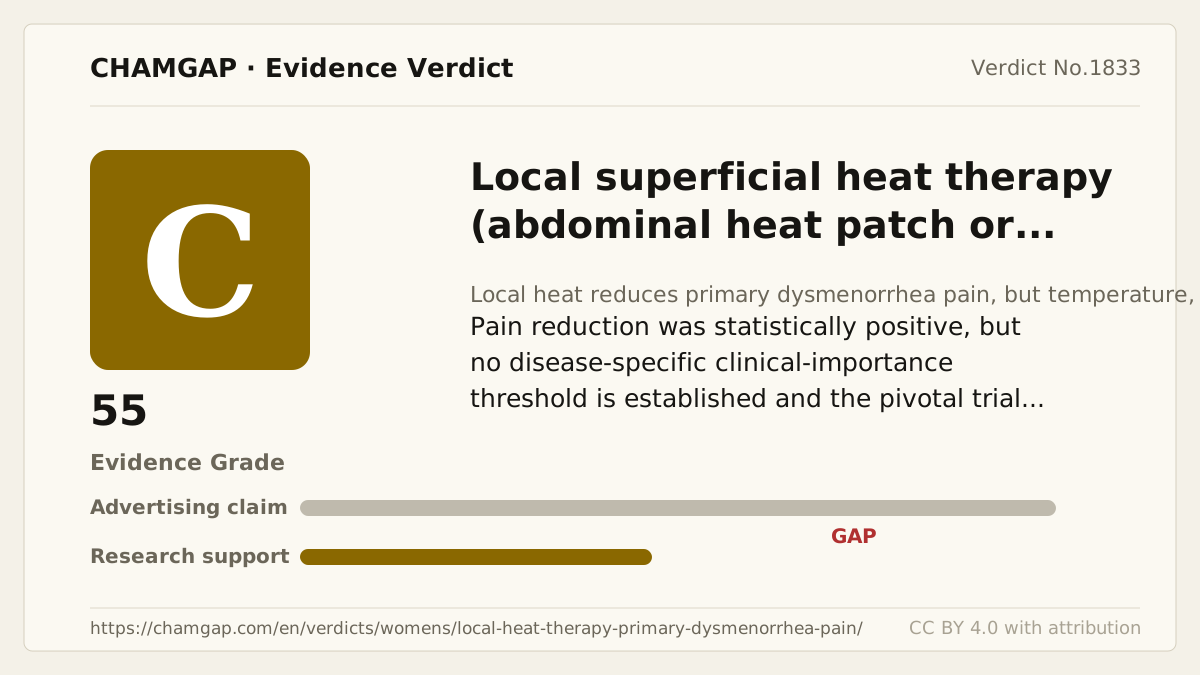
[Chamgap] Local heat therapy x relief of primary dysmenorrhea — Evidence Grade C·50. 2 cited sources checked. Source: https://chamgap.com/en/verdicts/womens/local-heat-therapy-primary-dysmenorrhea-pain/ · CC BY 4.0CC BY 4.0 — free to use with attribution; do not distort grades, numbers, or verdict meaning.
What this document does and does not do
Chamgap is an information source. It reports what research has and has not confirmed; it does not tell readers what to take or buy. That decision belongs to readers and, when needed, medical or legal professionals. This verdict reflects literature available up to the search date and may change as new research appears. Nothing here is medical advice.