
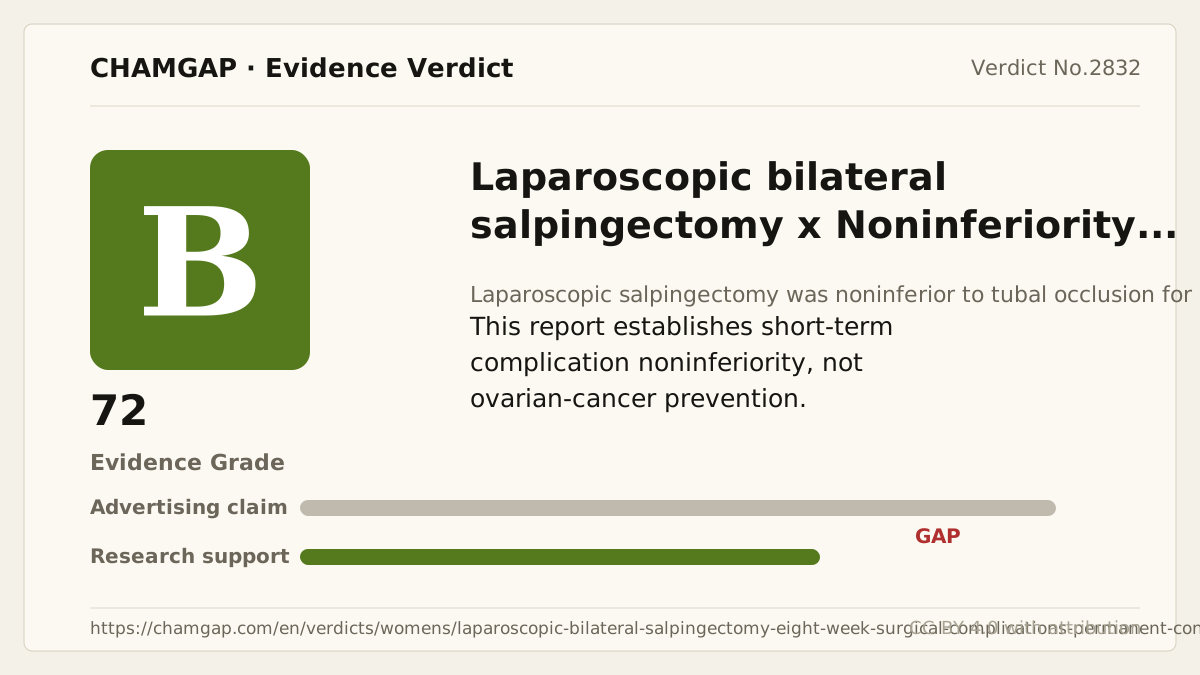
Laparoscopic bilateral salpingectomy,
does it really help with Noninferiority to tubal occlusion for surgical complications through eight weeks after permanent contraception?
research showsThe grade is B with 72 points. In SALSTER's multiply imputed per-protocol analysis, any complication through eight weeks occurred in 8.1% after salpingectomy and 6.2% after tubal occlusion: absolute difference 1.9 percentage points (95% CI -1.4 to 5.3). The 5.3-point upper bound was below the prespecified 10-point margin.
ads claimFive existing contraception verdicts in the corpus concern contraceptive use, continuation, access, or other interventions. SALSTER instead compares which permanent-contraception operation to perform.
Useful facts when choosing a product
- Severe complications occurred in one participant (0.2%) in each group.
- Salpingectomy can require more operative steps, dissection, ports, and time than occlusion.
- The second long-term primary outcome, age at natural menopause, was not reported in this paper.
Chamgap Semantic Classification Code
Candidate index · review held
P.laparoscopic-bilateral-salpingectomy.procedural.noninferiority-to-tubal-occlusion-for-surgical-complications-through-after-permanent-contraception.noninferior.MULTIProcedures, devices and tests > Laparoscopic bilateral salpingectomy > Procedural > Noninferiority to tubal occlusion for surgical complications through after permanent contraception > Noninferiority claim > Multiple: primary unresolved
An automated migration candidate, not an issued permanent code; exact claim scope remains under review. This machine-generated migration candidate helps retrieval but is not a permanent assignment. The original verdict ID and URL remain authoritative.
What the research actually shows
Forty-one Swedish gynecology departments randomized 1,066 participants, 539 versus 527. The prespecified primary population was per protocol, appropriate for noninferiority, with 473 versus 499 analyzed using multiple imputation; full-analysis-set and complete-case sensitivity analyses were similar. Limitation name: noninferiority design. Which listed item: noninferiority design. Was it avoidable: yes - a superiority design could test fewer complications, but the study asked whether the added surgical extent accepted for possible cancer prevention was no more than 10 points worse. Substantial attrition (>=15%): 94/1,066 (8.8%) were outside the primary PP population, so not applicable. Active comparator only: unavoidable - sham laparoscopic sterilization would not provide contraception and was not counted. Public and nonprofit funders were the Swedish Cancer Society, Lena Wäppling Foundation, Swedish ALF agreement, Umeå University, County of Värmland, and Gothenburg Society of Medicine.
Why this is classified as B (72)
A large publicly funded registry-based randomized trial found actual eight-week complications within a prespecified 10-point margin. A single pivotal trial and noninferiority design give B with 72 points.
Counterpoint. The 10-point margin was larger than the observed 6.2% control event rate. Noninferiority is not proof of identical risk, and the point estimate was 1.9 points higher after salpingectomy.
Rejudgment record. Article and registry cross-check — SALSTER's prespecified PP analysis, multiple imputation, eight-week absolute difference, 10-point margin, and public funding
| Endpoint | H | Hard endpoint - actual events such as death |
| Replication | R1 | Single confirmatory trial |
| Independence | I2 | Decisive evidence is publicly or non-profit funded |
| Effect size | E+ | Meets the clinically important threshold |
Stored derived and displayed grades match; this is not a current recalculation or validity check (B).
Sub-claim grades by effect
This ingredient is marketed for several effects. A single overall grade blends strong and weak claims together, so each effect is graded separately here. The overall grade reflects the strongest disconfirming or core claim.
| Effect (sub-claim) | Grade | Basis |
|---|---|---|
| Noninferiority for any surgical complication through eight weeks | B | The 5.3-point upper bound was below the 10-point margin. |
| Reduced ovarian-cancer incidence | ? | This was not the reported primary endpoint and was not directly measured. |
| Preserved long-term ovarian function | ? | Age at natural menopause has not yet been reported. |
Cross-check — AI research and Codex final gate
Evidence Table
| Study | Design | Sample | Funding | Endpoint | Result | Weight |
|---|---|---|---|---|---|---|
| Strandell A et al. 2024 SALSTER | Swedish national registry-based randomized noninferiority trial | 1,066 randomized, 539 versus 527; 473 versus 499 in the multiply imputed per-protocol analysis | Public and nonprofit Swedish cancer-society, ALF, university, regional, and foundation funding | Any physician-assessed complication through eight postoperative weeks | 8.1% versus 6.2%; absolute difference 1.9 points (95% CI -1.4 to 5.3); RR 1.33 (0.82 to 2.10); 10-point noninferiority margin | Pivotal single short-term surgical-safety trial |
Receipt — 1 References
All 1 cited sources were verified for existence at the original page (as of 2026-08-18).
Final verification and publication gate: Codex · Evidence date: 2026-08-18 · Corrections: none
Cite this verdict
[Chamgap] Laparoscopic Bilateral Salpingectomy for Eight-Week Surgical Complications in Permanent Contraception - Benefit — Evidence Grade B·72. 1 cited sources checked. Source: https://chamgap.com/en/verdicts/womens/laparoscopic-bilateral-salpingectomy-eight-week-surgical-complications-permanent-contraception-salster/ · CC BY 4.0CC BY 4.0 — free to use with attribution; do not distort grades, numbers, or verdict meaning.
What this document does and does not do
Chamgap is an information source. It reports what research has and has not confirmed; it does not tell readers what to take or buy. That decision belongs to readers and, when needed, medical or legal professionals. This verdict reflects literature available up to the search date and may change as new research appears. Nothing here is medical advice.