
Up to 30 minutes of immersive virtual reality with audio guidance during labor,
does it really help with Immediate labor-pain reduction before pharmacologic analgesia?
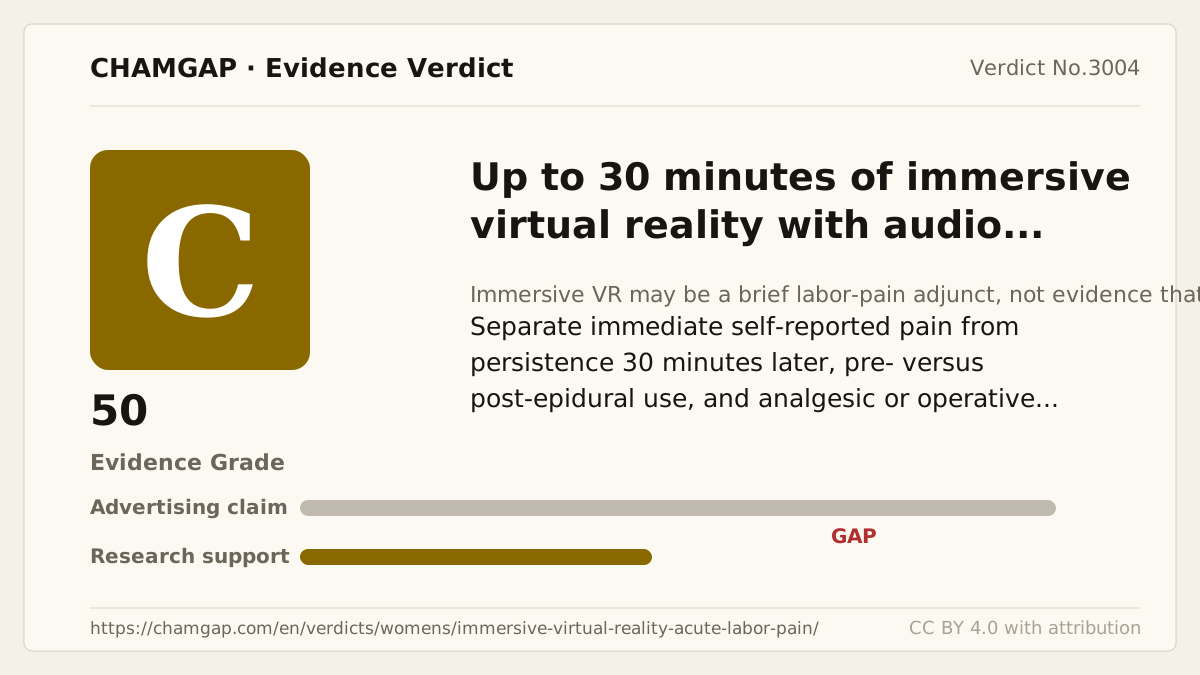
research showsGrade C with 50 points. In a 40-person trial of term nulliparous women, pain changed by +0.58 with control and -0.52 with VR, a between-group change difference of -1.10 points, P=.03. The 95% CI was unavailable, and a 30-minute unblinded trial does not establish pain control throughout labor or reduced epidural or cesarean use.
ads claimClaims such as 'VR instead of an epidural' or 'surgery-free birth with VR' extend an immediate pain-score signal to treatment replacement and obstetric-event prevention.
Useful facts when choosing a product
- The key intervention combined nature scenes, distraction, and labor-specific audio.
- Content, exposure time, headset, and epidural status varied among trials.
- All 40 participants were analyzed, but the trial was too small to assess rare maternal or neonatal harms.
Chamgap Semantic Classification Code
Permanent code issued
P.immersive-virtual-reality.device.labor-pain.reduce.standard-careProcedures, devices and tests > Up to 30 minutes of immersive virtual reality with audio guidance during labor > Device delivered > Immediate labor-pain reduction before pharmacologic analgesia > Reduction claim > Standard care
Codex retrospectively verified the principal intervention, delivery, population, endpoint, and comparator from the existing reviewed verdict and issued a permanent semantic code. Secondary outcomes on the page are not transferred as separate claims. The code identifies the intervention and claim; it never contains the evidence grade, score, or safety result.
Exact Claim Classification
These independent facets prevent evidence from different forms, routes, populations, effects, and comparators from being mixed.
| Intervention class | P · Procedure, surgery, device, or test |
|---|---|
| Canonical ingredient or intervention | Up to 30 minutes of immersive virtual reality with audio guidance during labor |
| Source or part used | Plant source not applicable; specified device or procedure |
| Formulation or processing | Up to 30 minutes of immersive virtual reality with audio guidance during labor |
| Route | Device delivered |
| Dose | Up to 30 minutes of immersive virtual reality with audio guidance during labor |
| Duration | Up to 30 minutes |
| Population | 40 participants, 21 VR and 19 control |
| Effect or condition | Immediate labor-pain reduction before pharmacologic analgesia |
| Primary endpoint | Between-group difference in pre-post pain change |
| Comparator | Standard care |
| Duplicate-detection key | immersive-virtual-reality|device|40 participants, 21 VR and 19 control|labor-pain|Up to 30 minutes |
What the research actually shows
The 40-person key trial compared up to 30 minutes of VR with no added intervention. A 27-person crossover compared VR and non-VR contractions for about ten minutes, and a 42-person study separated early labor from post-epidural assessment.
Why this is classified as C (50)
A direct primary pain signal is limited by a patient-reported endpoint, R1, I1, and small acute unblinded B2 studies, giving C with 50 points.
Counterpoint. Minimum-clinically-important-difference response was 0% versus 23.8%, P=.049, but the threshold's external validation and CI were unavailable, so it was not counted as another strength.
Rejudgment record. Cross-check applied — Separated the described primary pain change from epidural status, persistence, medication, and operative outcomes, and did not count a qualitative report from the same cohort as replication
| Endpoint | P | Symptom or function itself is the target - including patient reports and performance tests |
| Replication | R1 | Single confirmatory trial |
| Independence | I1 | Mixed funding sources |
| Effect size | E+ | Meets the clinically important threshold |
Stored derived and displayed grades match; this is not a current recalculation or validity check (C).
Sub-claim grades by effect
This ingredient is marketed for several effects. A single overall grade blends strong and weak claims together, so each effect is graded separately here. The overall grade reflects the strongest disconfirming or core claim.
| Effect (sub-claim) | Grade | Basis |
|---|---|---|
| Immediate labor-pain reduction before pharmacologic analgesia | C | A 40-person primary pain result and a small independent crossover support a brief signal. |
| Pain relief lasting beyond 30 minutes | D | A recent trial found that the during-use signal was not sustained 30 minutes later. |
| Reduced analgesic use, cesarean birth, or instrumental delivery | ? | Precise effects and adequate power for these outcomes were not established. |
Cross-check — AI research and Codex final gate
Evidence Table
| Study | Design | Sample | Funding | Endpoint | Result | Weight |
|---|---|---|---|---|---|---|
| Wong MS et al. 2021 | Open randomized controlled trial | 40 participants, 21 VR and 19 control | A same-cohort report disclosed AppliedVR device/software support and reported no role in analysis | Between-group difference in pre-post pain change | Control +0.58, VR -0.52; difference in change -1.10, P=.03 | Key direct pain trial |
| Frey DP et al. 2019 | Order-randomized acute crossover trial | 27 participants | NIH AR054115 and GM042725 | Sensory pain and anxiety | Sensory pain -1.5 (95% CI -2.2 to -0.8); anxiety -1.5 (-2.3 to -0.8) | Independent acute support |
| Carus EG et al. 2022 | Randomized controlled trial | 42 participants, 21 versus 21 | Reported no applicable funding and no conflicts | Primary childbirth satisfaction; secondary pain | Satisfaction P=.04; within-group early-pain reduction and no post-epidural change | Endpoint and epidural qualifier |
| Correia MCG et al. 2026 | Randomized controlled trial | 61 participants, 32 versus 29 | Not verified | Pain during use and 30 minutes later | The during-use signal was not sustained 30 minutes later | Recent persistence qualifier |
Receipt — 4 References
Of 4 cited sources, 2 had limited original-page access (blocked or summary-only) and were verified via index/summary, marked partial; the rest were verified at the original page. As of 2026-09-07.
Final verification and publication gate: Codex · Evidence date: 2026-09-07 · Corrections: none
Cite this verdict
[Chamgap] Intrapartum VR for Acute Pain—Brief Relief Signal, Unproven Analgesic or Operative-Birth Reduction — Evidence Grade C·50. 4 cited sources checked. Source: https://chamgap.com/en/verdicts/womens/immersive-virtual-reality-acute-labor-pain/ · CC BY 4.0CC BY 4.0 — free to use with attribution; do not distort grades, numbers, or verdict meaning.
What this document does and does not do
Chamgap is an information source. It reports what research has and has not confirmed; it does not tell readers what to take or buy. That decision belongs to readers and, when needed, medical or legal professionals. This verdict reflects literature available up to the search date and may change as new research appears. Nothing here is medical advice.