
Immediate kangaroo mother care,
does it really help with Reduced neonatal mortality in preterm or low-birth-weight infants?
research showsImmediate kangaroo mother care is graded A because a direct randomized trial and high-certainty synthesis of multiple trials show reduced neonatal mortality in preterm or low-birth-weight infants. In the five-country, 3,211-infant iKMC trial, 28-day mortality was 12.0% when KMC began before stabilization versus 15.7% when KMC began after stabilization, RR 0.75 (95% CI 0.64 to 0.89; P=.001). A 2023 systematic review included 31 trials and 15,559 infants and rated mortality during hospitalization or by 28 days with KMC versus conventional care as RR 0.68 (95% CI 0.53 to 0.86), with high certainty. WHO 2022 also classified immediate initiation as a strong recommendation supported by high-certainty evidence.
ads claimPresenting skin-to-skin contact as an isolated act can omit the monitoring, feeding support, infection control, staffing, and mother-newborn care unit that formed the immediate-KMC system.
Useful facts when choosing a product
- Immediate KMC starts prolonged skin-to-skin contact as soon as possible after birth and combines it with breast-milk feeding and clinical monitoring.
- Median skin-to-skin duration in the neonatal intensive care unit was 16.9 hours per day in the intervention group and 1.5 hours in the control group.
- The trial model allowed infants needing respiratory or intravenous treatment to receive specialized care while remaining in skin-to-skin contact in a mother-newborn care unit.
- No prominent serious intervention-harm signal emerged, although maternal fatigue, postural burden, space, staffing, and continuous observation are implementation requirements.
Chamgap Semantic Classification Code
Candidate index · review held
F.immediate-kangaroo-mother-care.food.neonatal-mortality-in-preterm-or-low-birth-weight-infants.reduce.usual-careFoods and beverages > Immediate kangaroo mother care > Food consumption > neonatal mortality in preterm or low-birth-weight infants > Reduction claim > Usual care
An automated migration candidate, not an issued permanent code; exact claim scope remains under review. This machine-generated migration candidate helps retrieval but is not a permanent assignment. The original verdict ID and URL remain authoritative.
What the research actually shows
The WHO Immediate KMC Study Group randomized 3,211 infants weighing 1.0 to 1.799 kg in five hospitals in Ghana, India, Malawi, Nigeria, and Tanzania to immediate KMC in 1,609 or KMC after stabilization in 1,602. Death by 28 days occurred in 191 infants (12.0%) versus 249 (15.7%), RR 0.75 (95% CI 0.64 to 0.89; P=.001). Death by 72 hours occurred in 74 versus 92, RR 0.77 (95% CI 0.58 to 1.04; P=.09). The 2023 review by Sivanandan and Sankar included 31 trials and 15,559 infants and rated mortality with KMC versus conventional care as RR 0.68 (95% CI 0.53 to 0.86; 12 trials and 10,505 infants), with high certainty.
Why this is classified as A (94)
The multinational iKMC trial found 28-day mortality RR 0.75 (95% CI 0.64 to 0.89), and the 2023 high-certainty synthesis found mortality RR 0.68 (95% CI 0.53 to 0.86) across 12 trials and 10,505 infants; direct mortality reductions across multiple randomized trials give A with 94 points.
Counterpoint. Evidence for infection and hypothermia varies in certainty by comparison, and breastfeeding is an important clinical outcome but is kept separate from the mortality basis of this verdict.
Rejudgment record. New verdict — Applied the multiple-independent-randomized-trial hard-endpoint criterion because the 3,211-infant multinational trial of initiation before stabilization reduced 28-day mortality and an 11-trial, 10,505-infant high-certainty mortality synthesis converged with the WHO 2022 assessment
Sub-claim grades by effect
This ingredient is marketed for several effects. A single overall grade blends strong and weak claims together, so each effect is graded separately here. The overall grade reflects the strongest disconfirming or core claim.
| Effect (sub-claim) | Grade | Basis |
|---|---|---|
| Reduction in neonatal mortality among preterm or low-birth-weight infants | A | The immediate-KMC trial RR of 0.75 converges with the high-certainty multiple-trial synthesis RR of 0.68. |
| Reduction in hypothermia | A | Immediate versus later KMC was rated high certainty for reduction, although definitions and measurement timing vary more than for mortality. |
| Reduction in severe infection | B | The KMC-versus-conventional-care synthesis found RR 0.85 (95% CI 0.79 to 0.92) with moderate certainty. |
Cross-check — AI research and Codex final gate
Evidence Table
| Study | Design | Sample | Funding | Endpoint | Result | Weight |
|---|---|---|---|---|---|---|
| WHO Immediate KMC Study Group, 2021 | Five-country multicenter open-label randomized controlled trial | 3,211 infants with birth weight from 1.0 to 1.799 kg | WHO support through the Bill & Melinda Gates Foundation | All-cause mortality by 28 days and 72 hours | Twenty-eight-day mortality 12.0% versus 15.7%, RR 0.75 (95% CI 0.64 to 0.89; P=.001); 72-hour RR 0.77 (95% CI 0.58 to 1.04; P=.09). | Pivotal direct randomized mortality evidence |
| Sivanandan S and Sankar MJ. 2023 | Systematic review and meta-analysis of randomized trials | 31 trials and 15,559 infants; mortality synthesis of 12 trials and 10,505 infants | No separate study funding reported | Mortality during hospitalization or by 28 days, infection, hypothermia, and breastfeeding | Mortality with KMC versus conventional care RR 0.68 (95% CI 0.53 to 0.86), high certainty. | Key high-certainty multiple-trial synthesis |
Receipt — 3 References
All 3 cited sources were verified for existence at the original page (as of 2026-07-23).
Final verification and publication gate: Codex · Evidence date: 2026-07-23 · Corrections: none
Cite this verdict
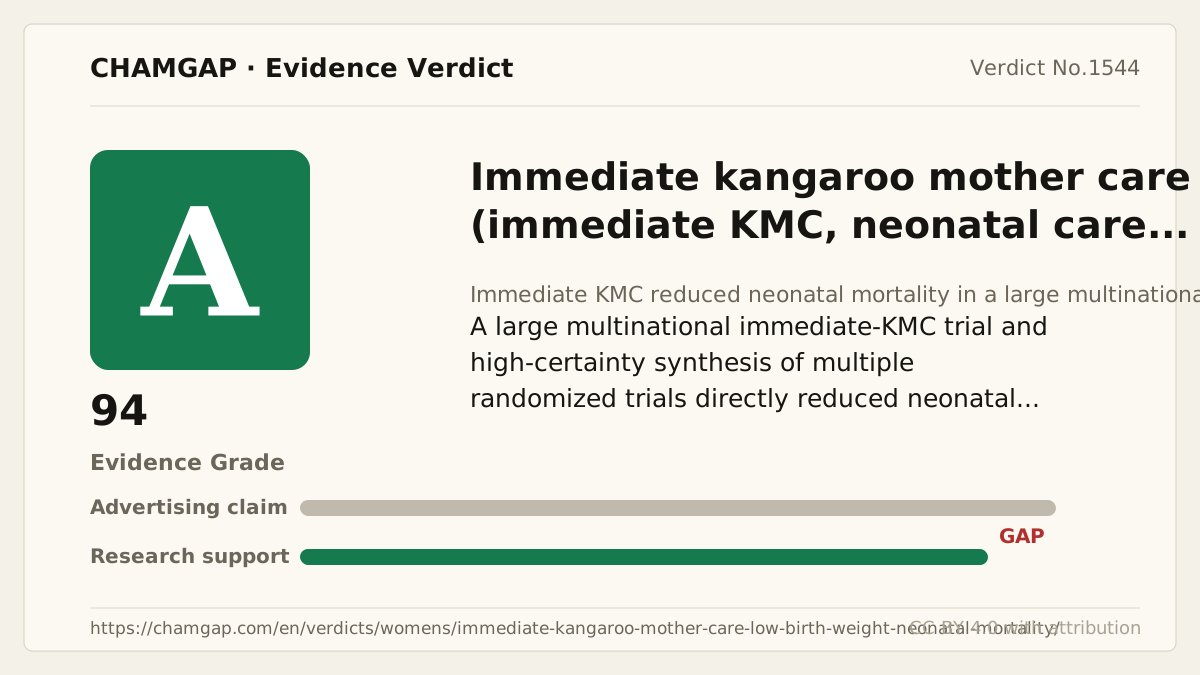
[Chamgap] Immediate kangaroo mother care x reduced neonatal mortality in preterm or low-birth-weight infants — Evidence Grade A·94. 3 cited sources checked. Source: https://chamgap.com/en/verdicts/womens/immediate-kangaroo-mother-care-low-birth-weight-neonatal-mortality/ · CC BY 4.0CC BY 4.0 — free to use with attribution; do not distort grades, numbers, or verdict meaning.
What this document does and does not do
Chamgap is an information source. It reports what research has and has not confirmed; it does not tell readers what to take or buy. That decision belongs to readers and, when needed, medical or legal professionals. This verdict reflects literature available up to the search date and may change as new research appears. Nothing here is medical advice.