
HPV vaccination,
does it really help with Reduced incidence of invasive cervical cancer?
research showsThe grade is B. Independent nationwide cohorts in Sweden and Denmark found the same large reduction in actual invasive cervical cancer after early vaccination. Sweden recorded 19 cases among vaccinated women and 538 among unvaccinated women, with cumulative incidence of 47 versus 94 per 100,000. These were observational cohorts, and neither directly adjusted for screening participation nor used a negative-control outcome or a dedicated healthy-vaccinee-bias analysis.
ads claimVerdict 691 is A with 91 points but concerns vaccine-type persistent infection and high-grade precancer. Verdict 1661 is A with 90 points but concerns high-risk HPV screening. This verdict uniquely combines vaccination with invasive cervical cancer.
Useful facts when choosing a product
- The pivotal evidence consists of nationwide observational cohorts, not randomized trials.
- Swedish cumulative invasive-cancer incidence was 47 versus 94 per 100,000.
- The two studies had no overlapping authors and reported different funding sources.
Chamgap Semantic Classification Code
Candidate index · review held
M.prophylactic-human-papillomavirus-vaccination.UNK.incidence-of-invasive-cervical-cancer.reduce.UNKMedicinal interventions > Prophylactic human papillomavirus vaccination > Unknown > incidence of invasive cervical cancer > Reduction claim > Unknown
An automated migration candidate, not an issued permanent code; exact claim scope remains under review. This machine-generated migration candidate helps retrieval but is not a permanent assignment. The original verdict ID and URL remain authoritative.
What the research actually shows
The Danish cohort followed 867,689 women aged 17 to 30 from October 2006 through 2019. With a one-year buffer, incidence-rate ratios were 0.14 for vaccination by age 16, 0.32 at ages 17 to 19, and 1.19 at ages 20 to 30. The full Swedish author list is Jiayao Lei, Alexander Ploner, K. Miriam Elfström, Jiangrong Wang, Adam Roth, Fang Fang, Karin Sundström, Joakim Dillner, and Pär Sparén. The Danish list is Susanne K. Kjaer, Christian Dehlendorff, Federica Belmonte, and Louise Baandrup. No names overlap. The Swedish paper states: “Supported by grants from the Swedish Foundation for Strategic Research (KF10-0046), the Swedish Cancer Society (CAN 2016/840), and the Swedish Research Council (2017-02346) and by the China Scholarship Council.” The Danish paper states: “This work was supported by the Mermaid project (Mermaid 2).” The sources differ.
Why this is classified as B (76)
Separate teams and funders found the same large association with actual invasive cancer, but neither cohort directly addressed screening participation, used a negative-control outcome, or performed a dedicated healthy-vaccinee-bias analysis, giving B with 76 points.
Counterpoint. The grade does not eliminate the need for screening. Residual confounding remains possible, and late adult vaccination should not be assumed to have the same effect as adolescent vaccination.
Rejudgment record. Cross-check applied — Direct cross-check of full author lists, verbatim funding statements, cases, absolute incidence, adjustments, and age-stratified results in the Swedish and Danish papers
| Endpoint | H | Hard endpoint - actual events such as death |
| Replication | R2 | Independently replicated across trials |
| Independence | I2 | Decisive evidence is publicly or non-profit funded |
| Effect size | E+ | Meets the clinically important threshold |
Stored derived and displayed grades match; this is not a current recalculation or validity check (B).
Sub-claim grades by effect
This ingredient is marketed for several effects. A single overall grade blends strong and weak claims together, so each effect is graded separately here. The overall grade reflects the strongest disconfirming or core claim.
| Effect (sub-claim) | Grade | Basis |
|---|---|---|
| HPV vaccination before age 17 and reduced invasive cervical cancer | A | Two national cohorts found large reductions in the same direction. |
| Vaccination at ages 20 to 30 and reduced invasive cervical cancer | D | The Danish primary estimate was 1.19 and did not establish benefit. |
| Reduced invasive cervical cancer across vaccinated women aged 30 or younger | A | The fully adjusted Swedish estimate for the overall vaccinated group was 0.37. |
Cross-check — AI research and Codex final gate
Evidence Table
| Study | Design | Sample | Funding | Endpoint | Result | Weight |
|---|---|---|---|---|---|---|
| Lei et al. 2020 Swedish nationwide cohort | Nationwide registry-based observational cohort | 1,672,983 girls and women aged 10 to 30; 2006-2017 | Supported by grants from the Swedish Foundation for Strategic Research (KF10-0046), the Swedish Cancer Society (CAN 2016/840), and the Swedish Research Council (2017-02346) and by the China Scholarship Council. | Invasive cervical cancer | 19 versus 538 cases; cumulative incidence 47 versus 94 per 100,000; fully adjusted IRR 0.37 (95% CI 0.21-0.57) | First large nationwide cohort measuring actual cancer |
| Kjaer et al. 2021 Danish nationwide cohort | Nationwide registry-based observational cohort | 867,689 women aged 17 to 30; 2006-2019 | This work was supported by the Mermaid project (Mermaid 2). | Invasive cervical cancer | IRR 0.14 (0.04-0.53) at age 16 or younger, 0.32 (0.08-1.28) at ages 17-19, and 1.19 (0.80-1.79) at ages 20-30 | Replication in an independent country, team, and funding source |
Receipt — 2 References
All 2 cited sources were verified for existence at the original page (as of 2026-08-06).
Final verification and publication gate: Codex · Evidence date: 2026-08-06 · Corrections: none
Cite this verdict
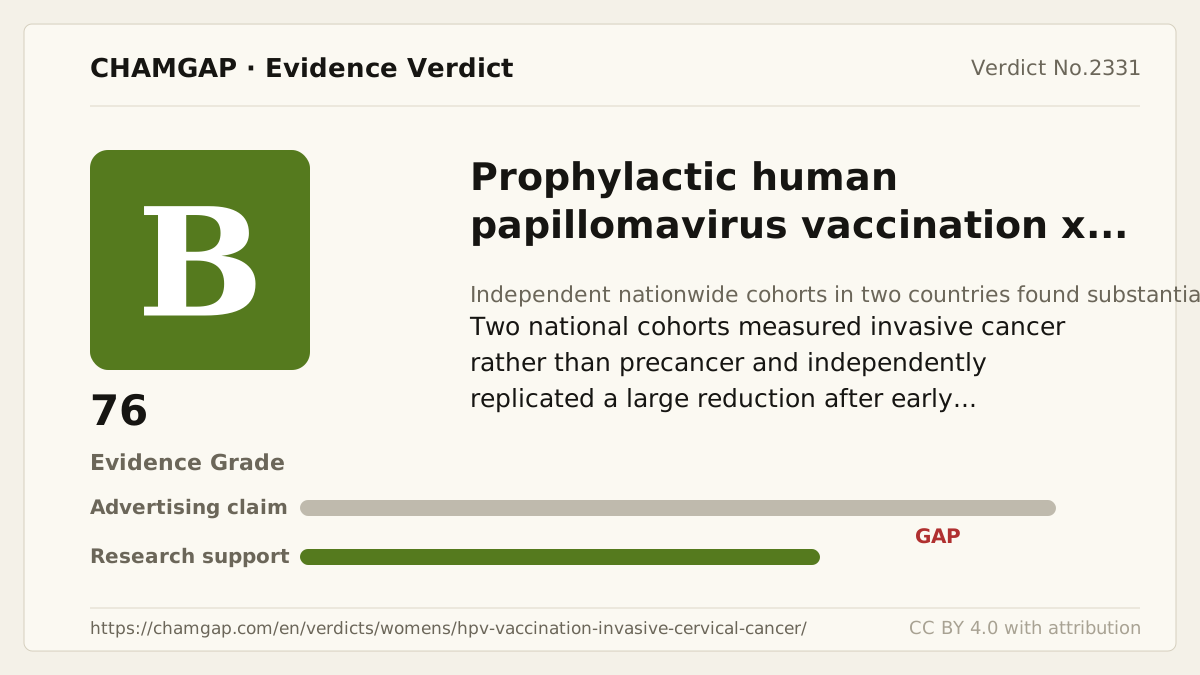
[Chamgap] HPV vaccination x reduced invasive cervical cancer — Evidence Grade B·76. 2 cited sources checked. Source: https://chamgap.com/en/verdicts/womens/hpv-vaccination-invasive-cervical-cancer/ · CC BY 4.0CC BY 4.0 — free to use with attribution; do not distort grades, numbers, or verdict meaning.
What this document does and does not do
Chamgap is an information source. It reports what research has and has not confirmed; it does not tell readers what to take or buy. That decision belongs to readers and, when needed, medical or legal professionals. This verdict reflects literature available up to the search date and may change as new research appears. Nothing here is medical advice.