
High-residue-classified produce,
does it really help with Lower clinical-pregnancy and live-birth success per assisted-reproduction cycle?
research showsThe grade is C with 56 points. Across 541 assisted-reproduction cycles in 325 fertility-clinic patients, women consuming at least 2.3 daily servings of high-residue-classified produce had adjusted clinical-pregnancy probability 0.49 versus 0.67 and live-birth probability 0.39 versus 0.65 compared with those consuming under one serving. Live birth is an important event, but pesticides were not measured in each woman's food or urine. A single-clinic cohort combining self-reported diet with crop-average US surveillance categories cannot establish causation.
ads claimHigh-residue crop classification does not mean that pesticides were measured on a particular woman's apples or strawberries. The study cannot establish the causal effect of a specific pesticide, product, or switching to organic food.
Useful facts when choosing a product
- The residue-burden score summed US crop-average detection, tolerance-exceedance, and at-least-three-pesticide measures from zero to six; four or above was classified high residue.
- No pesticide concentration was measured in individual participants' produce, blood, or urine.
- The highest group consumed 2.3 to 6.8 servings/day versus 0.3 to 1.0 in the lowest; mean high-residue intake was 1.7 plus or minus 1.0 servings/day.
Chamgap Semantic Classification Code
Candidate index · review held
UNK.at-least-2-3-servings-of-produce-classified.UNK.clinical-pregnancy-and-live-birth-success-per-assisted-reproduction-cycle.reduce.UNKUnknown > At least 2.3 servings of produce classified > Unknown > clinical-pregnancy and live-birth success per assisted-reproduction cycle > Reduction claim > Unknown
An automated migration candidate, not an issued permanent code; exact claim scope remains under review. This machine-generated migration candidate helps retrieval but is not a permanent assignment. The original verdict ID and URL remain authoritative.
What the research actually shows
The prospective EARTH cohort included 325 women contributing one to six cycles each, 541 cycles total, from 2007 through 2016. Analyses used initiated cycles and cluster-weighted generalized estimating equations. One-year self-reported food frequency was linked to USDA surveillance measures: any detection, tolerance exceedance, and at least three detected pesticides. Their 0-to-6 sum classified 14 crops at four or above as high residue and 22 as low residue. Mean plus or minus standard deviation intake was 1.7 plus or minus 1.0 high-residue and 2.8 plus or minus 1.6 low-residue servings/day. The highest-quartile boundary was at least 2.3 servings/day, while its rounded median was 2.2. Models adjusted for age, BMI, smoking, race, folate, organic frequency, residential pesticide use, dietary patterns, energy, infertility diagnosis, and the opposite residue category. Funding came from NIEHS and NIDDK, and no conflicts were reported.
Why this is classified as C (56)
The large association with live birth is retained, but indirect exposure classification, multiple analyses, and residual confounding give C with 56 points.
Counterpoint. The direct population is women receiving IVF treatment, not women conceiving naturally or the general population.
Rejudgment record. Cross-check applied — Assessment of clinical-pregnancy and live-birth probabilities per initiated assisted-reproduction cycle together with misclassification and confounding from crop-level rather than individual pesticide measurement
| Endpoint | H | Hard endpoint - actual events such as death |
| Replication | R1 | Single confirmatory trial |
| Independence | I2 | Decisive evidence is publicly or non-profit funded |
| Effect size | E+ | Meets the clinically important threshold |
Stored derived and displayed grades match; this is not a current recalculation or validity check (C).
Sub-claim grades by effect
This ingredient is marketed for several effects. A single overall grade blends strong and weak claims together, so each effect is graded separately here. The overall grade reflects the strongest disconfirming or core claim.
| Effect (sub-claim) | Grade | Basis |
|---|---|---|
| Lower live birth per IVF cycle | C | Adjusted probability was 39% in the highest versus 65% in the lowest group. |
| Lower clinical pregnancy per IVF cycle | C | Adjusted probability was 49% in the highest versus 67% in the lowest group. |
| A specific pesticide causes lower live birth | ? | Crop-average categories could not link a specific pesticide or individual dose to the outcome. |
Cross-check — AI research and Codex final gate
Evidence Table
| Study | Design | Sample | Funding | Endpoint | Result | Weight |
|---|---|---|---|---|---|---|
| Chiu et al. 2018 EARTH | Prospective single-fertility-center cohort analysis of repeated assisted-reproduction cycles | 325 women, 541 initiated cycles, and 228 live births | US public funding from NIEHS and NIDDK | Clinical pregnancy and live birth per initiated cycle | Adjusted clinical pregnancy was 0.49 (95% CI 0.37 to 0.62) versus 0.67 (0.55 to 0.77), and live birth 0.39 (0.28 to 0.52) versus 0.65 (0.52 to 0.76), highest versus lowest high-residue group | Pivotal observational birth-event evidence |
Receipt — 1 References
All 1 cited sources were verified for existence at the original page (as of 2026-08-04).
Final verification and publication gate: Codex · Evidence date: 2026-08-04 · Corrections: none
Cite this verdict
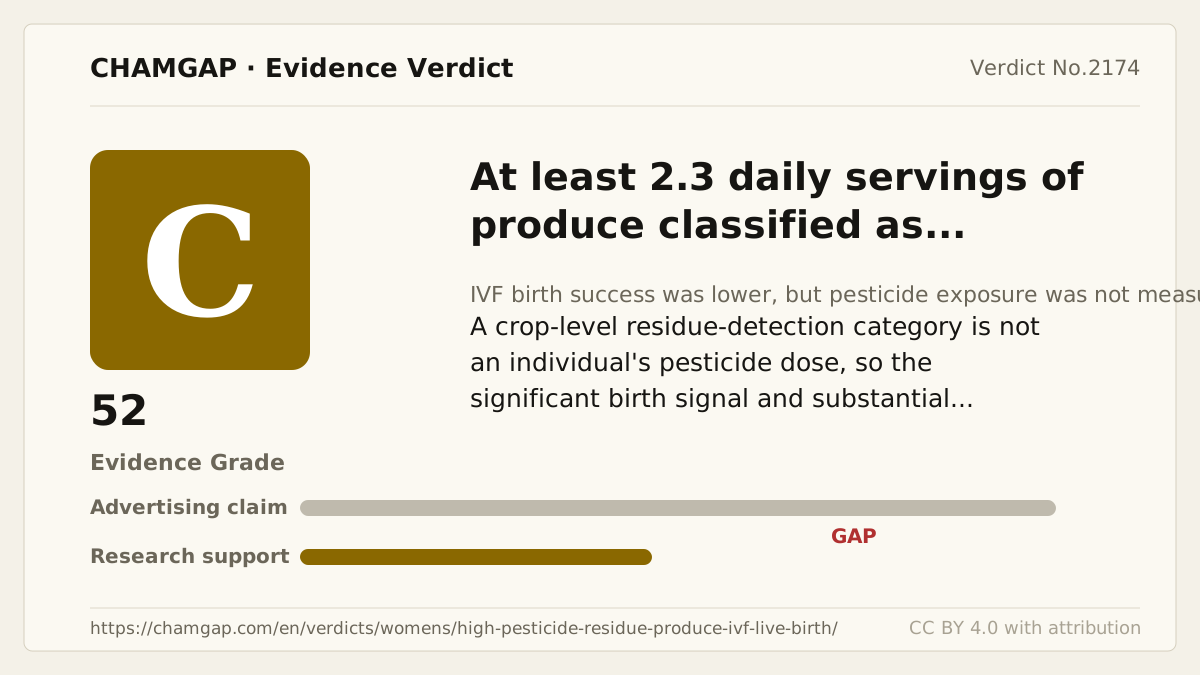
[Chamgap] High-residue-classified produce x lower IVF pregnancy and live birth — Evidence Grade C·56. 1 cited sources checked. Source: https://chamgap.com/en/verdicts/womens/high-pesticide-residue-produce-ivf-live-birth/ · CC BY 4.0CC BY 4.0 — free to use with attribution; do not distort grades, numbers, or verdict meaning.
What this document does and does not do
Chamgap is an information source. It reports what research has and has not confirmed; it does not tell readers what to take or buy. That decision belongs to readers and, when needed, medical or legal professionals. This verdict reflects literature available up to the search date and may change as new research appears. Nothing here is medical advice.