
Fractional carbon dioxide vaginal laser,
does it really help with Improved vaginal dryness, burning, and dyspareunia in genitourinary syndrome of menopause?
research showsThree sessions of fractional carbon dioxide vaginal laser are rated F when repeated sham-controlled trials and the 2025 AUA/SUFU/AUGS guideline are considered together. The JAMA trial by Li in 2021 randomized 85 women to three laser or sham sessions and followed them for 12 months, but all coprimary outcomes—overall-symptom VAS, most-severe-symptom VAS, and VSQ—were null, as were the vaginal health index and histology. The 60-person Page 2023 trial also found no difference from sham for the most bothersome symptom at 12 weeks (P=.13). A 2023 synthesis of seven sham-controlled trials and 407 women found laser comparable to sham for most outcomes, including dyspareunia VAS, vaginal health index, pH, and satisfaction. Some low-certainty positive analyses remain, but repeated sham-controlled null findings and guideline language that evidence does not support carbon dioxide laser, erbium:YAG laser, or radiofrequency efficacy are the direct grounds for F.
ads claimMarketing promotes collagen regeneration, vaginal rejuvenation, and a hormone-free root-cause treatment, treating tissue change as proof of symptom benefit. Histology itself was null in the 12-month sham trial, and both active and sham groups improved, showing how expectation and time can be mistaken for a laser effect.
Useful facts when choosing a product
- A common trial protocol applies intravaginal fractional carbon dioxide laser three times at four-to-eight-week intervals, but devices, energy settings, and intervals differ across studies.
- United States FDA clearance of devices for general soft-tissue cutting or coagulation is not approval of efficacy for GSM, menopausal vaginal symptoms, or vaginal rejuvenation. FDA warnings concern safety, unapproved uses, and deceptive marketing and must not be overstated as direct proof of inefficacy.
- No severe adverse event occurred in the Li trial, but vaginal pain or discomfort, spotting, discharge, and lower urinary tract symptoms were reported, and symptoms were also frequent with sham.
- FDA warnings and case reports include burns, scarring, dyspareunia, and chronic pain. Validated moisturizers, lubricants, and clinically appropriate low-dose vaginal hormone or other approved options should be reviewed first.
Chamgap Semantic Classification Code
Candidate index · review held
P.fractional-carbon-dioxide-vaginal-laser.vaginal.vaginal-dryness-burning-and-dyspareunia-in-genitourinary-syndrome-of-menopause.improve.shamProcedures, devices and tests > Fractional carbon dioxide vaginal laser > Vaginal > vaginal dryness, burning, and dyspareunia in genitourinary syndrome of menopause > Improvement claim > Sham procedure or device
An automated migration candidate, not an issued permanent code; exact claim scope remains under review. This machine-generated migration candidate helps retrieval but is not a permanent assignment. The original verdict ID and URL remain authoritative.
What the research actually shows
Li 2021 randomized 85 women with postmenopausal vaginal symptoms to three fractional carbon dioxide laser or sham sessions four to eight weeks apart and followed them for 12 months. All three coprimary outcomes, quality of life, vaginal health index, and histology were null. Page 2023 gave three laser and three sham applications in different sequences to 60 women with moderate to severe GSM, and the 12-week most-bothersome symptom result was null at P=.13. In Cruff 2021, the proportion with dyspareunia improvement and multiple sexual-function and symptom scales were no better than sham in 30 women. Prodromidou 2023 synthesized seven sham-controlled trials with 407 women and found laser comparable to sham for most outcomes. The 2025 AUA/SUFU/AUGS guideline states that evidence does not support carbon dioxide or erbium:YAG laser or radiofrequency efficacy for GSM-related outcomes. FDA warnings are used only as evidence about safety, lack of GSM approval, and deceptive marketing, not as direct proof of inefficacy.
Why this is classified as F (18)
Superiority over sham on core symptoms repeatedly failed in an 85-person 12-month trial, a 60-person trial, and a 30-person trial, while a seven-sham-trial synthesis found most key outcomes comparable. The 2025 AUA/SUFU/AUGS guideline also states that evidence does not support carbon dioxide or erbium:YAG laser or radiofrequency efficacy for GSM, meeting the repeated-refutation rule and giving F with 18 points.
Counterpoint. Unmet need is substantial for women who do not want or cannot use hormonal therapy, but need does not establish efficacy. GSM treatment should be individualized with discussion of moisturizers, lubricants, pelvic-floor care, low-dose vaginal estrogen, or other approved options according to symptoms, medical history, and cancer treatment.
Rejudgment record. Cross-check applied — Applied F under the repeated-refutation rule because several independent sham-controlled trials, including an 85-person long-term trial, and a seven-trial sham synthesis failed to reproduce superiority on core symptoms, while the 2025 AUA/SUFU/AUGS guideline states that evidence does not support carbon dioxide or erbium:YAG laser or radiofrequency efficacy for GSM; FDA warnings were separated as safety, unapproved-use, and deceptive-marketing evidence
Sub-claim grades by effect
This ingredient is marketed for several effects. A single overall grade blends strong and weak claims together, so each effect is graded separately here. The overall grade reflects the strongest disconfirming or core claim.
| Effect (sub-claim) | Grade | Basis |
|---|---|---|
| Improved vaginal dryness in GSM | F | Despite signals in some low-certainty meta-analyses, superiority on core symptoms was not reproduced in the strongest sham-controlled trials. |
| Improved vaginal burning in GSM | F | Sham groups also improved substantially, and long-term trials and sham-controlled synthesis did not establish a consistent added effect. |
| Improved dyspareunia in GSM | F | Two-grade improvement was 64% versus 67% in a 30-person trial, and dyspareunia VAS was comparable to sham in the seven-trial synthesis. |
Cross-check — AI research and Codex final gate
Evidence Table
| Study | Design | Sample | Funding | Endpoint | Result | Weight |
|---|---|---|---|---|---|---|
| Li FG et al. 2021 | Double-blind randomized sham-controlled trial with 12-month follow-up | 85 women; 43 laser and 42 sham | Grant support from Australian Gynaecological Endoscopy and Surgery | Coprimary overall- and most-severe-symptom VAS and VSQ; vaginal health index and histology | All 12-month coprimary outcomes, vaginal health index, and histology were null between laser and sham. | Strongest long-term direct null evidence |
| Page AS et al. 2023 | Double-blind randomized sham-controlled sequence trial | 60 women with moderate to severe GSM | Academic single-center study; no device-company funding stated in the abstract | Most bothersome symptom at 12 weeks, sexual and urinary function, vaginal health index, and pH | The most bothersome symptom changed by -23.6% with laser and -13.2% with sham, but the result was null at P=.13 and secondary outcomes showed no clear differences. | Independent replication of a null result |
| Prodromidou A et al. 2023 | Systematic review and meta-analysis of sham-controlled randomized trials | Seven randomized trials and 407 women | Academic meta-analysis with mixed funding across source trials | FSFI, dyspareunia VAS, vaginal health index, pH, satisfaction, and GSM symptom scales | Carbon dioxide laser and sham were comparable for most outcomes, with a signal remaining on one symptom scale. | Synthesis of reproducibility |
| AUA/SUFU/AUGS Guideline on GSM. 2025 | Evidence-based multisociety clinical guideline | Systematic synthesis of GSM intervention evidence | Guideline development by the American Urological Association | Efficacy of carbon dioxide and erbium:YAG lasers and radiofrequency for GSM symptoms, quality of life, and satisfaction | Stated that evidence does not support carbon dioxide or erbium:YAG laser or radiofrequency efficacy for GSM. | Current professional guideline finding no efficacy support |
| Adelman M and Nygaard IE. 2021 | JAMA expert editorial | Assessment of the Li 2021 trial and the evidence and regulatory context | Academic editorial | Evidence for continued vaginal-laser use in routine care | Called for a pause and reassessment because of the long-term sham-controlled null result and safety and regulatory uncertainty. | Expert recommendation to pause |
Receipt — 6 References
All 6 cited sources were verified for existence at the original page (as of 2026-07-24).
Final verification and publication gate: Codex · Evidence date: 2026-07-24 · Corrections: none
Cite this verdict
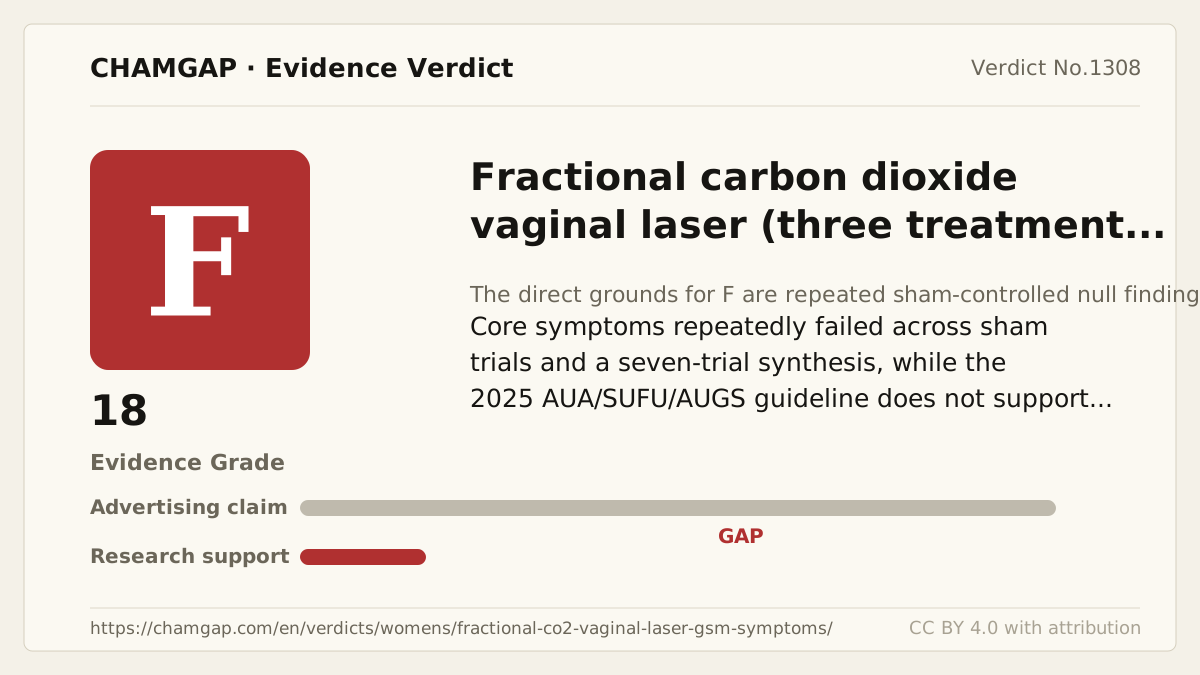
[Chamgap] Fractional carbon dioxide vaginal laser x improved GSM dryness, burning, and dyspareunia — Evidence Grade F·18. 6 cited sources checked. Source: https://chamgap.com/en/verdicts/womens/fractional-co2-vaginal-laser-gsm-symptoms/ · CC BY 4.0CC BY 4.0 — free to use with attribution; do not distort grades, numbers, or verdict meaning.
What this document does and does not do
Chamgap is an information source. It reports what research has and has not confirmed; it does not tell readers what to take or buy. That decision belongs to readers and, when needed, medical or legal professionals. This verdict reflects literature available up to the search date and may change as new research appears. Nothing here is medical advice.