
4% chlorhexidine cord care,
does it really help with Prevention of omphalitis and neonatal death in settings with unhygienic cord practices?
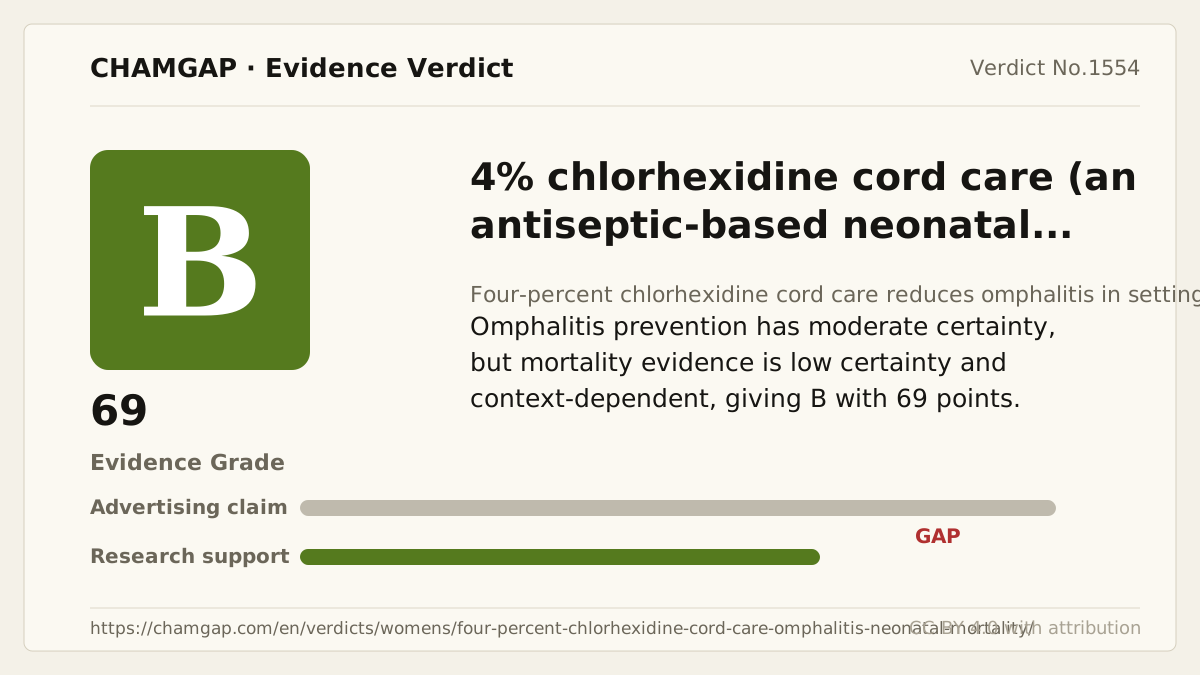
research showsFour-percent chlorhexidine cord care reduces omphalitis in low- and middle-income settings where unhygienic cord practices persist, supporting grade B. In the 2026 Cochrane update, five trials with 128,486 participants found RR 0.71 (95% CI 0.60 to 0.85) for omphalitis with moderate-certainty GRADE evidence, while five trials with 129,381 participants found RR 0.86 (95% CI 0.73 to 1.01) for neonatal mortality with low certainty. WHO's 2022 evidence assessment also confines the context to settings with unhygienic cord practices and finds no additional mortality benefit in hygienic or lower-mortality settings. The infection endpoint is therefore B, mortality is C, and the overall verdict is B.
ads claimThe antibacterial action of chlorhexidine may be expanded into superiority over dry care for every newborn and every birth facility. Direct clinical benefit best fits community settings with unhygienic cord practices and high infection risk.
Useful facts when choosing a product
- Four-percent chlorhexidine refers to the delivered active concentration from a 7.1% chlorhexidine digluconate aqueous solution or gel.
- This is an antiseptic applied to the cut cord stump after birth and is distinct from delayed cord clamping or chlorhexidine mouthwash.
- The latest Cochrane evidence indicates that cord separation is probably delayed by about two days versus dry care, with moderate certainty.
- Local skin irritation is uncommon but possible, and additional clinical benefit over dry care is unclear in hygienic, low-infection-risk settings.
Chamgap Semantic Classification Code
Candidate index · review held
P.4-percent-chlorhexidine-cord-care.UNK.omphalitis-and-neonatal-death-in-settings-with-unhygienic-cord-practices.prevent.UNKProcedures, devices and tests > 4% chlorhexidine cord care > Unknown > omphalitis and neonatal death in settings with unhygienic cord practices > Occurrence-prevention claim > Unknown
An automated migration candidate, not an issued permanent code; exact claim scope remains under review. This machine-generated migration candidate helps retrieval but is not a permanent assignment. The original verdict ID and URL remain authoritative.
What the research actually shows
The 2006 Nepal cluster trial by Mullany and colleagues randomized 413 communities, assigning 4,934 newborns to 4% chlorhexidine, 5,107 to soap and water, and 5,082 to dry cord care; among infants enrolled within 24 hours, mortality RR was 0.66 (95% CI 0.46 to 0.95). Large 2012 cluster trials in Bangladesh and Pakistan also evaluated community effects. The 2026 Cochrane update by Imdad and colleagues found omphalitis RR 0.71 (95% CI 0.60 to 0.85; five trials, 128,486 participants) with moderate certainty and neonatal mortality RR 0.86 (95% CI 0.73 to 1.01; five trials, 129,381 participants) with low certainty. WHO 2022 confined the intervention context to settings where unhygienic cord practices are present.
Why this is classified as B (69)
The latest Cochrane review found RR 0.71 for omphalitis with moderate certainty and RR 0.86 for neonatal mortality with low certainty, with benefit limited to unhygienic-practice settings, giving B with 69 points.
Counterpoint. Additional mortality benefit was not established in hygienic facility-birth or lower-mortality settings, and cord separation is delayed by about two days.
Rejudgment record. New verdict — The 2026 Cochrane review rates cord-infection evidence as moderate certainty and mortality evidence as low certainty, and WHO limits the context to unhygienic cord practices; the overall verdict is B with the mortality subclaim separated as C
Sub-claim grades by effect
This ingredient is marketed for several effects. A single overall grade blends strong and weak claims together, so each effect is graded separately here. The overall grade reflects the strongest disconfirming or core claim.
| Effect (sub-claim) | Grade | Basis |
|---|---|---|
| Prevention of omphalitis in settings with unhygienic cord practices | B | Five trials with 128,486 participants found RR 0.71 (95% CI 0.60 to 0.85), with moderate certainty. |
| Reduced neonatal mortality in settings with unhygienic cord practices | C | Five trials with 129,381 participants found RR 0.86 (95% CI 0.73 to 1.01), with low certainty. |
| Additional prevention of omphalitis or death in hygienic facility-birth settings | C | Additional mortality benefit is unestablished, and high-income-country chlorhexidine evidence is very low certainty. |
Cross-check — AI research and Codex final gate
Evidence Table
| Study | Design | Sample | Funding | Endpoint | Result | Weight |
|---|---|---|---|---|---|---|
| Imdad A, Medina M, Cooper C, and Bhutta ZA. 2026 | Cochrane systematic review and meta-analysis | 18 trials and 143,150 participants overall; five chlorhexidine mortality trials with 129,381 participants and five omphalitis trials with 128,486 participants | No dedicated funding | Omphalitis, all-cause neonatal mortality, and cord-separation time | Omphalitis RR was 0.71 (95% CI 0.60 to 0.85), moderate certainty; mortality RR was 0.86 (95% CI 0.73 to 1.01), low certainty; cord separation was delayed by 1.85 days. | Latest core GRADE evidence |
| Mullany LC et al. 2006 | Community-based cluster-randomized controlled trial | 413 communities and 15,123 newborns in Nepal | United States NIH, Bill & Melinda Gates Foundation, and other support | Omphalitis and neonatal mortality | Among infants enrolled within 24 hours, mortality RR was 0.66 (95% CI 0.46 to 0.95) versus dry care, and omphalitis was also reduced. | Representative pivotal community trial |
| WHO. 2022 postnatal care guideline | GRADE-based international guideline | Synthesis of cord-care trial evidence | World Health Organization | Neonatal mortality and moderate omphalitis | Made a context-specific recommendation for settings with unhygienic cord practices and rated moderate omphalitis OR 0.77 (95% CI 0.71 to 0.83) as moderate certainty. | Context limitation and GRADE confirmation |
Receipt — 3 References
All 3 cited sources were verified for existence at the original page (as of 2026-07-23).
Final verification and publication gate: Codex · Evidence date: 2026-07-23 · Corrections: none
Cite this verdict
[Chamgap] 4% chlorhexidine cord care x prevention of omphalitis and neonatal death in settings with unhygienic cord practices — Evidence Grade B·69. 3 cited sources checked. Source: https://chamgap.com/en/verdicts/womens/four-percent-chlorhexidine-cord-care-omphalitis-neonatal-mortality/ · CC BY 4.0CC BY 4.0 — free to use with attribution; do not distort grades, numbers, or verdict meaning.
What this document does and does not do
Chamgap is an information source. It reports what research has and has not confirmed; it does not tell readers what to take or buy. That decision belongs to readers and, when needed, medical or legal professionals. This verdict reflects literature available up to the search date and may change as new research appears. Nothing here is medical advice.