
Food-contact plastics,
does it really help with Reduced clinical pregnancy and live birth after in vitro fertilization?
research showsThe grade is C with 56 points. In the prospective EARTH cohort, 256 women contributed 375 IVF cycles and one or two pre-retrieval urine samples per cycle. Comparing the highest with lowest quartile of summed DEHP metabolites, adjusted probability differences were -0.19 for clinical pregnancy, 95% CI -0.29 to -0.08, and -0.19 for live birth, -0.28 to -0.08. Urinary DEHP integrates food packaging, medical, dust, personal-care, and other sources. A seven-day randomized low-plastic trial lowered selected metabolites but did not measure IVF outcomes.
ads claimA urinary metabolite is a biomarker of absorbed exposure, not a migration measurement from one container. The randomized finding that low-plastic food and kitchenware lowered selected urinary chemicals is real, but it cannot be converted into an IVF live-birth benefit.
Useful facts when choosing a product
- EARTH summed molar concentrations of MEHP, MEHHP, MEOHP, and MECPP as summed DEHP; the public table defined the lowest quartile as no more than 0.10 micromoles per liter and the highest as 0.43 to 5.60 micromoles per liter.
- After seven days, the PERTH food-plus-kitchenware group reduced urinary MnBP by 37.5%, 95% CI 12.0% to 55.6%, MBzP by 53.5%, 20.7% to 72.7%, and BPA by 59.7%, 6.88% to 82.5%.
- PERTH assigned 12 people to each of five groups and retained all 60. The registry listed data completeness as primary and urinary metabolites as secondary.
- EARTH urinary DEHP combined many exposure sources and cannot identify migration from a particular package.
Chamgap Semantic Classification Code
Candidate index · review held
UNK.plastic-contact-from-food-and-kitchenware-with-internal-phthalate-and-bisphenol-exposure.UNK.clinical-pregnancy-and-live-birth-after-in-vitro-fertilization.reduce.UNKUnknown > Plastic contact from food and kitchenware with internal phthalate and bisphenol exposure > Unknown > clinical pregnancy and live birth after in vitro fertilization > Reduction claim > Unknown
An automated migration candidate, not an issued permanent code; exact claim scope remains under review. This machine-generated migration candidate helps retrieval but is not a permanent assignment. The original verdict ID and URL remain authoritative.
What the research actually shows
EARTH analyzed 375 fresh nondonor IVF cycles from 256 women treated at Massachusetts General Hospital from 2004 to 2012. One or two pre-retrieval urine specimens per cycle were analyzed for 11 phthalate metabolites by mass spectrometry, and mixed models accounted for repeated cycles. Candidate covariates included age, BMI, smoking, treatment year, day-three FSH, protocol, and infertility diagnosis. PERTH comprised an observational cohort of 211 people and a seven-day randomized five-arm trial in 60 of them. ACTRN12622001252707 was prospectively registered on September 19, 2022, and the first participant was enrolled on May 9, 2023. The registry's primary outcome was complete acquisition of data from 60 participants and urinary metabolites were secondary, whereas the paper called urinary-metabolite differences its primary results. All 60 healthy nonpregnant adults completed the trial, which had no reproductive outcome. Both programs reported public or nonprofit funding. Verdict 2174 is C with 56 points and concerns the U.S. EARTH network, while verdict 2179 is C with 56 points and includes the separate Australian network; cross-citation between them is not counted twice as independent replication.
Why this is classified as C (56)
A large association linked measured urinary DEHP with IVF live birth, but exposure was variable, testing was multiple, and the randomized reduction trial did not measure birth, giving C with 56 points.
Counterpoint. Randomized exposure reduction did lower selected urinary biomarkers, showing that behavior can change internal exposure; birth benefit still needs a trial.
Rejudgment record. Cross-check applied — EARTH counts, repeated urine measurements, covariates, and live-birth differences were separated from the PERTH 211-person cohort, 60-person five-arm trial, prospective registration, registry-publication outcome mismatch, and favorable and unfavorable chemical-specific results; verdict 2174 is C with 56 points and was not double-counted as independent replication
| Endpoint | H | Hard endpoint - actual events such as death |
| Replication | R1 | Single confirmatory trial |
| Independence | I2 | Decisive evidence is publicly or non-profit funded |
| Effect size | E+ | Meets the clinically important threshold |
Stored derived and displayed grades match; this is not a current recalculation or validity check (C).
Sub-claim grades by effect
This ingredient is marketed for several effects. A single overall grade blends strong and weak claims together, so each effect is graded separately here. The overall grade reflects the strongest disconfirming or core claim.
| Effect (sub-claim) | Grade | Basis |
|---|---|---|
| High urinary summed DEHP and lower IVF live birth | C | Live birth was 19 points lower across 375 cycles, but this was one observational cohort. |
| Reduced internal exposure from low-plastic food and kitchenware | C | Selected phthalates and BPA decreased in a seven-day randomized trial. |
| Increased IVF live birth from a low-plastic intervention | ? | The randomized trial did not measure pregnancy or live birth. |
Cross-check — AI research and Codex final gate
Evidence Table
| Study | Design | Sample | Funding | Endpoint | Result | Weight |
|---|---|---|---|---|---|---|
| Hauser et al. 2016, EARTH | Prospective fertility-treatment cohort | 256 women, 375 IVF cycles, and 673 pre-retrieval urine specimens | Public funding including the U.S. National Institute of Environmental Health Sciences | Clinical pregnancy and live birth | Highest versus lowest summed-DEHP quartile probability differences: clinical pregnancy -0.19 (-0.29 to -0.08), live birth -0.19 (-0.28 to -0.08) | Direct observational hard-outcome evidence |
| Harray et al. 2026, PERTH | Observational cohort of 211 people and a seven-day five-arm randomized trial in 60 of them | 211 observed; 60 randomized and completed, 12 per arm | Australian public and nonprofit research funding | Registered primary data completeness and secondary urinary plastic-associated chemicals | Food-plus-kitchenware arm: MnBP -37.5% (-55.6 to -12.0), MBzP -53.5% (-72.7 to -20.7), bisphenol A -59.7% (-82.5 to -6.88); all measured DEHP metabolites increased within arms 1, 2, and 4 in exploratory analyses; pregnancy and birth not measured | Direct exposure-reduction evidence but indirect for reproductive outcomes |
Receipt — 3 References
All 3 cited sources were verified for existence at the original page (as of 2026-08-04).
Final verification and publication gate: Codex · Evidence date: 2026-08-04 · Corrections: none
Cite this verdict
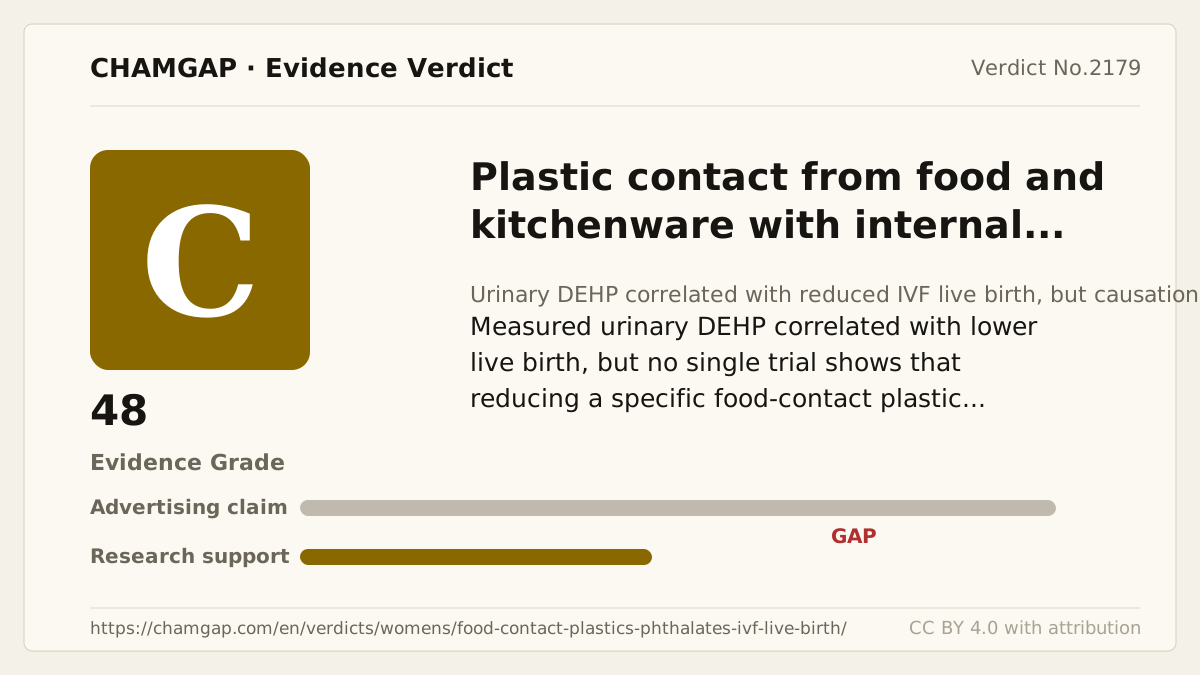
[Chamgap] Food-contact plastics x reduced IVF pregnancy and live birth — Evidence Grade C·56. 3 cited sources checked. Source: https://chamgap.com/en/verdicts/womens/food-contact-plastics-phthalates-ivf-live-birth/ · CC BY 4.0CC BY 4.0 — free to use with attribution; do not distort grades, numbers, or verdict meaning.
What this document does and does not do
Chamgap is an information source. It reports what research has and has not confirmed; it does not tell readers what to take or buy. That decision belongs to readers and, when needed, medical or legal professionals. This verdict reflects literature available up to the search date and may change as new research appears. Nothing here is medical advice.