
Home vaginal-probe electromyographic biofeedback added to pelvic floor muscle training,
does it really help with Improved urinary-incontinence symptoms at 24 months in women with stress or mixed incontinence?
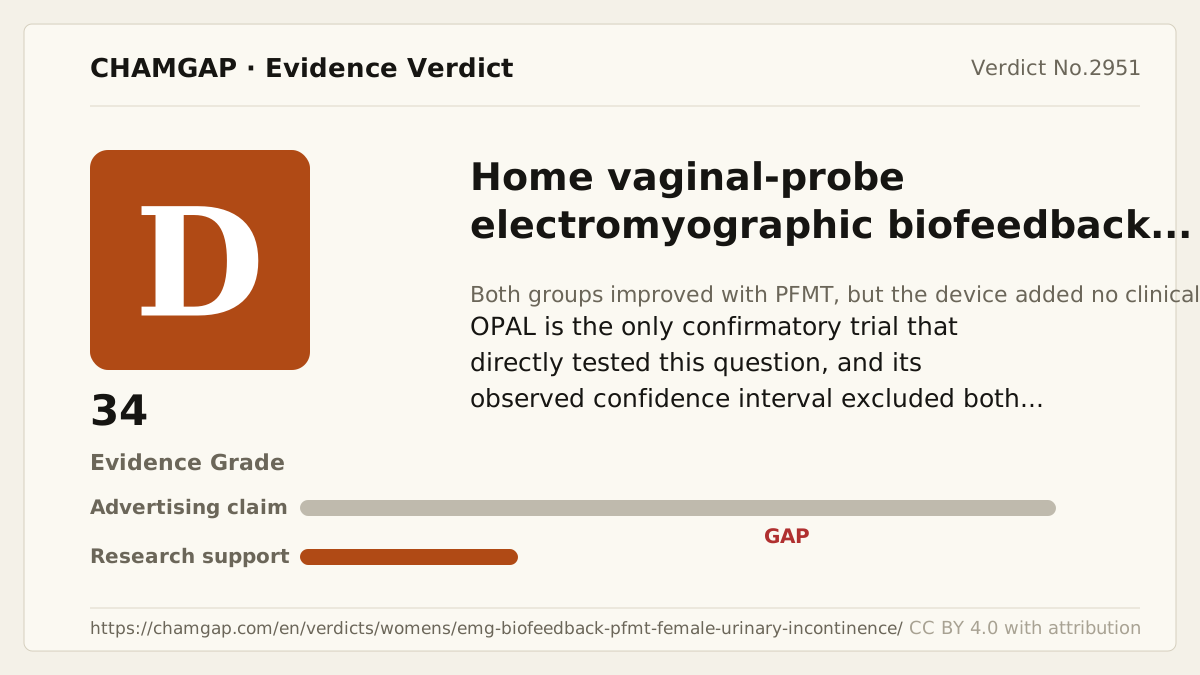
research showsThe grade is D with 34 points. At 24 months in OPAL, ICIQ-UI SF scores were 8.2 versus 8.5, adjusted mean difference -0.09 (95% CI -0.92 to 0.75), P=0.84. Both groups improved, but that improvement accompanied PFMT received by both groups and was not an added device effect.
ads claimEvidence that PFMT works is not evidence that adding a home probe provides extra benefit.
Useful facts when choosing a product
- The vaginal probe displays pelvic-floor electrical activity as a training aid.
- The observed 24-month confidence interval of -0.92 to 0.75 excluded both the 1.9-point and 2.5-point thresholds.
- No manufacturer cash, free equipment, employed author, or outsourced analysis was identified.
Chamgap Semantic Classification Code
Candidate index · review held
X.home-vaginal-probe-electromyographic-biofeedback-added-to-pelvic-floor-muscle-training.vaginal.urinary-incontinence-symptoms-at-with-stress-or-mixed-incontinence.improve.MULTIBehaviors, exposures and policies > Home vaginal-probe electromyographic biofeedback added to pelvic floor muscle training > Vaginal > urinary-incontinence symptoms at with stress or mixed incontinence > Improvement claim > Multiple: primary unresolved
An automated migration candidate, not an issued permanent code; exact claim scope remains under review. This machine-generated migration candidate helps retrieval but is not a permanent assignment. The original verdict ID and URL remain authoritative.
What the research actually shows
OPAL randomized 600 women with stress or mixed urinary incontinence at 23 UK centers and excluded urgency-only incontinence. It included 225 versus 235 in the 24-month primary analysis. Questionnaire attrition was about 22%, and both groups received supervised PFMT as an active control. NIHR HTA project 11/71/03 fully funded the trial. OPAL is the only confirmatory trial that directly tested this question. Burgio 2002 separately compared three different multicomponent behavioral programs in 222 women with urge incontinence or urge-predominant mixed incontinence. The 2024 Cochrane review pooled 33 trials. Both sources point in the same direction, but differences in population and comparator mean they were not counted as independent replications of the same claim. Across the PFMT-plus-biofeedback versus PFMT comparison, there were 33 trials and 3,031 women. Incontinence-related quality of life had SMD -0.07 (95% CI -0.18 to 0.05) in 11 trials with 1,169 women. Cure or improvement had OR 1.26 (95% CI 1.00 to 1.58) in 14 trials with 1,383 women; because the lower confidence bound is 1.00, this result cannot be characterized conclusively as either null or beneficial.
Why this is classified as D (34)
OPAL is the only confirmatory trial directly addressing this question, and its precise interval excludes both the 1.9-point and 2.5-point clinical thresholds, giving D with 34 points.
Counterpoint. PFMT itself and learning support for women unable to contract were not rejected.
Rejudgment record. Cross-check applied — No added benefit in one confirmatory trial and exclusion of the 1.9-point and 2.5-point clinical thresholds
| Endpoint | P | Symptom or function itself is the target - including patient reports and performance tests |
| Replication | R1 | Single confirmatory trial |
| Independence | I2 | Decisive evidence is publicly or non-profit funded |
| Effect size | E0 | Null |
| Precision | C1 | The confidence interval excludes meaningful benefit |
Stored derived and displayed grades match; this is not a current recalculation or validity check (D).
Sub-claim grades by effect
This ingredient is marketed for several effects. A single overall grade blends strong and weak claims together, so each effect is graded separately here. The overall grade reflects the strongest disconfirming or core claim.
| Effect (sub-claim) | Grade | Basis |
|---|---|---|
| Added benefit from a device on top of standard PFMT | D | A null result in one confirmatory trial and exclusion of the 1.9-point and 2.5-point thresholds |
| Benefit of PFMT itself | B | It was common to both arms and is not the target claim. |
Cross-check — AI research and Codex final gate
Evidence Table
| Study | Design | Sample | Funding | Endpoint | Result | Weight |
|---|---|---|---|---|---|---|
| Hagen S et al. 2020 OPAL | Multicenter randomized active-control trial | 600 randomized; 460 in the 24-month primary analysis | Fully funded by UK NIHR HTA | ICIQ-UI SF at 24 months | 8.2 vs 8.5; adjusted difference -0.09 (95% CI -0.92 to 0.75), P=0.84 | Pivotal precise refutation |
| Burgio KL et al. 2002 | Three-arm randomized trial comparing three different multicomponent behavioral programs in urge or urge-predominant mixed incontinence | 222 participants | US NIA/NIH | Reduction in incontinence episodes | 63.1% vs 69.4% vs 58.6%, P=0.23 | Contextual evidence with a different population and comparator |
| Fernandes et al. 2024 Cochrane update | Systematic review and meta-analysis | 33 comparison trials; 3,031 women overall | Cochrane review | Incontinence quality of life and cure or improvement | Quality of life: 11 trials, 1,169 women, SMD -0.07 (95% CI -0.18 to 0.05); cure or improvement: 14 trials, 1,383 women, OR 1.26 (95% CI 1.00 to 1.58) | Contextual meta-analysis; not counted as independent replication |
Receipt — 3 References
All 3 cited sources were verified for existence at the original page (as of 2026-08-26).
Final verification and publication gate: Codex · Evidence date: 2026-08-26 · Corrections: none
Cite this verdict
[Chamgap] No Benefit of Added EMG Biofeedback for 24-Month Urinary-Incontinence Symptoms — Evidence Grade D·34. 3 cited sources checked. Source: https://chamgap.com/en/verdicts/womens/emg-biofeedback-pfmt-female-urinary-incontinence/ · CC BY 4.0CC BY 4.0 — free to use with attribution; do not distort grades, numbers, or verdict meaning.
What this document does and does not do
Chamgap is an information source. It reports what research has and has not confirmed; it does not tell readers what to take or buy. That decision belongs to readers and, when needed, medical or legal professionals. This verdict reflects literature available up to the search date and may change as new research appears. Nothing here is medical advice.