
Elinzanetant,
does it really help with Reduced frequency and severity of moderate-to-severe menopausal hot flashes and night sweats?
research showsElinzanetant is rated B because multiple phase 3 randomized trials consistently reduced the frequency and severity of moderate-to-severe menopausal hot flashes and night sweats. OASIS 1 and OASIS 2 randomized 396 and 400 participants, respectively, and both found 3.2 fewer daily moderate-to-severe vasomotor symptoms than placebo at week 12. Response rates for at least a 50% frequency reduction were 71.4% versus 42.0% and 74.7% versus 48.3%, respectively. Daily patient-recorded hot flashes and night sweats are treatment-target symptoms, not surrogates. The pivotal evidence nevertheless comes from a manufacturer program with a 12-week primary confirmation period and no independent comparative trial, limiting the rating to B with 74 points.
ads claimMarketing may expand the evidence into hormone-free elimination of symptoms all night or fully established lifelong safety. What was shown was an average reduction in frequency and severity, not complete freedom from symptoms for everyone. Sleep improvement is a useful ancillary signal, but it does not establish treatment of a separate sleep disorder or lifetime safety.
Useful facts when choosing a product
- The United States product Lynkuet is a prescription drug taken as two 60-mg capsules, for a total of 120 mg, at about bedtime each day with or without food.
- Elinzanetant is a nonestrogen neurokinin-1 and neurokinin-3 receptor antagonist approved to treat moderate-to-severe vasomotor symptoms due to menopause.
- ALT, AST, alkaline phosphatase, and total and direct bilirubin should be checked before treatment, with transaminases reassessed three months after starting. Use is not recommended in moderate or severe hepatic impairment.
- Common adverse reactions include headache, fatigue, dizziness, and somnolence. Strong CYP3A4 inhibitors or inducers require avoidance, and pregnancy is a contraindication.
Chamgap Semantic Classification Code
Candidate index · review held
UNK.elinzanetant.oral.frequency-and-severity-of-moderate-to-severe-menopausal-hot-flashes-and-night-sweats.reduce.placeboUnknown > Elinzanetant > Oral > frequency and severity of moderate-to-severe menopausal hot flashes and night sweats > Reduction claim > Placebo
An automated migration candidate, not an issued permanent code; exact claim scope remains under review. This machine-generated migration candidate helps retrieval but is not a permanent assignment. The original verdict ID and URL remain authoritative.
What the research actually shows
OASIS 1 randomized 396 and OASIS 2 randomized 400 postmenopausal participants to elinzanetant 120 mg or placebo. Coprimary outcomes were changes in moderate-to-severe vasomotor symptom frequency and severity at weeks 4 and 12. The week-12 placebo-adjusted frequency difference was -3.2 events per day in both trials, with severity and 50% response rates favoring elinzanetant in the same direction. The PROMIS sleep-disturbance score improved by 5.6 and 4.3 points more than placebo at week 12, but this was an ancillary patient-reported outcome. OASIS 3 followed a broader group of 628 participants for 52 weeks and found a week-12 frequency difference of -1.6 events per day; later efficacy mainly described persistence without formal hypotheses. FDA approved 120 mg in 2025 based on OASIS 1, 2, and 3 and required liver testing before treatment and at three months.
Why this is classified as B (74)
Daily vasomotor symptoms are treatment targets rather than surrogates, and OASIS 1 and 2 consistently showed a -3.2-event-per-day difference and superior 50% response rates in separate samples. OASIS 3 reproduced a positive direction. Because all evidence comes from the manufacturer development program, the main placebo-controlled confirmation lasted 12 weeks, and independent long-term comparisons are lacking, the verdict is B with 74 points.
Counterpoint. This is an evidence-based nonhormonal option for patients who cannot or do not wish to use hormone therapy. Liver disease, pregnancy potential, sedating medicines, and CYP3A4 interactions require individual review before prescribing.
Rejudgment record. New verdict — Patient-reported symptoms that are themselves treatment targets, such as pain, sleep, bowel function, IRLS, IIEF or SEP, and depression or anxiety scales, are not surrogates. Applied this principle to hot-flash and night-sweat diaries and credited consistency across multiple phase 3 trials, while limiting the verdict to B because the evidence comes from a manufacturer program with a 12-week main confirmation period
Sub-claim grades by effect
This ingredient is marketed for several effects. A single overall grade blends strong and weak claims together, so each effect is graded separately here. The overall grade reflects the strongest disconfirming or core claim.
| Effect (sub-claim) | Grade | Basis |
|---|---|---|
| Reduced frequency of moderate-to-severe hot flashes and night sweats | B | OASIS 1 and 2 each found a week-12 difference of -3.2 events per day, with consistently superior 50% response rates. |
| Reduced severity of moderate-to-severe hot flashes and night sweats | B | Week-12 severity differences in OASIS 1 and 2 were -0.4 and -0.3 points, respectively, in the same direction. |
| Improved sleep disturbance accompanying menopausal vasomotor symptoms | C | Ancillary patient-reported outcomes were positive in OASIS 1 and 2, but these were not trials of a separate sleep disorder and long-term OASIS 3 analyses were descriptive. |
Cross-check — AI research and Codex final gate
Evidence Table
| Study | Design | Sample | Funding | Endpoint | Result | Weight |
|---|---|---|---|---|---|---|
| Pinkerton JV et al. 2024, OASIS 1 | Multicenter randomized double-blind placebo-controlled phase 3 trial | 396 participants; 199 elinzanetant and 197 placebo | Supported by Bayer; authors included Bayer employees | Frequency and severity of daily moderate-to-severe vasomotor symptoms at weeks 4 and 12 | At week 12, the placebo-adjusted frequency difference was -3.2 events per day, severity difference was -0.4 points, and the 50% response rate was 71.4% versus 42.0%. | Key confirmatory efficacy trial |
| Pinkerton JV et al. 2024, OASIS 2 | Multicenter randomized double-blind placebo-controlled phase 3 trial | 400 participants; 200 elinzanetant and 200 placebo | Supported by Bayer; authors included Bayer employees | Frequency and severity of daily moderate-to-severe vasomotor symptoms at weeks 4 and 12 | At week 12, the placebo-adjusted frequency difference was -3.2 events per day, severity difference was -0.3 points, and the 50% response rate was 74.7% versus 48.3%. | Replication in a separate confirmatory sample |
| Panay N et al. 2025, OASIS 3 | Fifty-two-week multicenter randomized double-blind placebo-controlled phase 3 trial | 628 participants; 313 elinzanetant and 315 placebo | Supported by Bayer; authors included Bayer employees | Daily moderate-to-severe vasomotor symptom frequency at week 12; 52-week safety and ancillary efficacy | Week-12 frequency changes were -5.4 versus -3.5 events per day, with a least-squares mean difference of -1.6 events per day. Efficacy after week 12 was described without formal hypotheses. | Long-term safety and directional replication |
Receipt — 3 References
All 3 cited sources were verified for existence at the original page (as of 2026-07-24).
Final verification and publication gate: Codex · Evidence date: 2026-07-24 · Corrections: none
Cite this verdict
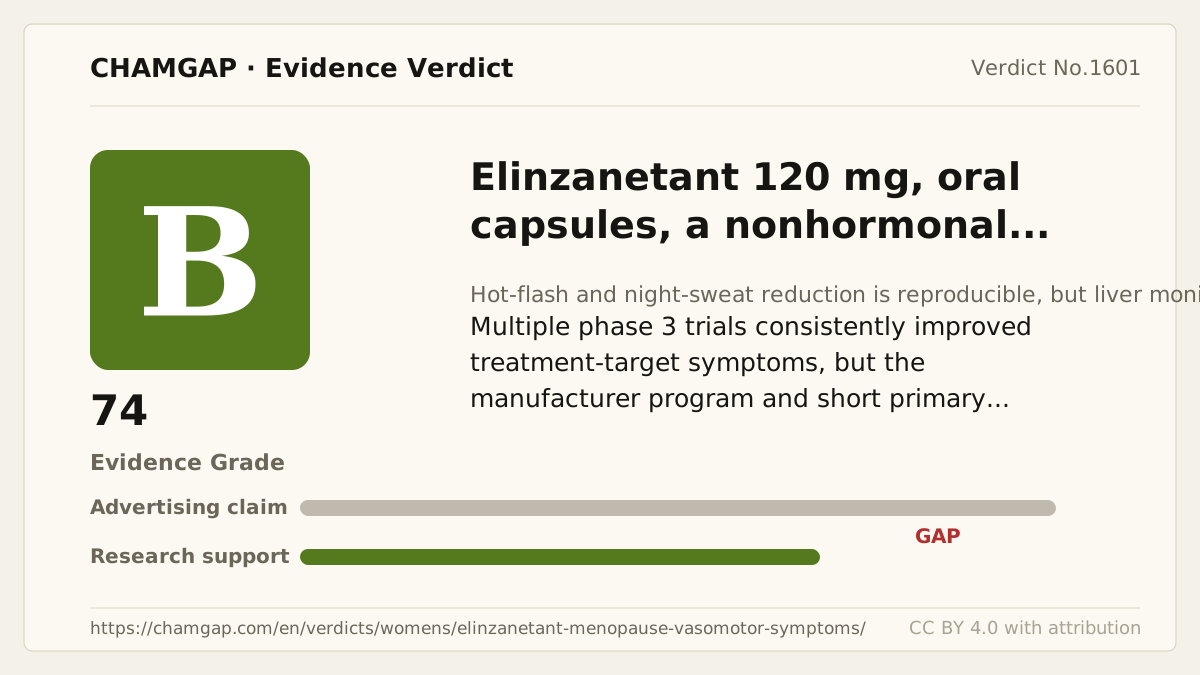
[Chamgap] Elinzanetant x reduced menopausal hot flashes and night sweats — Evidence Grade B·74. 3 cited sources checked. Source: https://chamgap.com/en/verdicts/womens/elinzanetant-menopause-vasomotor-symptoms/ · CC BY 4.0CC BY 4.0 — free to use with attribution; do not distort grades, numbers, or verdict meaning.
What this document does and does not do
Chamgap is an information source. It reports what research has and has not confirmed; it does not tell readers what to take or buy. That decision belongs to readers and, when needed, medical or legal professionals. This verdict reflects literature available up to the search date and may change as new research appears. Nothing here is medical advice.