
DHEA,
does it really help with Improved live-birth rate after IVF or ICSI in women with diminished ovarian reserve or poor ovarian response?
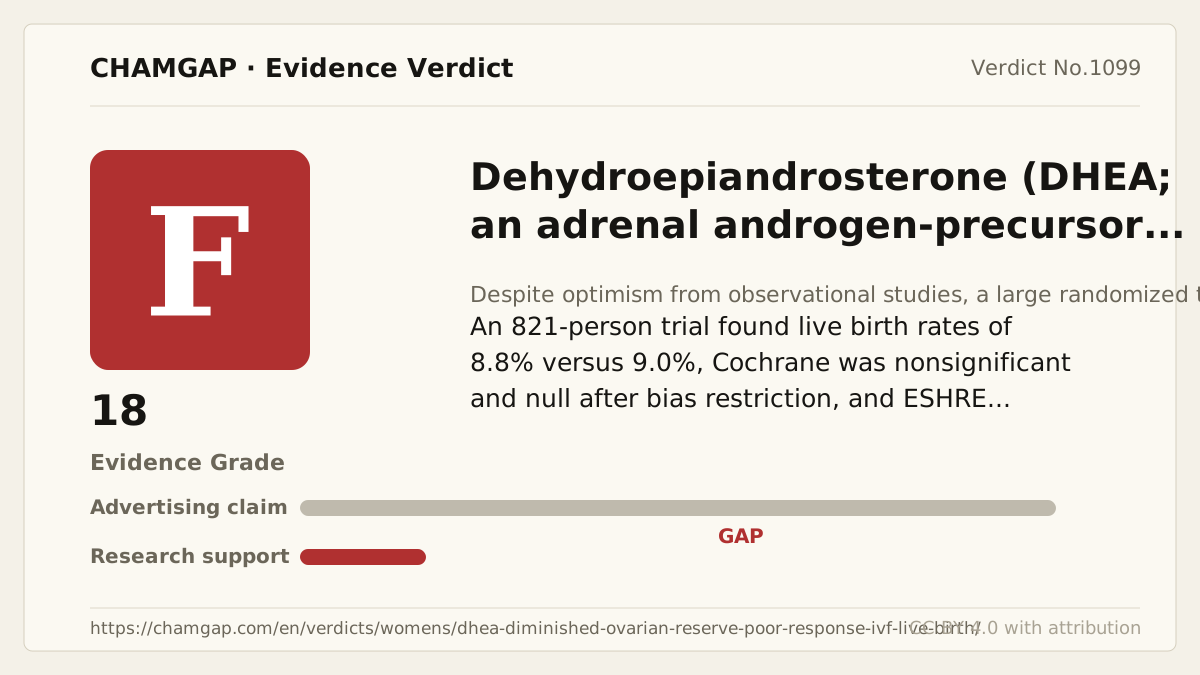
research showsThe claim that DHEA improves IVF or ICSI live-birth rates in women with diminished ovarian reserve or poor response is rated F. The largest nine-center double-blind randomized trial assigned 821 women meeting Bologna poor-response criteria to DHEA or placebo, but live birth after the first embryo transfer was 8.8% versus 9.0%, relative risk 0.98 (95% CI 0.63 to 1.51). A 2024 Cochrane update found a nonsignificant odds ratio of 1.30 (95% CI 0.95 to 1.76) across nine randomized trials and 1,433 women; after high-risk-of-bias trials were excluded, the estimate was 1.08 (0.75 to 1.54), indicating little to no difference. ESHRE 2025 strongly recommends against DHEA in low responders. Early positive small trials are contradicted by the large trial, bias-restricted synthesis, and guideline, yielding F with 18 points while retaining residual uncertainty.
ads claimMarketing may turn changes in AMH, antral follicle count, or oocyte yield and pregnancies in observational cohorts into restored egg quality and a higher chance of delivery. A changed ovarian-response marker does not establish more live births, and before-after comparisons are especially vulnerable to age, embryo-chromosome, sperm, and laboratory confounding.
Useful facts when choosing a product
- DHEA is an adrenal and ovarian precursor of androgen and estrogen steroids. It is sold as a supplement in some countries, but that does not make it an approved standard medicine for improving IVF live birth.
- A common research regimen used 25 mg three times daily, totaling 75 mg/day, for weeks to months before IVF. Dose, duration, and participant selection varied and should not be transferred automatically to another product.
- Supplement products may vary in actual DHEA content, impurities, and lot consistency. Unsupervised use that ignores DHEA sulfate and testosterone levels or symptoms such as acne and hirsutism should be avoided.
- DHEA does not replace a standard ovarian-stimulation protocol, counseling based on age, AMH and antral follicle count, or embryo and sperm assessment. The IVF team should review the entire treatment plan and interactions.
Chamgap Semantic Classification Code
Candidate index · review held
S.dehydroepiandrosterone.UNK.live-birth-rate-after-ivf-or-icsi-with-diminished-ovarian-reserve-or-poor-ovarian-response.improve.placeboSupplements and nutraceuticals > Dehydroepiandrosterone > Unknown > live-birth rate after IVF or ICSI with diminished ovarian reserve or poor ovarian response > Improvement claim > Placebo
An automated migration candidate, not an issued permanent code; exact claim scope remains under review. This machine-generated migration candidate helps retrieval but is not a permanent assignment. The original verdict ID and URL remain authoritative.
What the research actually shows
Wang and colleagues randomized 821 women meeting Bologna poor-response criteria at nine Chinese reproductive centers to DHEA 75 mg/day or placebo for four to twelve weeks before IVF. Live birth after the first embryo transfer occurred in 36 of 410 women (8.8%) versus 37 of 411 (9.0%), relative risk 0.98, with no difference in retrieved oocytes, clinical pregnancy, pregnancy loss, or cumulative live birth. The 2023 Zhang meta-analysis included 14 randomized trials, 11 self-controlled studies, and seven case-control studies. Clinical pregnancy and live birth were higher in the pooled mixed designs but not in randomized-only analyses; retrieved oocytes and transferred embryos were also nonsignificant, while selected response measures such as antral follicle count, basal FSH, gonadotropin dose, and stimulation days changed. The 2024 Cochrane review pooled nine DHEA trials with 1,433 women for live birth or ongoing pregnancy, odds ratio 1.30 (95% CI 0.95-1.76); excluding trials at high risk of bias gave 1.08 (0.75-1.54), indicating little to no difference. ESHRE 2025 strongly recommends against DHEA before or during ovarian stimulation in low responders.
Why this is classified as F (18)
The large 821-person trial in women meeting Bologna poor-response criteria found a live-birth relative risk of 0.98 (95% CI 0.63-1.51) and null clinical-pregnancy, oocyte, and cumulative-live-birth outcomes. The 2024 Cochrane estimate across nine trials and 1,433 women was a nonsignificant 1.30 (0.95-1.76), and bias restriction gave 1.08 (0.75-1.54), indicating little to no difference. ESHRE 2025 strongly recommends against DHEA in low responders. Early positive small trials are contradicted by the large trial, bias-restricted synthesis, and guideline, yielding F with 18 points. Hormonal and androgenic adverse effects and unknown long-term safety remain separate safety issues.
Counterpoint. Anyone already using DHEA should tell the reproductive-medicine team the product, dose, duration, and other hormones before IVF. A selected low-DHEA-sulfate subgroup remains a research question, but current evidence cannot promise a live-birth benefit to all poor responders.
Rejudgment record. Cross-check applied — Applied F because the 821-person randomized trial found live birth of 8.8% versus 9.0%, the 2024 Cochrane estimate across nine trials and 1,433 women was a nonsignificant 1.30 (0.95-1.76) and 1.08 (0.75-1.54) after excluding high-risk-of-bias trials, and ESHRE 2025 strongly recommends against DHEA in low responders; residual uncertainty supports 18 points
Sub-claim grades by effect
This ingredient is marketed for several effects. A single overall grade blends strong and weak claims together, so each effect is graded separately here. The overall grade reflects the strongest disconfirming or core claim.
| Effect (sub-claim) | Grade | Basis |
|---|---|---|
| Improved live-birth rate after IVF or ICSI | F | The 821-person trial and bias-restricted Cochrane analysis found no direct live-birth benefit, and ESHRE strongly recommends against use in low responders. |
| Improved clinical-pregnancy rate after IVF or ICSI | F | Positive nonrandomized findings were not reproduced in the randomized subgroup or large placebo-controlled trial, and ESHRE strongly recommends against use. |
| Increased number of retrieved oocytes during IVF or ICSI | D | Some small studies produced mixed ovarian-response signals, but the large trial and 2023 randomized subgroup found no significant increase in retrieved oocytes. |
Cross-check — AI research and Codex final gate
Evidence Table
| Study | Design | Sample | Funding | Endpoint | Result | Weight |
|---|---|---|---|---|---|---|
| Wang Z et al. 2022 | Nine-center randomized double-blind placebo-controlled trial | 821 women meeting Bologna poor-response criteria; 410 assigned DHEA and 411 placebo | Chinese multicenter academic trial with no commercial sponsor stated | Live birth after first embryo transfer; clinical pregnancy, cumulative live birth, and retrieved oocytes | Live birth was 8.8% versus 9.0%, relative risk 0.98 (95% CI 0.63-1.51), with no significant difference in other pregnancy or ovarian-response outcomes. | Pivotal large randomized trial with a direct null live-birth endpoint |
| Zhang J et al. 2023 | Systematic review and meta-analysis of randomized and nonrandomized studies | 32 studies: 14 randomized, 11 self-controlled, and seven case-control | Chinese academic research declaring no commercial conflicts | Live birth, clinical pregnancy, retrieved oocytes, ovarian reserve, and stimulation measures | Higher live birth and clinical pregnancy appeared only in nonrandomized studies; both clinical endpoints and retrieved oocytes were nonsignificant in the randomized subgroup. | Shows the design-dependent split between observational positives and randomized null findings |
| Naik S et al. 2024 Cochrane review | Cochrane systematic review of randomized androgen pretreatment trials in assisted reproduction | Nine DHEA randomized trials with 1,433 women for live birth or ongoing pregnancy | Cochrane systematic review | Live birth or ongoing pregnancy, clinical pregnancy, and miscarriage | The live-birth or ongoing-pregnancy odds ratio was 1.30 (95% CI 0.95-1.76), and 1.08 (0.75-1.54) after excluding high-risk-of-bias trials, indicating little to no difference. | Updated moderate-certainty randomized synthesis showing no meaningful benefit |
Receipt — 3 References
All 3 cited sources were verified for existence at the original page (as of 2026-07-22).
Final verification and publication gate: Codex · Evidence date: 2026-07-22 · Corrections: none
Cite this verdict
[Chamgap] DHEA x improved IVF or ICSI live-birth rate in women with diminished ovarian reserve or poor response — Evidence Grade F·18. 3 cited sources checked. Source: https://chamgap.com/en/verdicts/womens/dhea-diminished-ovarian-reserve-poor-response-ivf-live-birth/ · CC BY 4.0CC BY 4.0 — free to use with attribution; do not distort grades, numbers, or verdict meaning.
What this document does and does not do
Chamgap is an information source. It reports what research has and has not confirmed; it does not tell readers what to take or buy. That decision belongs to readers and, when needed, medical or legal professionals. This verdict reflects literature available up to the search date and may change as new research appears. Nothing here is medical advice.