
Delayed cord clamping in preterm birth,
does it really help with Reduced neonatal death before hospital discharge among infants born preterm?
research showsDelayed cord clamping in preterm birth is rated A because an individual-participant-data meta-analysis of multiple randomized trials found fewer deaths before discharge than with immediate clamping. Seidler and colleagues reported an odds ratio of 0.68 with a 95% confidence interval of 0.51 to 0.91 in a direct comparison of 20 trials and 3,260 preterm infants, and rated the evidence as high certainty. This intervention-specific randomized mortality benefit replicated across trials meets the A criterion.
ads claimDescriptions of delivery practice can reduce delayed clamping to one mandatory timing rule for every newborn circumstance. The evidence concerns maintaining placental circulation for a period rather than clamping immediately at preterm birth, while resuscitation needs and local protocols modify the procedure.
Useful facts when choosing a product
- Delayed cord clamping is a delivery procedure in which placental-to-infant blood flow is maintained for a period after birth before the cord is clamped.
- The 2023 individual-participant-data meta-analysis generally classified deferred clamping as clamping at least 15 seconds after birth and immediate clamping as within 15 seconds.
- Greater placental transfusion can increase early hemoglobin and circulating blood volume and reduce the need for red-cell transfusion.
- Hyperbilirubinemia and phototherapy may increase, and infants needing immediate positive-pressure ventilation require a separate sequence for resuscitation and cord management.
Chamgap Semantic Classification Code
Candidate index · review held
P.deferred-or-delayed-cord-clamping-in-preterm-birth.procedural.neonatal-death-before-hospital-discharge-born-preterm.reduce.UNKProcedures, devices and tests > Deferred or delayed cord clamping in preterm birth > Procedural > neonatal death before hospital discharge born preterm > Reduction claim > Unknown
An automated migration candidate, not an issued permanent code; exact claim scope remains under review. This machine-generated migration candidate helps retrieval but is not a permanent assignment. The original verdict ID and URL remain authoritative.
What the research actually shows
Seidler and colleagues collected individual participant data from randomized trials comparing immediate clamping, deferred clamping, and cord milking at preterm birth. The direct deferred-versus-immediate comparison included 20 trials, 3,260 infants, and 232 deaths, with an odds ratio of 0.68 for death before discharge. A separate timing network analysis suggested that deferral for at least 120 seconds might rank best for mortality, but certainty about the optimal duration was lower than certainty about deferral itself. WHO and ACOG guidance also supports delayed clamping for stable preterm infants.
Why this is classified as A (93)
For the hard endpoint of death before discharge, an individual-participant-data meta-analysis of 20 randomized trials and 3,260 infants found an odds ratio of 0.68 with high certainty. Replicated intervention-specific mortality reduction across multiple trials gives A with 93 points. Jaundice and resuscitation circumstances are separate safety and applicability conditions.
Counterpoint. The A rating concerns the mortality effect of deferral itself and does not establish 30, 60, or 120 seconds as the optimal duration with equal certainty.
Rejudgment record. New verdict — Applied A because a direct individual-participant-data meta-analysis of 20 randomized trials and 3,260 infants found a high-certainty reduction in death before discharge, satisfying the rule for replicated intervention-specific mortality benefit
Sub-claim grades by effect
This ingredient is marketed for several effects. A single overall grade blends strong and weak claims together, so each effect is graded separately here. The overall grade reflects the strongest disconfirming or core claim.
| Effect (sub-claim) | Grade | Basis |
|---|---|---|
| Reduced death before discharge among preterm infants | A | The direct individual-participant-data comparison of 20 trials and 3,260 infants found an odds ratio of 0.68 with high certainty. |
| Reduced need for red-cell transfusion among preterm infants | A | Multiple randomized trials and guidance consistently found fewer transfusions with greater placental transfusion. |
| Reduced major neonatal morbidity among preterm infants | B | Some outcomes, including intraventricular hemorrhage and necrotizing enterocolitis, favor deferral, but certainty and consistency are lower than for mortality. |
Cross-check — AI research and Codex final gate
Evidence Table
| Study | Design | Sample | Funding | Endpoint | Result | Weight |
|---|---|---|---|---|---|---|
| Seidler AL et al. iCOMP individual-participant-data meta-analysis, 2023 | Systematic review and individual-participant-data meta-analysis of randomized trials | 6,367 infants in the full individual-participant dataset; 20 trials and 3,260 infants in the direct deferred-versus-immediate comparison | Australian NHMRC and academic public funding | Death before discharge and major neonatal morbidity | Deferred clamping reduced death before discharge versus immediate clamping (OR 0.68, 95% CI 0.51 to 0.91; high certainty). | Pivotal high-certainty mortality synthesis |
| ACOG Committee Opinion No. 814, 2020 | Professional evidence review and clinical guidance | Synthesis of term and preterm evidence | American College of Obstetricians and Gynecologists | Circulatory transition, transfusion, necrotizing enterocolitis, intraventricular hemorrhage, and jaundice | Recognized benefits in blood volume, transfusion, and major morbidity in preterm infants and supported a 30-to-60-second delay in vigorous newborns. | Guideline concordance and applicability |
| Tarnow-Mordi W et al. Australian Placental Transfusion Study (APTS), 2017 | Multinational multicenter randomized controlled trial | 1,566 infants born before 30 weeks of gestation (784 deferred, 782 immediate) | Australian NHMRC and the NHMRC Clinical Trials Centre | Composite of death or major morbidity by 36 weeks of postmenstrual age | The primary composite did not differ (37.0% versus 37.2%; RR 1.00, 95% CI 0.88 to 1.13). Mortality was 6.4% with deferred versus 9.0% with immediate clamping, favoring deferral, but was not significant after post hoc adjustment for multiplicity (unadjusted P=0.03, adjusted P=0.39). | Largest independent single-trial replication; null primary composite, mortality direction consistent with the meta-analysis |
| Armstrong-Buisseret L et al. Cord Pilot Trial two-year follow-up, 2020 | Two-year follow-up of a parallel-group randomized pilot trial in eight UK tertiary maternity units | 276 babies of 261 women expected to deliver before 32 weeks; 218 analyzed at 2 years (115 deferred, 103 immediate) | UK National Institute for Health Research Programme Grants for Applied Research | Composite of death or adverse neurodevelopmental outcome at 2 years corrected age | Deferred clamping was favorable at 21% versus 34% with immediate clamping (RR 0.61, 95% CI 0.39 to 0.96); with multiple imputation for missing data the RR was 0.69 (95% CI 0.44 to 1.09), at the margin of significance. | Small independent replication by a different team with different public funding; consistent direction, pilot scale |
Receipt — 4 References
All 4 cited sources were verified for existence at the original page (as of 2026-08-11).
Final verification and publication gate: Codex · Evidence date: 2026-08-11 · Corrections: none
Cite this verdict
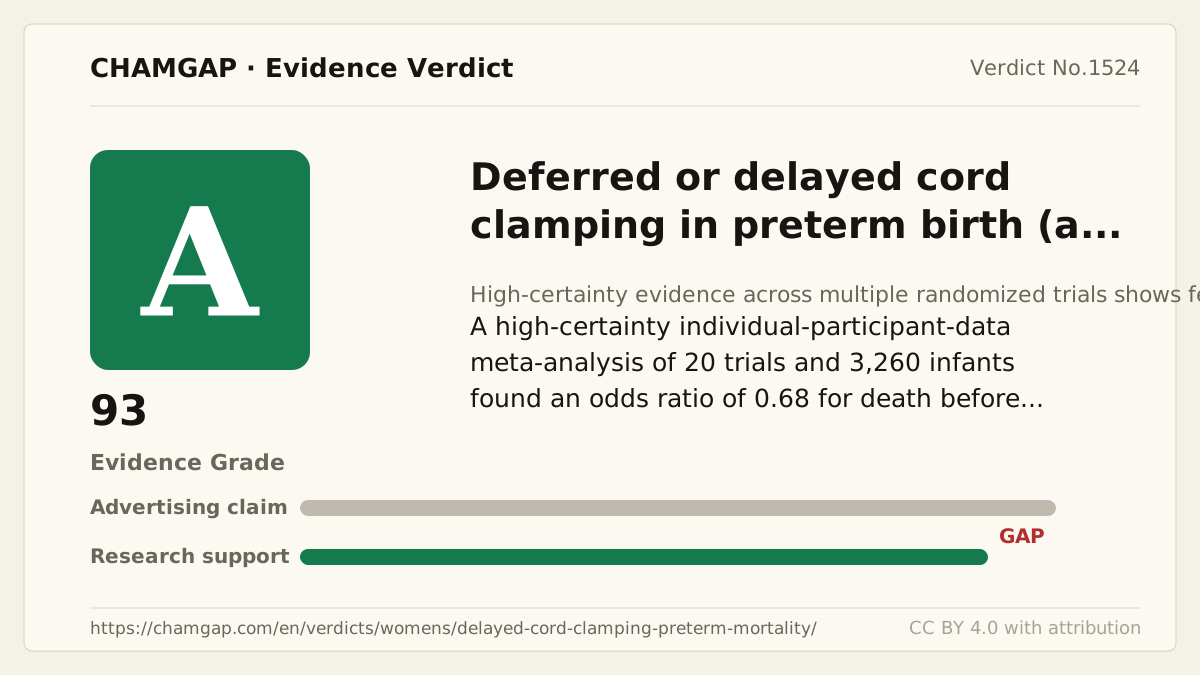
[Chamgap] Delayed cord clamping in preterm birth x reduced death before discharge — Evidence Grade A·93. 4 cited sources checked. Source: https://chamgap.com/en/verdicts/womens/delayed-cord-clamping-preterm-mortality/ · CC BY 4.0CC BY 4.0 — free to use with attribution; do not distort grades, numbers, or verdict meaning.
What this document does and does not do
Chamgap is an information source. It reports what research has and has not confirmed; it does not tell readers what to take or buy. That decision belongs to readers and, when needed, medical or legal professionals. This verdict reflects literature available up to the search date and may change as new research appears. Nothing here is medical advice.