
Cervical cerclage,
does it really help with Prevention of previable birth, perinatal death, and preterm birth in singleton pregnancies with a prior spontaneous birth before 34 weeks and a short midtrimester cervix?
research showsCervical cerclage is rated B for singleton pregnancies with a prior spontaneous birth before 34 weeks and a midtrimester cervical length below 25 mm. The Owen 2009 randomized trial did not significantly reduce birth before 35 weeks in the overall group, but planned analyses showed fewer births before viability and perinatal deaths, while the subgroup below 15 mm had fewer births before 35 weeks. A later meta-analysis of randomized trials supported reduced preterm birth in this specific indication. Dependence on subgroup and secondary outcomes and restriction to a selected high-risk population prevent an A grade.
ads claimDescriptions can expand the procedure into a universal solution for any short cervix. The evidence best fits a prior spontaneous birth before 34 weeks, singleton pregnancy, and cervical length below 25 mm before 24 weeks, with the strongest preterm-birth signal below 15 mm.
Useful facts when choosing a product
- Cervical cerclage is a prescription operation that closes the cervix with a nonabsorbable suture; McDonald and Shirodkar techniques are commonly used.
- This verdict is restricted to singleton pregnancy with a prior spontaneous birth before 34 weeks and transvaginal cervical length below 25 mm before 24 weeks.
- Vaginal progesterone is a drug, whereas cerclage is a surgical stitch with different mechanisms, indications, and risks.
- Labor, infection, membrane rupture, bleeding, cervical laceration, and suture-related complications can occur; maternal-fetal medicine specialists determine timing and removal.
Chamgap Semantic Classification Code
Candidate index · review held
P.cervical-cerclage.procedural.previable-birth-perinatal-death-and-preterm-birth-in-singleton-pregnancies-with-a-prior-spontaneous-birth-before-and-a-short-midtrimester-cervix.prevent.UNKProcedures, devices and tests > Cervical cerclage > Procedural > previable birth, perinatal death, and preterm birth in singleton pregnancies with a prior spontaneous birth before and a short midtrimester cervix > Occurrence-prevention claim > Unknown
An automated migration candidate, not an issued permanent code; exact claim scope remains under review. This machine-generated migration candidate helps retrieval but is not a permanent assignment. The original verdict ID and URL remain authoritative.
What the research actually shows
Owen and colleagues screened singleton pregnancies with a prior spontaneous birth before 34 weeks and randomized women whose cervical length was below 25 mm at 16 to 22 weeks and 6 days to McDonald cerclage or no cerclage. The primary outcome of birth before 35 weeks was not significant overall, but birth before 24 weeks was 6.1% versus 14%, perinatal mortality was significantly lower, and the odds ratio for birth before 35 weeks in the subgroup below 15 mm was 0.23. A meta-analysis by Berghella and colleagues of five randomized trials reported an RR of 0.70 for birth before 35 weeks and fewer adverse perinatal outcomes in the same high-risk singleton setting. This is evidence for a surgical stitch, not for vaginal progesterone.
Why this is classified as B (74)
Previable birth, perinatal death, and birth before 35 weeks improve in a selected high-risk singleton population, but the pivotal trial missed its overall primary outcome and the preterm-birth effect was driven by the subgroup below 15 mm. Meta-analysis reinforces direction without removing indication specificity or subgroup dependence, giving B with 74 points.
Counterpoint. When the indication fits, cerclage is a specialist-selected surgical prevention strategy rather than a simple substitute for medication. Efficacy must not be extended to unselected or multifetal pregnancies.
Rejudgment record. New verdict — Accepted reduced previable birth and perinatal death in the Owen randomized trial, reduced preterm birth in the subgroup below 15 mm, and supportive meta-analysis in high-risk singleton pregnancy, while applying a ceiling for a negative overall primary outcome, subgroup dependence, and indication specificity
Sub-claim grades by effect
This ingredient is marketed for several effects. A single overall grade blends strong and weak claims together, so each effect is graded separately here. The overall grade reflects the strongest disconfirming or core claim.
| Effect (sub-claim) | Grade | Basis |
|---|---|---|
| Prevention of previable birth and perinatal death | B | These outcomes declined in planned secondary analyses of the pivotal trial but were not the primary outcome. |
| Prevention of birth before 35 weeks when cervical length is below 15 mm | B | Benefit was pronounced in a planned subgroup, with direction supported by meta-analysis in high-risk singleton pregnancy. |
| Prevention of preterm birth in unselected singleton or multifetal pregnancy | C | The randomized evidence used for this verdict does not establish comparable benefit in these populations. |
Cross-check — AI research and Codex final gate
Evidence Table
| Study | Design | Sample | Funding | Endpoint | Result | Weight |
|---|---|---|---|---|---|---|
| Owen J et al. 2009 | Multicenter randomized no-cerclage controlled trial | 302 randomized participants | United States NICHD Maternal-Fetal Medicine Units Network | Primary outcome of birth before 35 weeks; planned analyses of birth before 24 weeks and perinatal death | Birth before 35 weeks was not significant overall at 32% versus 42%, but birth before 24 weeks and perinatal death declined, and the subgroup below 15 mm had an OR of 0.23 for birth before 35 weeks. | Pivotal direct randomized trial with subgroup and secondary-outcome dependence |
| Berghella V et al. 2011 | Meta-analysis of randomized trials | Five trials and 504 participants | Academic meta-analysis with no reported industry sponsorship | Preterm birth before 35 weeks and perinatal mortality or morbidity | Birth before 35 weeks was 28.4% versus 41.3%, RR 0.70, with fewer adverse composite perinatal outcomes. | Synthesis for the selected high-risk singleton indication |
Receipt — 2 References
All 2 cited sources were verified for existence at the original page (as of 2026-07-23).
Final verification and publication gate: Codex · Evidence date: 2026-07-23 · Corrections: none
Cite this verdict
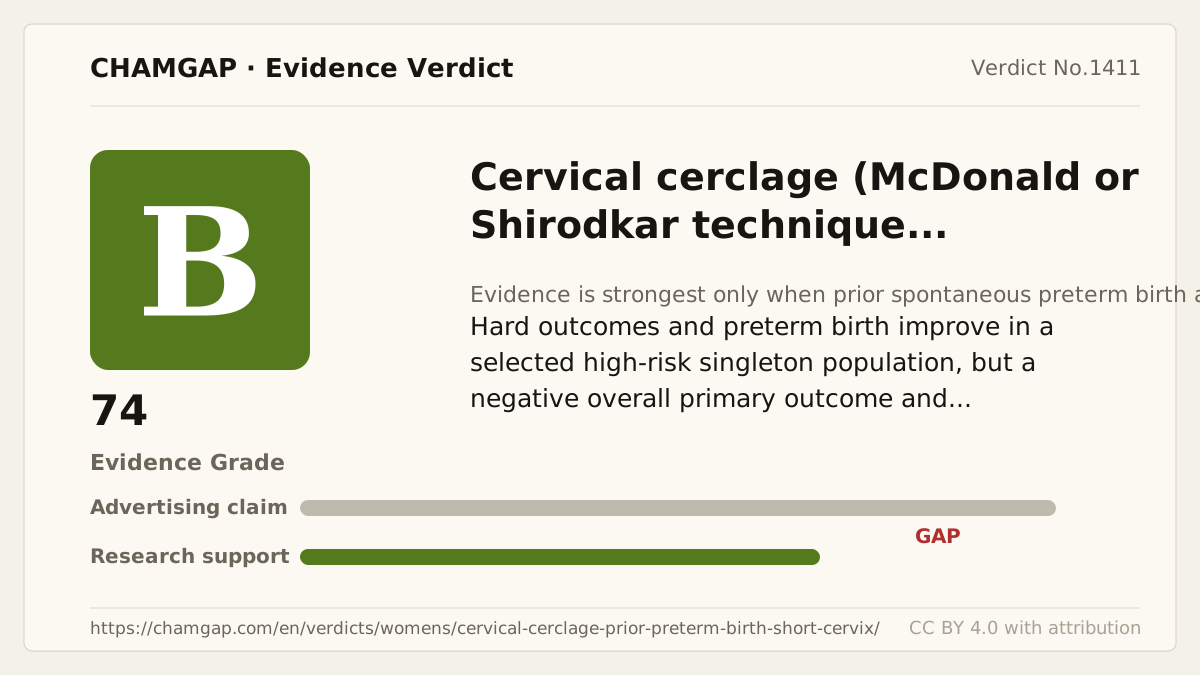
[Chamgap] Cervical cerclage x prevention of previable birth, perinatal death, and preterm birth in high-risk singleton pregnancy — Evidence Grade B·74. 2 cited sources checked. Source: https://chamgap.com/en/verdicts/womens/cervical-cerclage-prior-preterm-birth-short-cervix/ · CC BY 4.0CC BY 4.0 — free to use with attribution; do not distort grades, numbers, or verdict meaning.
What this document does and does not do
Chamgap is an information source. It reports what research has and has not confirmed; it does not tell readers what to take or buy. That decision belongs to readers and, when needed, medical or legal professionals. This verdict reflects literature available up to the search date and may change as new research appears. Nothing here is medical advice.