
Caseload midwifery continuity,
does it really help with Reduced caesarean birth among women at low obstetric risk?
research showsThe grade is B. In the COSMOS randomized trial of 2,314 low-risk pregnant women, caesarean birth occurred in 19.4% with caseload midwifery and 24.9% with standard care, RR 0.78 (95% CI 0.67 to 0.91). Classifying this binary event by absolute-risk and NNT conventions gives a -5.5-point difference and an NNT of about 18. M@NGO enrolled women of any risk, did not separately report a low-risk subgroup effect, and shared NHMRC funding with COSMOS, so it was not counted as independent replication.
ads claimThe result does not describe one midwife working alone in every circumstance. A primary midwife and small backup team provided continuity while collaborating with obstetricians when complications developed.
Useful facts when choosing a product
- COSMOS and M@NGO were separate trials with different registration numbers, hospitals, and populations.
- In COSMOS, the primary midwife continued care in collaboration with obstetric and other specialists if complications developed.
- Caseload midwifery continuity does not remove obstetric emergency response or specialist care.
Chamgap Semantic Classification Code
Candidate index · review held
UNK.caseload-midwifery-continuity-through-pregnancy.UNK.caesarean-birth-at-low-obstetric-risk.reduce.UNKUnknown > Caseload midwifery continuity through pregnancy > Unknown > caesarean birth at low obstetric risk > Reduction claim > Unknown
An automated migration candidate, not an issued permanent code; exact claim scope remains under review. This machine-generated migration candidate helps retrieval but is not a permanent assignment. The original verdict ID and URL remain authoritative.
What the research actually shows
COSMOS randomized 2,314 low-risk women with singleton pregnancies before 24 weeks, 1,156 versus 1,158. Seventeen were excluded after randomization, leaving 1,146 and 1,151, or 2,297 total, in the analysis; primary-outcome ascertainment nevertheless exceeded 99%. The paper reported stratified blocks and a telephone “interactive voice response system” at the NHMRC Clinical Trials Centre for concealed assignment, and an electronic obstetric database “blinded to treatment allocation” for caesarean data. Registration and paper both identified caesarean birth as primary. Participant masking was impossible for this care model, but the objective birth event came from the masked data source. The normalized registration is ACTRN12607000073404; the original paper used the older form ACTRN012607000073404. Funding was public NHMRC support.
Why this is classified as B (72)
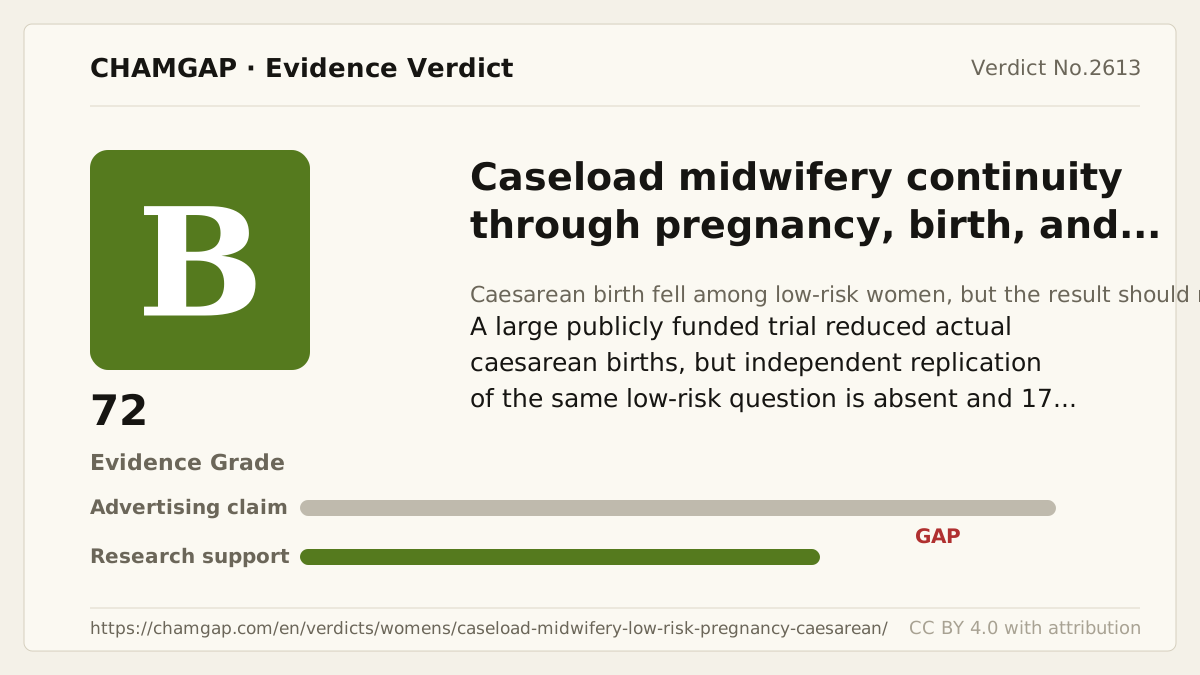
A large publicly funded randomized trial in low-risk women reduced the prespecified primary event with concealed allocation and masked outcome data. Direct independent replication is absent, and 17 of 2,314 participants were excluded after randomization, giving B with 72 points.
Counterpoint. Absolute benefit may differ where baseline caesarean rates, staffing, and obstetric risk classification differ.
Rejudgment record. Cross-check applied — A large publicly funded low-risk trial reduced its registered primary caesarean outcome, but 17 participants were excluded after randomization; the all-risk trial failed the population and funding-source gates for direct replication
| Endpoint | H | Hard endpoint - actual events such as death |
| Replication | R1 | Single confirmatory trial |
| Independence | I2 | Decisive evidence is publicly or non-profit funded |
| Effect size | E+ | Meets the clinically important threshold |
Stored derived and displayed grades match; this is not a current recalculation or validity check (B).
Sub-claim grades by effect
This ingredient is marketed for several effects. A single overall grade blends strong and weak claims together, so each effect is graded separately here. The overall grade reflects the strongest disconfirming or core claim.
| Effect (sub-claim) | Grade | Basis |
|---|---|---|
| Reduced overall caesarean birth in low-risk pregnancy | B | COSMOS found 19.4% versus 24.9%. |
| Reduced overall caesarean birth across all obstetric risk | D | The 21% versus 23% difference in M@NGO was not significant. |
Cross-check — AI research and Codex final gate
Evidence Table
| Study | Design | Sample | Funding | Endpoint | Result | Weight |
|---|---|---|---|---|---|---|
| McLachlan HL et al. 2012 COSMOS | Single-hospital randomized controlled trial in low-risk pregnancy | 2,314 randomized (1,156/1,158); 2,297 analyzed (1,146/1,151) after 17 exclusions | Public Australian NHMRC funding, project grant 433040 | Primary outcome of caesarean birth | 19.4% versus 24.9%, RR 0.78 (95% CI 0.67 to 0.91), P=0.001. | Pivotal large publicly funded trial |
| Tracy SK et al. 2013 M@NGO | Two-hospital randomized controlled trial enrolling women of all obstetric risk | 1,748 randomized (871/877), analyzed by intention to treat | Support from the Australian NHMRC and Mater Foundation | Overall caesarean birth among the main maternal outcomes | 183/871 (21%) versus 204/877 (23%), OR 0.88 (95% CI 0.70 to 1.10), P=0.26. | Separate trial allowing only indirect comparison because the population differed |
Receipt — 3 References
All 3 cited sources were verified for existence at the original page (as of 2026-08-15).
Final verification and publication gate: Codex · Evidence date: 2026-08-15 · Corrections: none
Cite this verdict
[Chamgap] Caseload midwifery continuity x caesarean birth in low-risk pregnancy — Evidence Grade B·72. 3 cited sources checked. Source: https://chamgap.com/en/verdicts/womens/caseload-midwifery-low-risk-pregnancy-caesarean/ · CC BY 4.0CC BY 4.0 — free to use with attribution; do not distort grades, numbers, or verdict meaning.
What this document does and does not do
Chamgap is an information source. It reports what research has and has not confirmed; it does not tell readers what to take or buy. That decision belongs to readers and, when needed, medical or legal professionals. This verdict reflects literature available up to the search date and may change as new research appears. Nothing here is medical advice.