
Carbetocin,
does it really help with Prevention of postpartum hemorrhage and severe postpartum hemorrhage when given immediately after birth?
research showsCarbetocin is rated B because administration immediately after vaginal birth was noninferior to refrigerated oxytocin for preventing the composite of at least 500 mL blood loss or use of an additional uterotonic. The WHO CHAMPION trial randomized 29,645 women and established noninferiority for that primary composite. For blood loss of at least 1,000 mL, however, the confidence interval crossed the prespecified noninferiority margin, so prevention of severe hemorrhage cannot be claimed with the same certainty.
ads claimLong action does not guarantee prevention of every hemorrhage. Blood loss and uterine tone still require monitoring, and established postpartum hemorrhage requires immediate standard treatment.
Useful facts when choosing a product
- Carbetocin is a long-acting oxytocin-receptor agonist prescription uterotonic used immediately after birth to support uterine contraction and placental-site hemostasis.
- CHAMPION compared a heat-stable 100-microgram intramuscular formulation with refrigerated oxytocin 10 IU after vaginal birth; formulation and route must follow the local label.
- Nausea, abdominal pain, flushing, headache, dizziness, hypotension, and tachycardia can occur, and cardiovascular, hepatic, renal, or seizure disorders require careful assessment.
- This verdict is limited to prevention immediately after birth, not postmenopausal use or proof that carbetocin alone treats established severe postpartum hemorrhage.
Chamgap Semantic Classification Code
Candidate index · review held
M.carbetocin.UNK.postpartum-hemorrhage-and-severe-postpartum-hemorrhage-when-given-immediately-after-birth.prevent.MULTIMedicinal interventions > Carbetocin > Unknown > postpartum hemorrhage and severe postpartum hemorrhage when given immediately after birth > Occurrence-prevention claim > Multiple: primary unresolved
An automated migration candidate, not an issued permanent code; exact claim scope remains under review. This machine-generated migration candidate helps retrieval but is not a permanent assignment. The original verdict ID and URL remain authoritative.
What the research actually shows
CHAMPION double-blindly randomized women at 23 hospitals in 10 countries to heat-stable carbetocin 100 micrograms or oxytocin 10 IU immediately after vaginal birth. Blood loss of at least 500 mL or use of an additional uterotonic occurred in 14.5% versus 14.4%, meeting noninferiority. Blood loss of at least 1,000 mL occurred in 1.51% versus 1.45%, so noninferiority for the second primary outcome was not established. Earlier Cochrane and later meta-analytic evidence suggests less need for additional uterotonics, but trials vary by delivery mode and comparator.
Why this is classified as B (68)
A 29,645-participant double-blind trial established noninferiority to oxytocin for preventing the composite of 500-mL hemorrhage or additional uterotonic use. It did not establish superiority, and noninferiority for 1,000-mL severe hemorrhage remained inconclusive, supporting B with 68 points. Nausea, flushing, and hypotension are separate safety considerations.
Counterpoint. Heat stability has practical value where reliable refrigeration is difficult, but guideline conditions, including comparable cost with other effective uterotonics, matter.
Rejudgment record. Cross-check applied — The very large double-blind CHAMPION trial established noninferiority to oxytocin for at least 500 mL blood loss or additional uterotonic use, but not superiority, and noninferiority for at least 1,000 mL blood loss was inconclusive. At cross-check the score was lowered to 68 (grade B retained) to reflect unproven noninferiority for 1,000-mL severe hemorrhage and the context-limited WHO recommendation.
Sub-claim grades by effect
This ingredient is marketed for several effects. A single overall grade blends strong and weak claims together, so each effect is graded separately here. The overall grade reflects the strongest disconfirming or core claim.
| Effect (sub-claim) | Grade | Basis |
|---|---|---|
| Prevention of at least 500 mL postpartum blood loss immediately after birth | B | The composite with additional uterotonic use was noninferior to oxytocin. |
| Prevention of the need for additional uterotonics immediately after birth | B | The CHAMPION composite primary outcome and earlier synthesis support prevention. |
| Prevention of severe postpartum hemorrhage of at least 1,000 mL immediately after birth | B | Rates were similar, but the CHAMPION confidence interval crossed the noninferiority margin, limiting certainty. |
Cross-check — AI research and Codex final gate
Evidence Table
| Study | Design | Sample | Funding | Endpoint | Result | Weight |
|---|---|---|---|---|---|---|
| Widmer M et al.; WHO CHAMPION Trial Group. 2018 | Multinational multicenter double-blind randomized active-control noninferiority trial | 29,645 women with vaginal birth | Supported by WHO, Merck for Mothers, and Ferring Pharmaceuticals | At least 500 mL blood loss or additional uterotonic use; at least 1,000 mL blood loss | The first composite was noninferior at 14.5% versus 14.4%; at least 1,000 mL blood loss was 1.51% versus 1.45%, RR 1.04 (95% CI 0.87 to 1.25), leaving noninferiority inconclusive. | Key very large direct prevention evidence |
| Su LL, Chong YS, and Samuel M. 2012 | Cochrane systematic review of randomized trials | 11 studies involving 2,635 women | Academic Cochrane review; some included trials had manufacturer involvement | Postpartum hemorrhage, additional uterotonics, transfusion, and adverse effects | Carbetocin reduced the need for additional uterotonics in some comparisons, while certainty for differences in postpartum hemorrhage was limited. | Supporting synthesis |
Receipt — 2 References
All 2 cited sources were verified for existence at the original page (as of 2026-07-23).
Final verification and publication gate: Codex · Evidence date: 2026-07-23 · Corrections: none
Cite this verdict
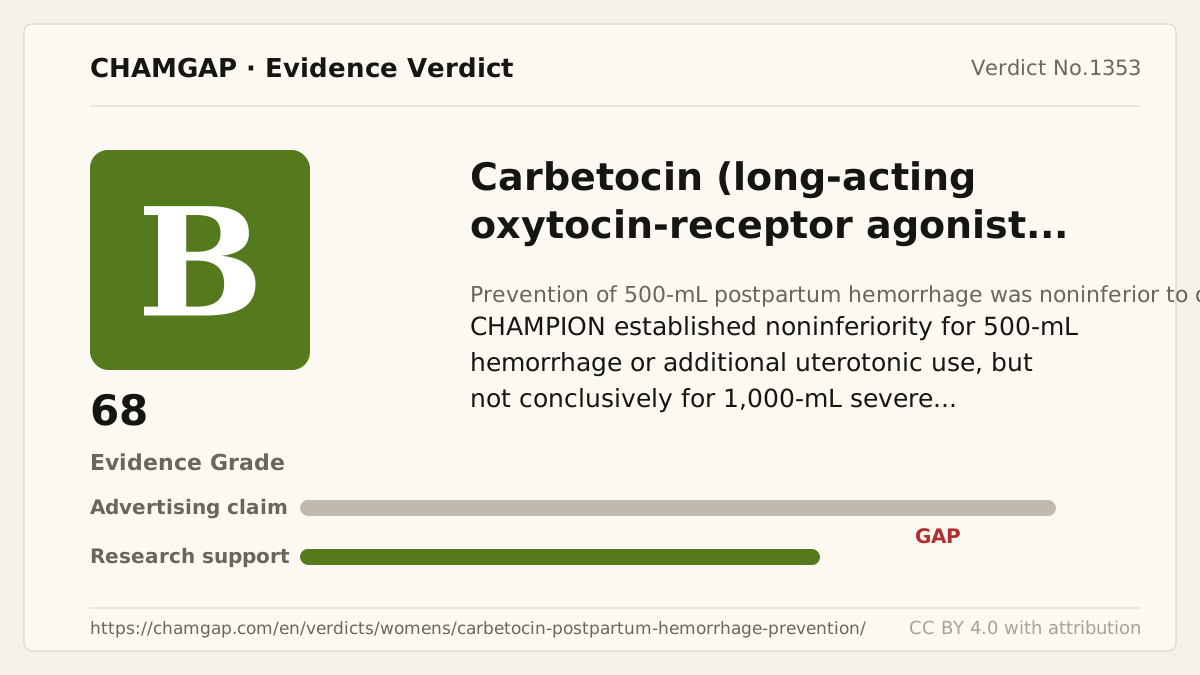
[Chamgap] Carbetocin x prevention of postpartum and severe postpartum hemorrhage immediately after birth — Evidence Grade B·68. 2 cited sources checked. Source: https://chamgap.com/en/verdicts/womens/carbetocin-postpartum-hemorrhage-prevention/ · CC BY 4.0CC BY 4.0 — free to use with attribution; do not distort grades, numbers, or verdict meaning.
What this document does and does not do
Chamgap is an information source. It reports what research has and has not confirmed; it does not tell readers what to take or buy. That decision belongs to readers and, when needed, medical or legal professionals. This verdict reflects literature available up to the search date and may change as new research appears. Nothing here is medical advice.